
SaaS Marketing Strategy: A Complete Campaign Blueprint
By Bill Scott, Ad Web Designs
A software company can attract more visitors, collect more demo requests, and still struggle to grow. The missing connection is often between what marketing promises, what sales qualifies, and what the customer experiences after signing up.
This SaaS marketing strategy example follows a subscription software company through its request for proposals, Ad Web Designs’ response, campaign planning, and acquisition economics. It shows how SEO, AI visibility, paid search, social media, and video can work together to acquire customers worth keeping.
The company and campaign figures are educational examples, not reported client results. Example campaign costs are not a quote or forecast. Actual budgets depend on the product, market, competition, scope, and existing resources.
The Business Behind the Campaign
CrewRoute Example provides subscription software for commercial cleaning companies. In this scenario, its product connects recurring schedules, crew instructions, inspection records, and documented job completion.
The strongest prospect is an established cleaning business managing multiple crews and customer locations. The owner or operations manager spends too much time coordinating work through spreadsheets, calls, and text messages. Winning another cleaning contract should be good news, but the current operating process makes growth difficult.
That is the campaign’s starting point. “Scheduling software” describes a product category. “Keep schedule changes from becoming missed work” explains why a buyer might care.
The Sample SaaS Marketing RFP
From CrewRoute Example Leadership
We have paying customers and a working product, but customer acquisition depends heavily on referrals and founder-led selling. We want a repeatable national marketing program.
Our website explains features without showing enough of the daily workflow. Some demo requests come from businesses we cannot serve well. We also cannot reliably connect marketing sources to customers who activate and remain subscribed.
We are requesting a program that addresses:
- Qualified customer acquisition through organic and paid channels.
- Clearer product positioning and more useful demonstrations.
- Visibility in traditional and AI-assisted software research.
- Reporting that connects marketing spending to customer revenue and retention.
For this planning example, we have provisionally allocated $20,000 per month. We want to understand what that budget supports, what must be measured, and which results would justify additional investment.
Ad Web Designs’ Reply
Before buying traffic, we need to define the customer worth acquiring.
A small cleaning company might request a demo quickly but generate little subscription revenue while requiring extensive support. A larger operator may take longer to evaluate the product but produce stronger contribution and retention. Treating both inquiries as equal conversions hides an important business difference.
Ad Web Designs would begin by reviewing customer revenue, gross margin, sales effort, onboarding requirements, activation behavior, and retention. Conversations with sales and customer support would help explain what the numbers alone cannot.
We would then establish two connected stages:
- Validate the acquisition opportunity. Identify the customer segment, buying problem, offer, and economics that justify a controlled campaign.
- Test the complete customer journey. Follow prospects from discovery through evaluation, payment, activation, and retention before deciding what deserves more spending.
You don’t take clicks or leads to the bank; you take conversions to the bank. For SaaS, a customer who pays once and leaves can still represent an acquisition failure.
Position the Product Around a Buying Situation
Someone replacing an established software platform has different concerns from someone leaving spreadsheets for the first time.
The spreadsheet buyer needs to understand whether switching will reduce confusion without creating a training burden. The replacement buyer needs evidence that the new product solves a specific limitation and that migration is manageable.
The campaign should give each buyer a relevant path. A migration guide can help one visitor; a detailed workflow comparison may help another. Both should lead toward an informed evaluation rather than an immediate sales commitment.
For this example, a qualified demo request means a unique inquiry from a supported U.S. commercial cleaning business, involving someone who participates in buying the software and has a relevant operational need. Spam, duplicate inquiries, job applicants, and existing customer support requests do not count. A demo request is not the same as an attended demo or a paying customer.
Why This SaaS Example Uses a Demo Instead of a Free Trial
CrewRoute Example starts with an assisted demonstration because a cleaning company may need to migrate schedules, train supervisors, and change how crews document work. The owner evaluates cost and risk. The operations manager tests scheduling. Crew members need clear instructions they can use on a job. The demonstration should address each perspective.
A free trial deserves testing if a prospect can import a sample schedule and reach a useful result independently. Measure completed setup and subsequent paid adoption, not registrations alone. A hybrid approach could let smaller accounts evaluate independently while providing assistance for more complicated implementations. The right choice depends on the buying and onboarding process, not a rule that every SaaS company needs the same funnel.
SaaS Website Design Example: Make the Product Understandable
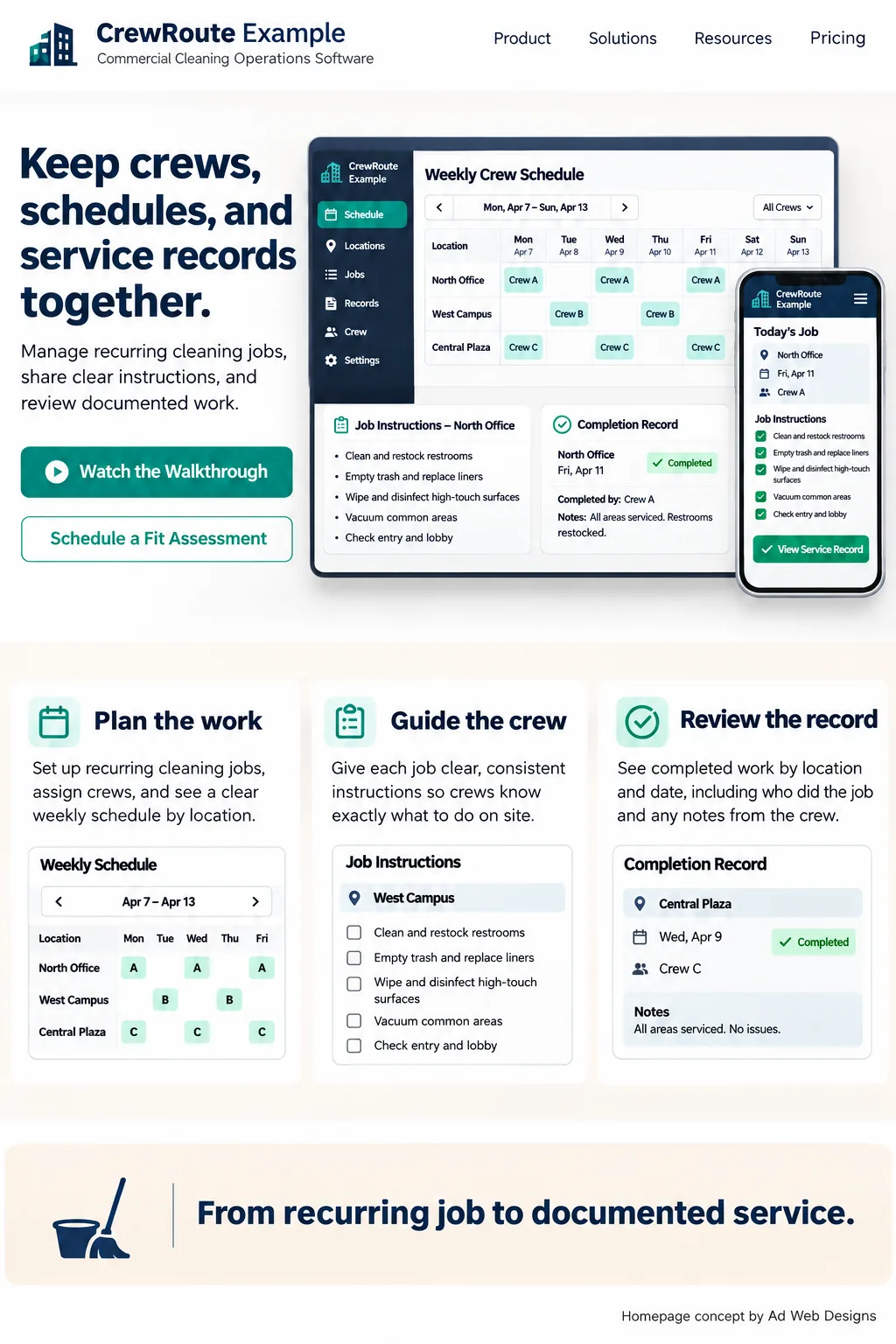
The homepage concept leads with a practical promise: Keep crews, schedules, and service records together.
Its supporting interface shows how that promise works. An operations manager assigns recurring jobs. A crew member receives instructions. A completion record gives management something to review.
The two actions serve different levels of readiness. “Watch the Walkthrough” lets a visitor investigate independently. “Schedule a Fit Assessment” opens a product-fit conversation for someone ready to discuss requirements. That example software sales conversation is separate from Ad Web Designs’ paid assessment service.
The website should answer:
- Who is this product designed to serve?
- What does the daily workflow look like?
- What will implementation and training require?
- What limitations should a buyer understand before committing?
For an actual software company, demonstrations must use real product capabilities. A concept image illustrates the campaign; it is not evidence of available functionality or a working software application.
SEO: Answer the Questions That Surround the Purchase
The content foundation should reach beyond a single “cleaning software” page.
A buyer may begin by researching how to coordinate recurring work, document service quality, or move away from spreadsheets. Later, the same buyer may investigate pricing, integrations, mobile access, training, and implementation.
Each page should help resolve a distinct decision. A scheduling page needs to demonstrate scheduling. An implementation page needs to explain preparation, responsibilities, and realistic requirements. Pricing should explain the charging model and any material restrictions rather than forcing every visitor to speak to sales for basic information.
Before finalizing a campaign brief, Ad Web Designs would review the top three organic results for the selected primary phrase. That review belongs early enough to influence the page, followed by a second comparison during the draft audit. It should examine intent, demonstrations, evidence, implementation coverage, and unanswered questions.
This is a research step in the example process, not a claim that particular competitors have been reviewed here. Search demand, competitive results, and likely media costs must be validated for an actual engagement.
How to Entity Optimize a SaaS Company for AI Search
A prospect may ask an AI system which software fits a commercial cleaning business with multiple crews. Useful product information gives that system material to retrieve and evaluate.
The foundation includes consistent company and product identities, accurate descriptions, clear customer fit, supported integrations, pricing explanations, and accessible documentation. The relationship between the company, its product, its leadership, and its official profiles should be understandable.
Entity optimization connects those facts across the website and legitimate external profiles. Structured data should describe the real business and software accurately. It cannot substitute for useful content or independent evidence. Security claims, customer ratings, certifications, and integrations must be supported before they appear in either copy or markup.
Ad Web Designs’ AI search visibility and entity optimization work supports this foundation. Discovery and recommendations must then be observed and measured, including whether a system finds the company without being given its URL.
SaaS Advertising Campaign Example: Match the Ad to the Evaluation
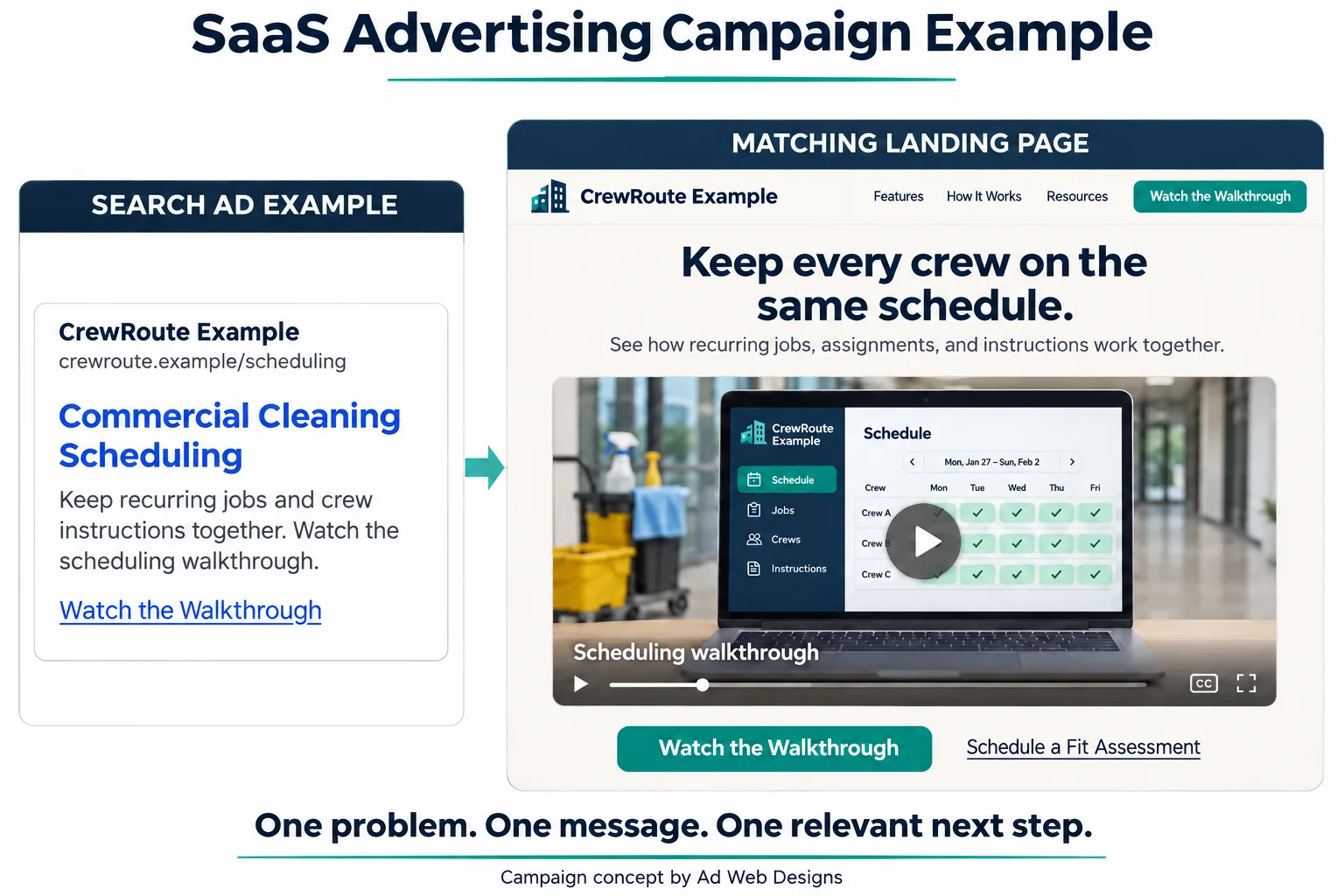
The first paid campaigns would focus on searches that suggest a relevant software need. Commercial cleaning scheduling and inspection software deserve different ad groups and different landing-page demonstrations.
An ad promising a scheduling walkthrough should lead directly to one. Sending every visitor to a broad homepage makes the prospect repeat the work of finding the answer.
The initial campaign structure would separate:
- Commercial cleaning scheduling searches.
- Inspection and quality-control searches.
- Spreadsheet replacement searches.
- Brand searches, reported independently.
Search-term reviews would identify irrelevant traffic. Employment searches, consumer cleaning requests, and unsupported software needs should not consume the acquisition budget.
The campaign graphic illustrates message continuity. Final advertising assets would be adapted to the selected platform’s current specifications before launch. The displayed page and video player are static design examples, not interactive controls or a produced video.
Social Media: Demonstrate an Operational Problem
Social content should make the intended buyer recognize a familiar situation. A short campaign could follow a schedule change from the office to the supervisor to the crew. The story reveals where separate tools create confusion, then demonstrates how the product handles that same task.
For example, an educational carousel could open with “The schedule changed. Did every crew get the update?” The following panels would show the office editing a spreadsheet, a supervisor sending a text, and a crew member following outdated instructions. The final panel would demonstrate the product’s actual update process and invite the viewer to watch it.
That concept supports an operational explanation. It should not imply that software eliminates every missed task or replaces management oversight. Paid social would begin as a controlled test and earn further spending through qualified opportunities and customer outcomes.
Video: Show the Work
Video should make the workflow visible. A concise introduction can establish relevance, while a longer walkthrough answers evaluation questions. Separate demonstrations can cover inspections, issue tracking, and onboarding without forcing every prospect through the same presentation.
An example 60-second introduction would spend the first ten seconds establishing the coordination problem. The next fifteen seconds would show an operations manager assigning a recurring job. From seconds 25 to 40, the demonstration would follow crew instructions and documented completion. The next ten seconds would show management reviewing the record, followed by a ten-second invitation to watch the full walkthrough.
The script must reflect actual product behavior. This blueprint describes the proposed video; it does not include a finished playable video.
SaaS Follow-Up and Onboarding Example: What Happens After the Demo?
The next message should address what the buyer needs to do next. A prospect who missed a demonstration needs a different response from a customer who has paid but cannot finish setup.
| Observed event | Example response | Owner |
|---|---|---|
| A qualified buyer misses the demo. | Offer the scheduling walkthrough and a straightforward way to reschedule. | Sales |
| A demo attendee has an unresolved migration question. | Answer the specific question and offer an implementation discussion. | Sales and onboarding |
| A new customer has not created a recurring job. | Provide a focused setup guide and offer assistance. | Customer success |
| A crew completes its first documented job. | Confirm that the workflow delivered value before discussing additional locations. | Customer success |
Messages should follow observed behavior, permission, and communication preferences. Stop prospect reminders when someone becomes a customer. Validate whether completing that first job predicts continued use. If it does not, revise the activation definition instead of celebrating an activity that has little relationship to retention.
SaaS Marketing Budget and Acquisition Cost Example
These illustrative campaign costs explain the planning process and are not a quote or forecast. Actual budgets depend on your product, market, competition, scope, and existing resources.
| Activity | Example monthly budget |
|---|---|
| Paid search media | $7,000 |
| Paid social and remarketing media | $1,000 |
| Campaign management | $3,000 |
| SEO, content, and entity work | $4,000 |
| Landing pages and creative | $2,500 |
| Measurement and reporting | $2,500 |
| Total | $20,000 |
This example includes $8,000 in media and $12,000 in services. These allocations are planning assumptions, not a published Ad Web Designs service rate card. Work and production scope would be defined before an engagement begins.
Separate actual service fee: the standard Ad Web Digital Intelligence Assessment fee is $12,500. Combining that fee with three months of this example recurring program produces a planning envelope of $72,500 before separately approved expenses. This calculation does not turn the hypothetical recurring program into a quote.
Spending should follow readiness. Media can be held back while tracking or implementation problems are corrected. A mature acquisition cohort should not be assumed to occur during a prelaunch month.
SaaS Customer Acquisition Cost Example
Assume a mature monthly acquisition cohort produces 80 qualified demo requests. At 75% attendance, 60 prospects attend. If 20% of those attendees eventually become paying customers, the cohort produces 12 customers. They may begin paying in later months, depending on the sales cycle.
Media acquisition cost is $8,000 divided by 12, or $666.67 per customer. Recurring program acquisition cost is $20,000 divided by 12, or $1,666.67 per customer. Neither figure includes internal selling costs or the initial assessment, so neither is a fully loaded acquisition cost.
At an example $500 monthly subscription and 80% gross margin, each customer produces $400 in monthly gross profit. That is not net profit. Costs must be classified consistently; onboarding or support costs excluded from the assumed gross margin would need to be added separately.
Simplified recurring program payback is $1,666.67 divided by $400, or approximately 4.17 months after payment begins. At eight customers it becomes 6.25 months. At four customers it becomes 12.5 months. At zero customers, there is no finite acquisition payback.
This calculation excludes the assessment, internal sales costs, sales-cycle delays, discounts, and cancellations before payback. It assumes the stated monthly gross profit continues. It is not a forecast of available cash or a guarantee of recovery.
We would not calculate a confident lifetime value from an invented customer lifespan. Retention must be observed by cohort, and any resulting estimate should reflect the available evidence.
Recurring Revenue Example: New Sales Can Conceal Customer Losses
Suppose an existing customer cohort begins a month at $10,000 in monthly recurring revenue. Cancellations remove $1,000, downgrades remove $500, and account expansions add $2,000. Ending monthly recurring revenue from that same cohort is $10,500.
Net revenue retention: ($10,000 − $1,000 − $500 + $2,000) ÷ $10,000 = 105%. Gross revenue retention: ($10,000 − $1,000 − $500) ÷ $10,000 = 85%. Gross retention excludes expansion. New customer revenue is excluded from both calculations.
The 105% result does not mean that no customers left. Expansion increased revenue while cancellations and downgrades removed 15% of the starting revenue. This is why Ad Web Designs would report new sales, existing-customer losses, and expansion separately. These figures illustrate the calculation; they are not a performance target or forecast.
The First 90 Days
The first month establishes customer definitions, measurement, positioning, and campaign readiness. That includes confirming that CRM records can connect a marketing inquiry to an attended demo, a paying subscription, and a product account without counting the same customer multiple times.
The second month introduces controlled acquisition tests and focused content. Sales feedback should identify whether inquiries have the right business profile, whether demos happen, and which objections prevent progress.
The third month follows early customers into activation while improving weak points in the journey. For this example, an activation event could be a customer scheduling its first recurring job, assigning a crew, and recording a completed service. The product team would validate whether that behavior predicts continued use.
That schedule does not guarantee a complete profitability answer within 90 days. A longer sales cycle or limited retention history may require more time. Reporting should show what is known, what remains immature, and which decisions the evidence supports.
The executive report should connect:
- Spending and acquisition cost to new paying customers.
- Demo quality and attendance to sales outcomes.
- Activation and retention to acquisition source.
- Gross profit and payback to the decision to continue, adjust, or scale.
When to Increase, Change, or Stop SaaS Marketing Spending
Hold expansion when measurement cannot connect spending to paying accounts, sales cannot handle inquiries, or onboarding is failing. If qualified buyers attend demonstrations but do not buy, investigate product fit, objections, and the sales process. If customers buy but do not activate, fix implementation before paying to send more people into the same problem.
Consider a measured spending increase when sufficiently mature customer cohorts support the acquisition case and the team can serve additional accounts. Define the test budget and acceptable payback with the business before launching. Check the economics of the additional spending separately: an attractive historical average does not guarantee an attractive next customer.
Reduce or stop a channel when mature results do not support its agreed economics and the available evidence does not justify another test. Record why the decision was made, what was learned, and where the budget can create more value. The objective is profitable growth, not keeping every campaign running.
How This SaaS Marketing Example Changes With the Business
A self-service product would place more emphasis on signup, activation, checkout, and the cost of supporting users. Enterprise software may require buying committees, procurement, security reviews, and a much longer sales cycle.
Freemium software must account for the cost of free users and the proportion that become sustainable paying customers. Usage-based products need a model that connects consumption, revenue, and delivery costs. A vertical product needs language and demonstrations that fit the industry’s actual workflow.
The method can be reused. The assumptions cannot simply be copied from one company to another.
How Ad Web Designs Solves the Digital Problem
A company can have effective ads and an unclear product page. It can have useful content and a weak demonstration. It can close customers who never activate.
The diagnosis should identify where the customer journey breaks:
- Are we reaching businesses the product can serve profitably?
- Can those buyers understand and evaluate the product?
- Do new customers reach a meaningful activation point?
- Do enough customers stay to recover acquisition costs?
Ad Web Designs connects those parts so the business can identify what is working and what deserves correction. The goal is to create something worth finding, help the right buyer understand it, and measure whether acquiring that customer makes economic sense.
Explore the marketing blueprints or find your opportunity with Ad Web Designs.
