
Analytics, Attribution & ROI
Analytics is valuable when it changes a decision.
A dashboard can report impressions, clicks, sessions and leads while still failing to answer the question that matters most: did marketing produce something valuable?
Ad Web Designs builds measurement around business outcomes, moving beyond surface activity toward qualified leads, customers, sales, revenue and return wherever the available data can reliably support it.
The objective is not more data. The objective is better business decisions.
Before We Measure Marketing, We Define What Success Means
Measurement should follow the economics of the business rather than forcing every company into the same analytics model.
An ecommerce business may care about purchases, revenue, margin, repeat purchases and customer lifetime value. A law firm may need to distinguish an inquiry from a qualified lead, a signed case and eventual case value. A B2B company may need to connect an initial inquiry to qualification, opportunity creation and closed revenue.
The measurement architecture follows the business model.
We begin by asking what the business produces, what can be measured reliably, where those outcomes are recorded and how far downstream marketing activity can reasonably be connected to economic value.
Sometimes that means stopping at a qualified lead. Sometimes it reaches the customer or sale. Businesses with recurring revenue or repeat purchases may be able to extend measurement into lifetime value.
We follow the money as far downstream as the data remains reliable.
Not All Conversions Are Equal
Analytics platforms are very good at counting events. The harder question is deciding which events represent meaningful business value.
A useful measurement hierarchy might look like this:
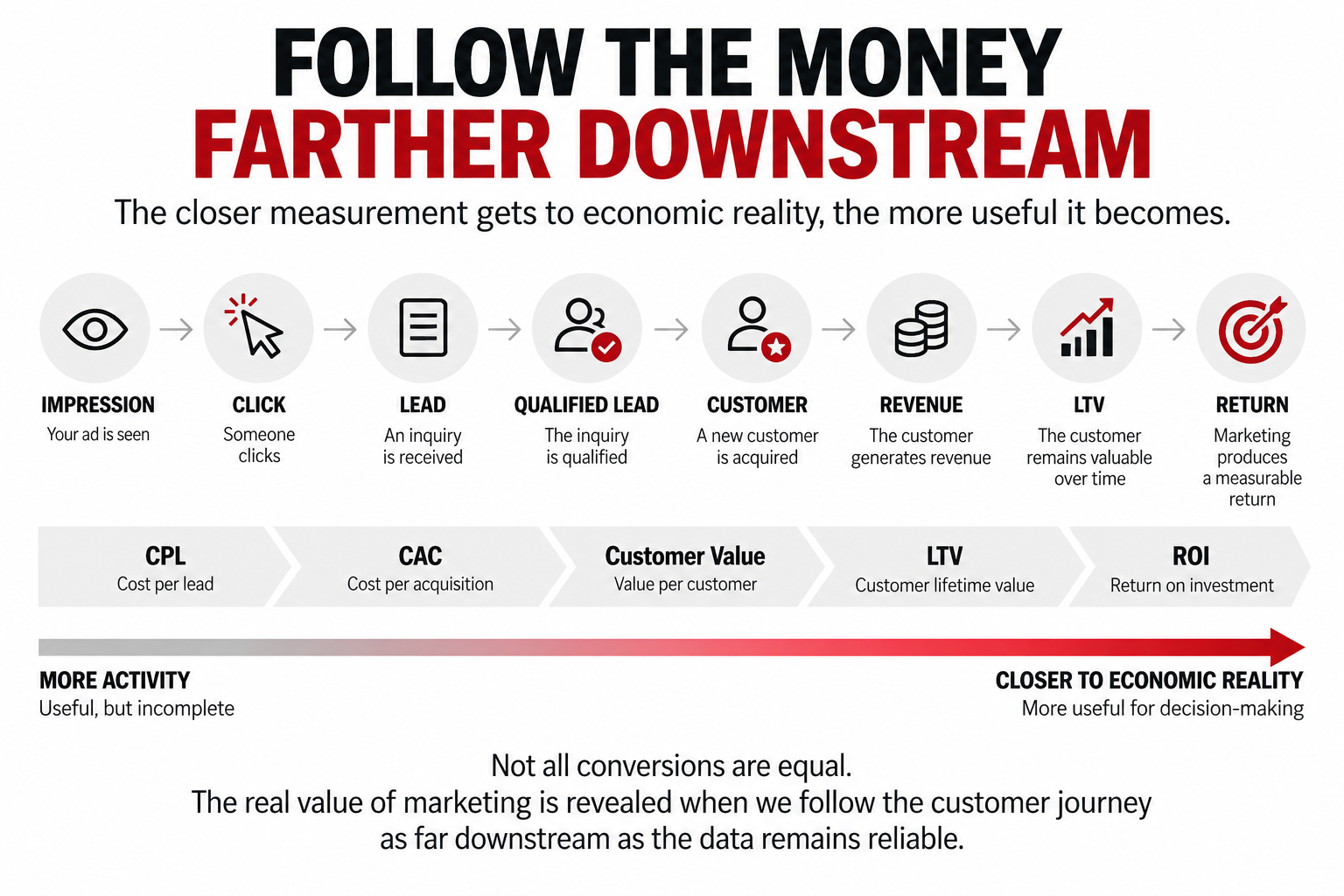
Impression → Click → Visit → Inquiry → Qualified Lead → Customer → Revenue → Lifetime Value
For a law firm, the meaningful chain may move from an inquiry to a qualified lead to a signed case. For ecommerce, it may move from a visit to a purchase, repeat purchase and customer value. Higher education may need to follow an inquiry through application, enrollment and eventual student value.
The closer measurement gets to economic reality, the more useful it becomes for making marketing decisions.
Marketing Metrics Are Inputs. Business Outcomes Are the Objective.
A campaign can produce inexpensive leads that rarely become customers. Another campaign can produce more expensive leads that convert at a much higher rate and ultimately create better economics.
If measurement stops at cost per lead, the cheaper campaign can look better even when it costs substantially more to acquire an actual customer.
You don’t take clicks or leads to the bank. You take conversions to the bank.
Even the conversion may not be the end of the economic story. Customer value, repeat purchases, retention and lifetime value can change the answer again.
From Marketing Source to Business Outcome
A practical measurement system connects marketing activity to progressively more meaningful outcomes:
Source / Campaign → Visit → Lead → Qualified Lead → Customer → Revenue → LTV
That information may come from Google Ads, GA4, Search Console, call tracking, CRM systems, ecommerce platforms, lead-management systems, sales records, offline conversion imports and other business data.
The objective is not to connect systems simply because the connection is technically possible. It is to answer better economic questions.
- Which campaigns produce customers rather than just leads?
- Which channels produce the highest-quality opportunities?
- Which sources create the most valuable customers?
- Where are leads being lost after acquisition?
- What acquisition cost can the business sustain?
- Where should the next marketing dollar go?
Attribution Is a Model of What Happened
Customers often interact with multiple marketing channels before converting. Search, paid advertising, direct visits, email, social media, referrals and offline interactions may all contribute to the same decision.
Attribution models attempt to distribute credit across that journey. The result depends on the model, identifiers, tracking configuration, available data and business process.
Ad Web Designs treats attribution as evidence, not absolute truth.
Attribution can be extremely useful for decision-making without pretending that it perfectly reconstructs why a human being ultimately purchased.
Understanding what the data cannot prove is part of understanding what it can.
Define the Economics Before Using the Acronym
ROAS and ROI are often used interchangeably even though they answer different questions.
ROAS generally compares attributed revenue with advertising spend. If $10,000 in advertising produces $50,000 in attributed revenue, the reported ROAS is 5:1.
ROI measures return relative to the investment and may include costs beyond media spend.
An attractive ROAS can still represent weak economics after product costs, overhead, labor or other expenses are considered. Likewise, first-purchase revenue may represent only a portion of the customer’s eventual value.
Ad Web Designs defines the metric, the inputs used in the calculation and the measurement period before judging performance.
It prevents a surprising amount of bad analysis.
Acquisition Cost Only Makes Sense Relative to Customer Value
A $500 customer acquisition cost is neither inherently good nor bad.
If the customer creates $400 in economic value, the acquisition is difficult to justify. If that same customer creates thousands of dollars in value across a longer relationship, the economics may be very different.
Customer lifetime value estimates the value a customer generates across the customer relationship. Depending on the business and purpose of the analysis, the calculation may be based on revenue, gross margin, contribution margin or another clearly defined measure.
For businesses with repeat purchases, subscriptions, renewals or continuing relationships, the first transaction may represent only a fraction of the total customer value.
The question changes from:
How cheaply can we acquire a customer?
to:
What can we afford to pay to acquire a profitable customer?
Understanding customer value can help establish a rational allowable acquisition cost while preserving the economics the business requires. That can influence bidding strategy, budgets, growth targets and channel selection.
Follow the Economics Farther Downstream
Consider two illustrative campaigns.
Campaign A: $100 cost per lead, 100 leads and a 5% lead-to-customer rate. The campaign produces five customers from $10,000 in acquisition spend, resulting in a $2,000 customer acquisition cost.
Campaign B: $200 cost per lead, 100 leads and a 20% lead-to-customer rate. The campaign produces twenty customers from $20,000 in acquisition spend, resulting in a $1,000 customer acquisition cost.
The campaign with the higher cost per lead produced the lower cost per customer.
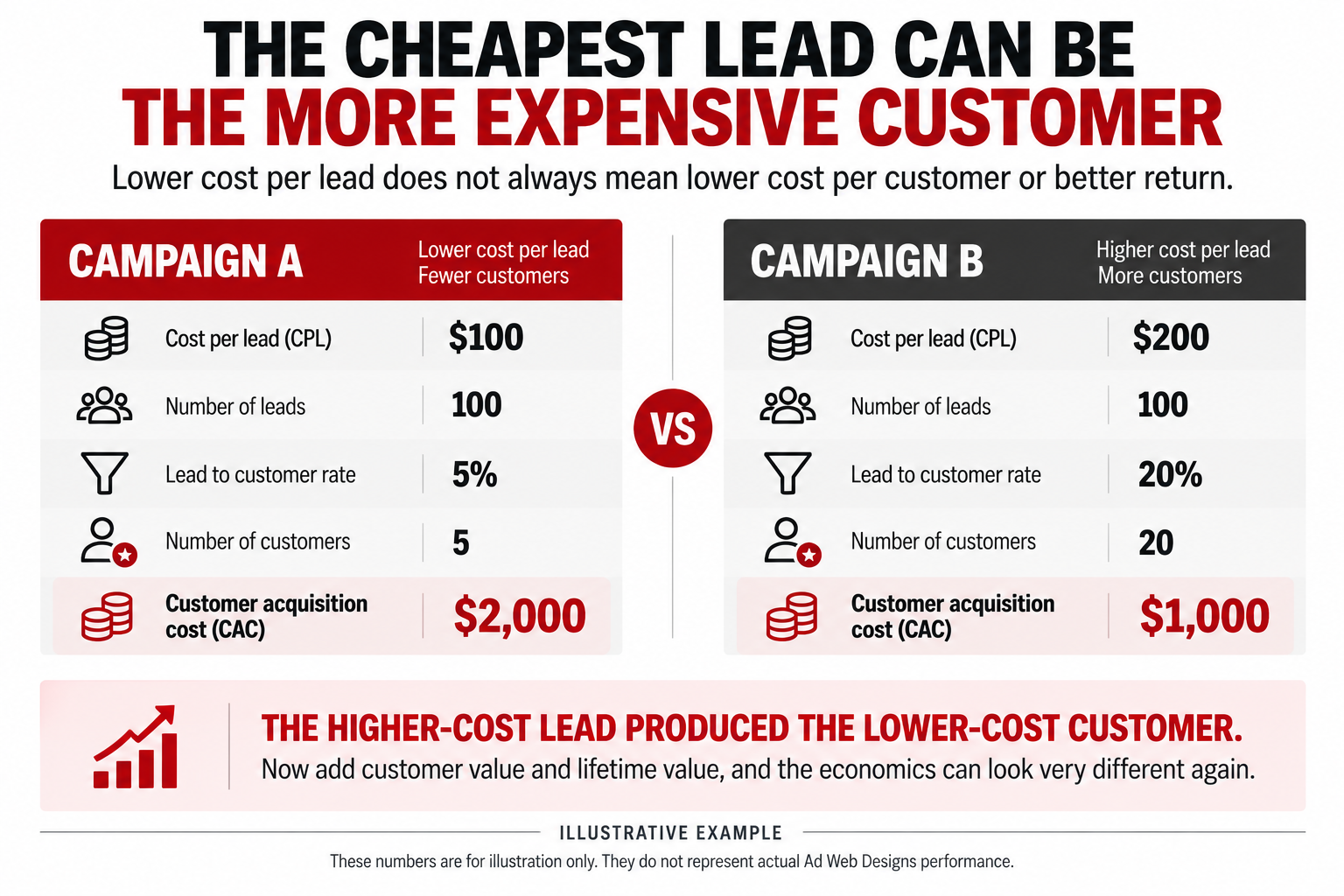
Now add differences in customer value or lifetime value and the economics can change again. A customer with a higher acquisition cost may still be more profitable if that customer spends more, remains longer or purchases repeatedly.
CPL → CAC → Customer Value → LTV → Return
The lowest lead cost does not automatically produce the lowest customer cost, and the lowest customer cost does not automatically produce the greatest return.
The campaign numbers above are illustrative examples used to demonstrate the economic principle.
Do Not Turn Lifetime Value Into Another Vanity Metric
Lifetime value is useful only when the underlying calculation can be trusted.
Unrealistic retention assumptions can make LTV every bit as misleading as a dashboard filled with meaningless conversions.
The calculation should fit the business and clearly define what is being measured. Depending on the organization, that may involve historical revenue, repeat purchases, retention, gross margin, contribution margin, churn or cohort behavior.
The measurement period matters as well. Observed twelve-month customer value is not the same thing as a projected five-year lifetime value.
Referral value can be economically real, but it is often harder to attribute reliably. Unless dependable referral data exists, Ad Web Designs generally treats it separately rather than adding speculative value to an LTV calculation.
Precision is not the same thing as accuracy.
Prediction Is Useful. Actual Performance Is Better.
Forecasting can help establish expectations before money is committed. A forecast may model traffic, conversion rates, acquisition costs, budgets and expected return.
Once the campaign is running, actual performance becomes the stronger evidence.
The questions become straightforward:
- What did we expect?
- What actually happened?
- Where did the forecast differ from reality?
- Why?
- What should change next?
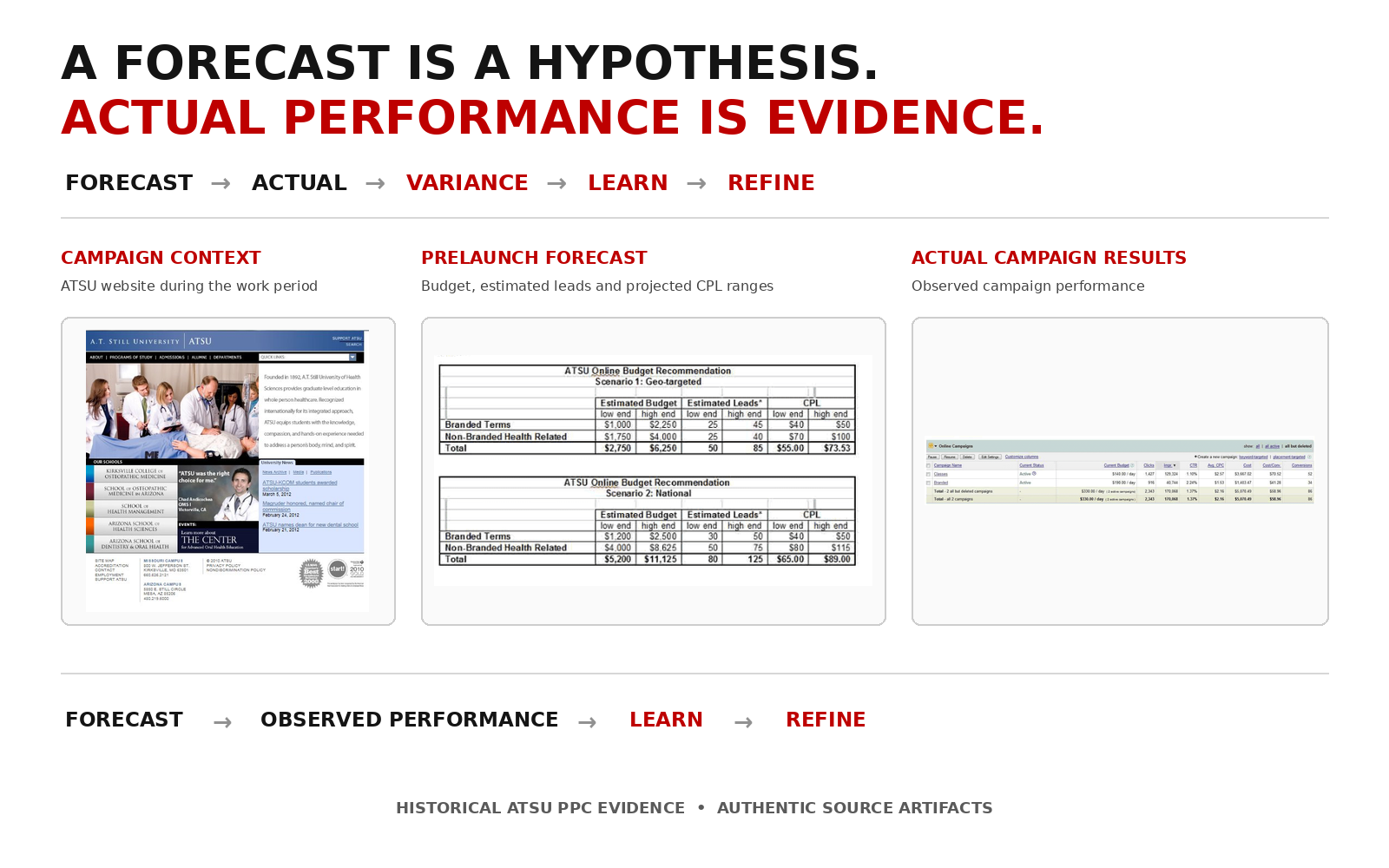
A forecast is a hypothesis. Actual performance is evidence.
The difference between the two is where learning begins.
Historical Evidence Matters When It Has Context
Ad Web Designs maintains surviving historical campaign evidence because old marketing claims are most useful when the underlying artifact still exists.
One surviving paid-search artifact from the 2006 to 2007 period documents a reported conversion-rate increase from 4.72% to 13.78% and a reduction in reported cost per lead from $36.66 to $13.10 during the documented campaign periods.
That does not establish a universal result or promise future performance. It documents what happened within a particular historical campaign context.
Evidence should establish what happened. It should not be stretched into something it cannot prove.
Review additional historical artifacts and evidence boundaries →
Reporting Is the Beginning of Analysis
A report might show that conversions declined 20 percent. Analysis asks why.
Did traffic decline? Did the channel mix change? Did conversion rate fall? Did mobile performance weaken? Did a high-value campaign lose impression share? Did tracking break? Did lead quality deteriorate? Did revenue per customer change?
Good analytics keeps decomposing the result until the business reaches something it can act on.
A dashboard can be informative and still be unfinished if it does not help someone make a decision.
Bad Inputs Produce Precise-Looking Bad Answers
Before relying on attribution, ROI or lifetime value, the underlying data needs to be trustworthy.
That can require reviewing:
- Conversion definitions
- Duplicate conversions
- Missing events
- Attribution settings
- Cross-domain tracking
- UTM conventions
- Call tracking
- CRM fields
- Offline conversion matching
- Revenue and customer values
- Customer identifiers
- Bot and spam contamination
- Internal traffic
- Consent and privacy requirements
Lifetime-value analysis introduces another requirement: the business must be able to connect customers with subsequent transactions or downstream value reliably enough to support the calculation.
Measurement quality comes before measurement sophistication.
The Website Is Not Always Where the Conversion Ends
Many businesses do not complete the economic transaction online.
A form may become a qualified opportunity days later. A phone call may become a signed contract. A lead may move through a sales team before revenue is created.
If the advertising platform sees only the form submission, it may never learn which leads became the best customers.
Where systems, identifiers and privacy requirements permit, offline conversion feedback can extend the measurement chain.
Marketing generates demand → the business determines quality → downstream outcomes add economic value → measurement feeds back → future decisions improve.
There Is No Universal Analytics Dashboard
A startup may first need reliable baseline measurement, clear event definitions and controlled acquisition tests.
An established company may already have years of analytics data but still lack a dependable connection between marketing activity and revenue.
A mature recurring-revenue business may need cohort analysis, retention, CAC and customer lifetime value.
A professional-services business may care far more about qualified opportunities, signed customers and customer or case value than raw form submissions.
The architecture depends on what is known, what can be measured and what decisions the business needs to make.
We begin by asking which questions the business needs answered.
What Ad Web Designs Audits
- GA4 configuration and conversions
- Google Ads conversion tracking
- Search and campaign attribution
- Call tracking
- UTM conventions
- CRM and downstream outcome data
- Offline conversion imports
- Lead-quality measurement
- Customer acquisition cost
- Revenue and transaction values
- Repeat purchases and retention
- Customer lifetime value where appropriate
- LTV:CAC where both values are reliable
- Cost per lead and cost per acquisition
- ROAS
- ROI
- Channel economics
- Reporting consistency
- Bot, spam and internal traffic contamination
- Dashboard usefulness
- Measurement gaps and attribution limits
The objective is not to collect every possible metric. The objective is to produce decision-quality information.
Measure → Learn → Refine → Reallocate
Marketing produces data. Business outcomes give that data meaning. Customer value reveals whether those outcomes made economic sense.
Analysis turns that evidence into decisions about budgets, channels, offers, campaigns and strategy.
Those decisions produce new evidence, and the process repeats.
Analytics becomes a capital-allocation system rather than a reporting exercise.
Frequently Asked Questions
What is marketing attribution?
Marketing attribution is a method for assigning credit for a conversion across marketing interactions. Attribution can support decision-making, but routine attribution reporting should not be mistaken for perfect causal proof.
What is the difference between ROI and ROAS?
ROAS generally compares attributed revenue or value with advertising spend. ROI can use a broader investment base and may account for additional costs. The formula should be defined before performance is judged.
What is customer lifetime value?
Customer lifetime value estimates the value generated across the customer relationship. Depending on the business and purpose of the analysis, the calculation may use revenue, gross margin, contribution margin, retention or another clearly defined measure of customer value.
Why does lifetime value matter?
Lifetime value provides context for customer acquisition cost. Two customers acquired at the same cost can have very different economics if one purchases once while another buys repeatedly or remains a customer much longer.
What is LTV:CAC?
LTV:CAC compares customer lifetime value with customer acquisition cost when both values can be defined and measured reliably. It can help evaluate acquisition economics and growth investment, but there is no universal ratio that applies to every business.
Should referral value be included in lifetime value?
Only when reliable evidence supports it. Referral value can be economically real, but speculative referral assumptions can make an LTV calculation look more precise than the underlying data supports.
Is cost per lead a good marketing metric?
Cost per lead can be useful when lead quality is relatively consistent. If lead quality varies significantly, customer acquisition cost, customer value or deeper downstream metrics may provide better information.
Can online advertising be connected to offline sales?
Often, yes. CRM systems, customer identifiers, call tracking and offline conversion imports can help connect digital marketing activity with downstream business outcomes when the systems and privacy requirements permit it.
Does GA4 tell me my true ROI?
Not by itself. Reliable ROI analysis may also require advertising costs, CRM data, revenue, margins, customer value and other business information that does not exist inside GA4.
Do I need complicated analytics?
No. Measurement should be only as sophisticated as the decision requires. A simple reliable measurement system is more useful than a complicated system built on weak assumptions.
How does Ad Web Designs measure success?
We try to measure the deepest reliable business outcome the available data can support. Depending on the business, that might be a qualified lead, customer, revenue, margin or lifetime value. We stop where the reliable evidence stops.
Analytics Should Change a Decision
More data is not the objective. Better decisions are.
Ad Web Designs approaches analytics, attribution and ROI as the measurement layer connecting marketing activity to economic performance.
Define the outcome. Build the measurement chain. Follow customer value as far downstream as the evidence allows. Understand what the data can and cannot prove. Learn from actual performance. Then use that evidence to decide what happens next.
Ultimately, the question is not how many clicks, leads or even customers marketing produced. The question is whether the economics made sense.
