
Real Estate Digital Marketing & Lead Generation
Real Estate Marketing Built Around Intent — Since the Early Commercial Web
Real estate has been part of the Ad Web Designs story since the early commercial Web.
Long before today’s conversations about AI search, entity optimization, automated advertising and sophisticated attribution, we were working on a fundamental marketing problem:
How do you connect someone expressing a specific real-estate need with the right property, community, information or professional—and turn that attention into a business opportunity?
The technology has changed dramatically. The commercial objective has not.
Ad Web Designs approaches real-estate marketing as a complete acquisition system. That can include SEO, paid search, social media, video, local discovery, display advertising, email, retargeting, third-party distribution, entity development, AI discovery, conversion optimization and attribution.
We don’t begin by deciding which channel we want to sell.
We begin with the business objective, understand the audience and opportunity, and then determine which combination of media and marketing strategies makes sense.
Real Estate Experience That Can Still Be Examined
There is a difference between saying you have decades of experience and still having evidence of the work.
Surviving Ad Web Designs materials include archived real-estate websites, original source files, historical search-engine results, analytics reports, marketing materials and records of the strategies used to build and promote real-estate properties online.
Some of those artifacts reach back to the first generation of commercial Internet marketing.
They provide a window into how people searched for real estate before today’s portals, automated advertising platforms and AI-generated recommendations became part of the landscape.
More importantly, they show something that remains relevant today: Real-estate demand is fragmented by intent.
People don’t simply search for “real estate.” They search for a city, neighborhood, property type, price range, lifestyle, agent, broker, brokerage, investment opportunity, commercial property, school district, development, home style or combination of those things.
Real Estate Search Marketing Before Google Dominated Search
PhoenixHomeSearch.com provides an early example.
Surviving Internet Archive records document the site operating during the late 1990s, including residential property listings from 1999.
The site’s architecture separated different types of real-estate intent through sections such as Search MLS, Arizona homes for sale, Phoenix homes, Find a Realtor, rental homes, vacation housing and foreclosure lists.
Geography was segmented as well, with individual markets across Phoenix’s East and West Valleys.
This wasn’t content being created simply because a keyword tool produced a list. It represented an early attempt to organize a real-estate website around what people wanted and where they wanted it.
New Media Real Estate and the Arizona Domain Portfolio
As the Internet matured, the real-estate work expanded.
Through New Media Real Estate, a substantial portfolio of Arizona real-estate domains was developed around cities, communities, property types and different forms of search intent.
A surviving historical press-release artifact documents the positioning and scale of that operation.
The strategy was straightforward: instead of expecting one generic website to satisfy every possible real-estate search, build highly relevant digital properties around specific markets and forms of demand.
An Arizona Real Estate Network Built Around Intent
The strategy became even more explicit through AZREPS, an Arizona-focused online real-estate network.
Surviving archived materials describe an interconnected system of real-estate properties using dedicated domains, targeted keywords, search-engine optimization, real-estate portals, paid search, email and other Internet marketing methods.
Break a large market into identifiable audiences and forms of intent, create relevant experiences for those audiences, distribute those experiences through appropriate channels, capture demand and measure the result.
From Cities to Individual Communities
By 2005, surviving source files show the strategy extending well beyond city-level pages.
Individual content was developed around communities and developments including DC Ranch, Silverleaf, Desert Mountain, Grayhawk, Gainey Ranch, Estancia, Troon North, The Boulders, Terravita, Mirabel, McDowell Mountain and numerous other Arizona real-estate markets.
There were also pages devoted to property search, home buying, home finding, golf communities and selling a Scottsdale property.
The Original Analytics Survived
Historical claims are useful. Original analytics are considerably more useful.
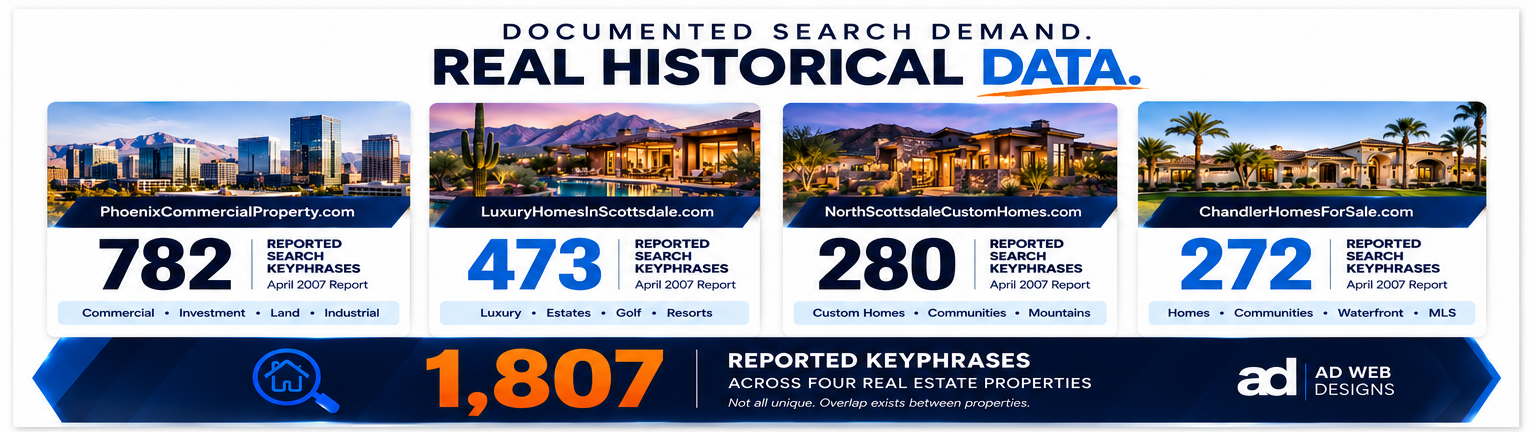
An April 2007 analytics report for PhoenixCommercialProperty.com recorded 782 different search keyphrases bringing search-engine traffic to the property.
Those searches included phoenix commercial real estate, commercial real estate phoenix, phoenix commercial property, arizona commercial property for sale, phoenix land for sale, industrial land phoenix, commercial real estate scottsdale and investment property phoenix.
Luxury Real Estate Was a Different Search Market
Luxury real estate demonstrated the same fragmentation in a different market.
The surviving April 2007 report for LuxuryHomesInScottsdale.com recorded 473 different keyphrases.
Other surviving reports document hundreds of additional keyphrases around North Scottsdale custom homes and Chandler residential real estate.
Across four surviving property-level reports, the recorded totals add up to 1,807 reported keyphrases.
The lesson wasn’t that every real-estate company needed 1,807 keywords. The lesson was that there was never really a single “real-estate keyword.”
Demand fragments across geography, community, property type, price, lifestyle, transaction, buyer/seller intent, professional need and combinations of those things.
Realty Web Masters: Marketing Specifically for Real Estate
Real-estate work eventually developed into a dedicated vertical operation through Realty Web Masters.
Archived pages show a Phoenix-based business specifically marketing Internet services to Realtors, real-estate agents, brokers, real-estate companies, builders and related businesses.
What Did Decades of Change Teach Us?
One lesson stands above the others: Don’t depend on one platform.
Search engines change. Advertising platforms change. Social networks rise and fall. Portals consolidate. Algorithms change. Consumer behavior changes. AI systems are creating another layer between people and information.
Selecting the Right Media Mix
A real-estate strategy might incorporate organic search, Google Ads, local search, paid social, organic social, YouTube, online video, display or programmatic advertising, streaming media, email and CRM, retargeting, directories, marketplaces, public relations, partnerships, third-party content distribution, AI discovery or other channels.
Goals first. Strategy second. Channels third. Measurement throughout.
SEO Still Matters
Organic search remains particularly well suited to real estate because the market naturally produces enormous amounts of specific intent.
PPC Can Generate Business—and Intelligence
Paid search serves a different purpose. It can provide immediate access to people expressing valuable intent while giving marketers faster feedback about which searches, messages, offers and landing experiences generate meaningful action.
Let one channel teach the others.
Entity Strategy: Real Estate Has a Special Problem
Modern digital discovery increasingly depends on systems understanding not merely words, but the people, companies, places, services and relationships those words represent.
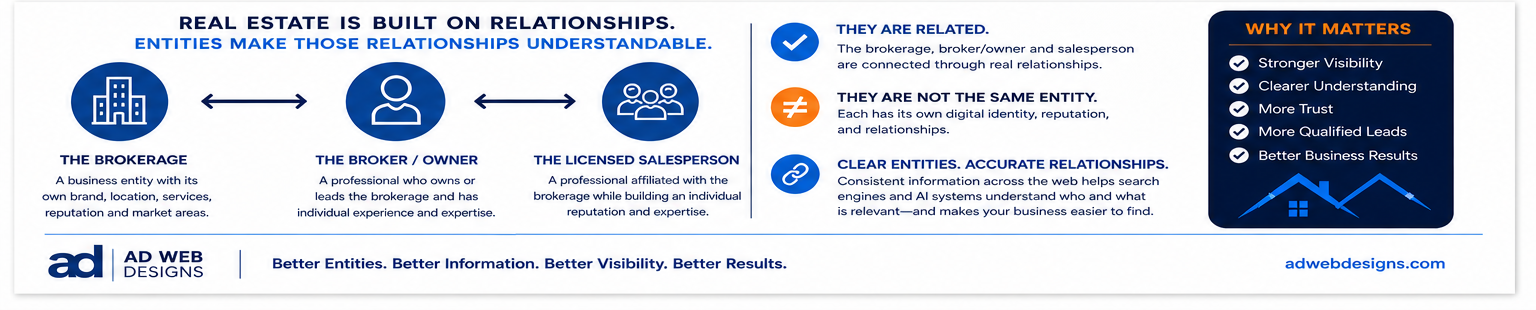
A brokerage is not the same entity as its broker or owner. A broker or owner is not the same entity as an individual licensed salesperson. And a salesperson’s professional identity does not disappear simply because that person is affiliated with a brokerage.
Brokerage ≠ Broker/Owner ≠ Licensed Salesperson
They are related. They are not the same entity.
Why Entity Definition Matters Outside the Website
A company’s website is only one source of information about the company.
Search engines and AI systems can encounter information through business profiles, professional organizations, licensing databases, directories, publications, social profiles, industry websites, news coverage and other third-party sources.
The objective isn’t to manufacture authority. It is to create a clearer, more accurate and more corroborated digital footprint.
Mentions and Citations Can Become Long-Term Digital Assets
A legitimate professional profile, industry citation, publication mention, directory listing or other third-party reference can become another durable source describing a business or professional.
Conversion Optimization: Attention Isn’t the Finish Line
Traffic isn’t the business objective. Neither is a ranking. Neither is an impression. And in most cases, neither is a lead.
Conversion optimization connects media investment with business opportunity.
Attribution: What Actually Produced the Business?
Where the available data permits, marketing analysis should move farther down the conversion path:
Media → Visitor → Lead → Qualified Prospect → Appointment or Showing → Opportunity → Transaction → Revenue
The purpose of attribution isn’t to create prettier dashboards. It’s to make better investment decisions.
From Search Intent to Entity Understanding to AI Discovery
Intent helps us understand what someone wants. Media helps us reach that person. Content provides useful information. Entities help systems understand who and what is being represented. Third-party corroboration helps establish consistency outside the company’s own website. Conversion optimization turns attention into action. Attribution helps determine whether the marketing produced business.
Our Real Estate Marketing Framework
A Strategic Process Focused on Measurable Results.
1. Business Goals
Define the desired economic outcome.
2. Audience & Intent
Determine who matters and what those people are trying to accomplish.
3. Media Selection
Select the combination of channels appropriate to the opportunity.
4. Entity Development
Clearly define the brokerage, professionals, locations, markets, services and relationships being marketed.
5. Conversion Optimization
Build experiences and paths designed to turn relevant attention into meaningful action.
6. Attribution & Measurement
Measure the channels, campaigns and interactions contributing to leads, opportunities and revenue as far as reliable data allows.
7. Optimization
Use what we learn to improve media allocation, messaging, content, conversion paths and strategy.

Experience Is Useful. Documented Experience Is Better.
Digital marketing changes too quickly for experience alone to be enough.
That’s why Ad Web Designs is preserving its historical work rather than simply making claims about longevity.
What happened? What can we prove? What did we learn? And what should we do next?
The Next Real Estate Marketing Strategy Doesn’t Have to Look Like the Last One
A luxury brokerage doesn’t necessarily need the same strategy as a commercial broker. A residential team doesn’t necessarily need the same media mix as a developer.
That’s why Ad Web Designs doesn’t begin with a predetermined channel. We begin with the opportunity.
Find Your Real Estate Marketing Opportunity
If you’re investing in real-estate marketing—or preparing to—and want an experienced outside view of where the opportunity may be, start there.
