
Campaign Blueprints / Home Services / HVAC
By Bill Scott · Ad Web Designs
HVAC Marketing Strategy:
A Complete Campaign Blueprint
More calls are useful when they become work your technicians can complete profitably. This HVAC marketing strategy connects search, AI visibility, PPC, social media and video to that business requirement.
Follow a residential contractor scenario from its RFP through Ad Web Designs’ response, acquisition economics, channel plans and a 90-day deployment roadmap. You can use the example to prepare an agency brief, challenge a proposed campaign or find the questions missing from your reporting.
Educational scenario: Every company detail, budget, price, margin, conversion rate and target below is an illustrative planning assumption, not a client result or an HVAC industry benchmark. Forecast arithmetic shows how to evaluate a plan; it does not predict performance.
1. The Company’s RFP: “We Want More Replacement Jobs”
Request for proposals — version 1.0
Business: Sonoran Breeze Heating & Air, an independent residential HVAC contractor serving a defined Phoenix-area territory. Six service technicians and one installation crew. Repairs, replacement systems and annual maintenance agreements.
Situation: The owner sees advertising reports showing calls and forms but cannot reliably reconcile those numbers with completed jobs. Repair demand fills some weeks while installation capacity remains available. Existing customer records are fragmented.
Business objective: Develop a repeatable way to acquire profitable replacement customers, fill selected service appointments and grow maintenance relationships without promising appointments dispatch cannot deliver.
Requested scope: SEO, Google Ads, visibility in AI search, social media and video. Explain the role of each channel, proposed creative, tracking, reporting and launch sequence.
Planning budget: $18,000 per month during a three-month pilot, including media, campaign management, content, measurement and creative. One-time discovery and implementation costs must be stated separately.
Capacity: Up to 12 additional replacement installations per month, subject to equipment availability, crew scheduling and job complexity. The owner must confirm this before launch.
Agency selection: Explain acquisition economics, show sample execution, identify dependencies and provide access to accounts and reporting. Separate assumptions from verified findings. Explain what would cause you to reduce spending.
Questions the RFP Leaves Unanswered
How much contribution does a completed installation produce after equipment, installation labor and other variable costs? How many qualified inquiries become attended estimates, and how many estimates become completed, collected jobs? Which systems and service areas are profitable? Can the team answer calls during every advertised hour? What happens to an estimate the customer does not accept immediately?
We also need to know whether the replacement opportunity is actually an acquisition problem. If inquiries are plentiful but estimates are delayed, another advertising campaign could make the operation busier without improving the result.
2. Ad Web Designs’ Reply: Validate the Constraint Before Buying More Demand
Thank you for the brief. We propose a replacement-led pilot supported by repair and maintenance activity where the economics and available appointments justify it. Before committing media, we will reconcile recent inquiries with estimates, completed jobs and collected revenue, then agree on allowable acquisition costs by service line.
We will build the search, landing-page and tracking foundation first. Social and video will explain the buying decision and support planned replacement demand. AI visibility work will establish a baseline and improve accurate, useful information about the business. We will measure those activities separately rather than credit every improvement to every channel.
Discovery Deliverables and Responsibilities
- Ad Web Designs: review the account structure, search queries, landing pages, business information, competitive results, call dispositions and job records. Deliver a prioritized findings document, an acquisition model and a pilot specification.
- Owner: confirm service territory, pricing rules, margin inputs, equipment lines, substantiated credentials and approved offers. Supply access through appropriate account permissions.
- Dispatch manager: maintain capacity by service line, document inquiry outcomes and flag missed appointments or response problems.
- Sales lead: record estimates, lost-sale reasons, follow-up dates and completed sales using consistent definitions.
The example separates an illustrative $12,500 one-time assessment from the recurring campaign budget. Discovery may show that the proposed scope or budget should change. Implementation begins after the findings, priorities and responsibilities are agreed. The monthly allocations below fund the defined campaign work; any additional setup or development must be explicitly priced and approved before commitment. It is not silently included in the assessment fee.
3. Work Backward From Contribution, Not Lead Count
For this model, contribution means collected job revenue less the specified variable costs, before marketing and fixed overhead. It is not net profit. The owner and finance team must agree on the cost definition so the campaign does not receive credit for money the business never keeps.
| Input or calculation | Base assumption | Meaning |
|---|---|---|
| Collected revenue per completed replacement | $10,000 | After discounts; financing charges belong in the cost model where applicable. |
| Variable cost per replacement | $6,500 | Equipment, direct labor and other defined variable costs. |
| Contribution before marketing | $3,500 | $10,000 − $6,500. |
| Qualified inquiry → attended estimate | 60% | Qualification alone is not an appointment. |
| Attended estimate → completed, collected replacement | 30% | Includes losses and cancellations before completion. |
| Qualified inquiry → completed replacement | 18% | 60% × 30%. |
| Expected contribution per qualified inquiry | $630 | 18% × $3,500, before marketing and fixed overhead. |
| Replacement media cost per qualified inquiry | $180 | A test assumption to validate. |
| Media acquisition cost per replacement | $1,000 | $180 ÷ 18%. |
The $630 expected contribution per inquiry is a mathematical pre-overhead ceiling, not a sensible target price. At that cost, nothing remains to cover campaign work or fixed expenses. An allowable cost must leave room for those obligations and the owner’s profit requirement.
Qualified inquiry, for this model: a unique prospective customer requesting a supported residential service, at a covered property, with authority to arrange the work. Exclude spam, suppliers, job seekers, duplicate contacts and existing-customer service requests from the new-customer acquisition cohort. Apply the same definition in dispatch and campaign reporting.
What Would 12 Additional Installations Require?
At an 18% inquiry-to-completed-job rate, 12 additional installations require about 67 qualified inquiries. At $180 each, that would require approximately $12,000 in replacement media alone. Our proposed allocation below provides only $7,000 for that line. It therefore does not support a promise of 12 paid-search installations.
With $7,000 of replacement media, the model produces roughly 38.9 qualified inquiries, 23.3 attended estimates and seven completed replacements. That equals about $70,000 in revenue and $24,500 in contribution before marketing. These are expected values, not literal fractional appointments or a guaranteed outcome.
If we conservatively charge the entire $18,000 monthly campaign budget against those seven replacements, $6,500 remains before fixed overhead, the one-time assessment and tax. Repair and maintenance returns are excluded from that calculation rather than invented. The pilot can still lose money if the assumptions fail.
The Sensitivity That Changes the Decision
If only 15% of attended estimates become completed replacements, the inquiry-to-job rate falls to 9%. The same replacement media then produces an expected 3.5 jobs and $12,250 in pre-marketing contribution. After the full $18,000 campaign budget, the shortfall is $5,750 before the other costs above. Closing performance deserves as much scrutiny as the ad headline.
4. Three Customer Journeys, Three Different Campaign Jobs
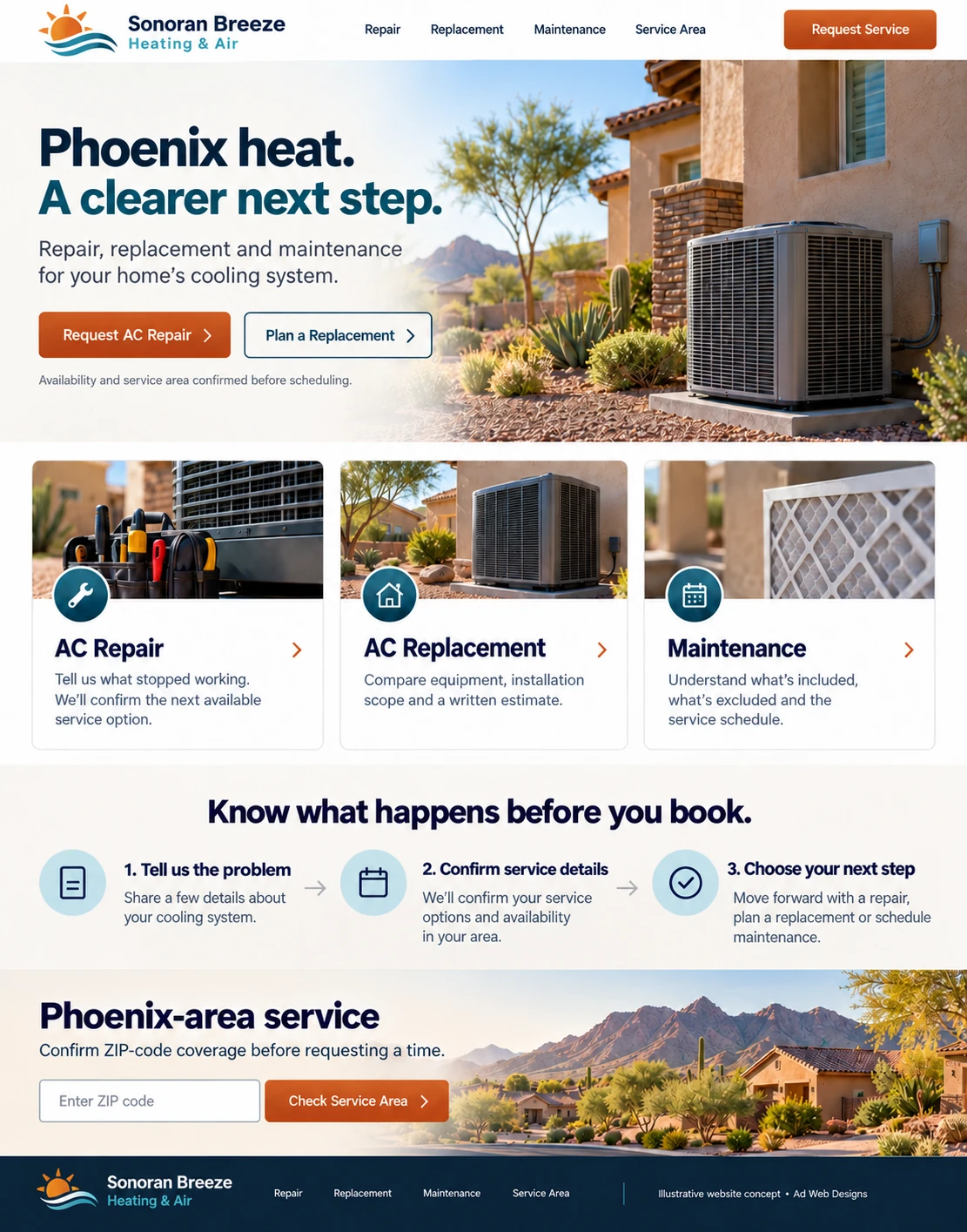
Repair
The system is not working. Confirm territory, availability, diagnostic terms and the next practical step.
Outcome: a completed service job with known contribution.
Replacement
The owner is comparing repair versus replacement, equipment options and proposals. Explain the estimate process and reduce uncertainty.
Outcome: a completed, collected installation.
Maintenance
The customer wants a clear service schedule and dependable follow-through. Explain inclusions, exclusions and renewal terms.
Outcome: an active agreement with measured service costs and retention.
A single “HVAC services” landing page would force all three buyers through the same explanation. Separate journeys allow offers, qualification and reporting to match the decision. A low-priced maintenance sale should not be assigned the same value as a replacement installation.
5. HVAC SEO: Build Pages That Help Customers Choose
The initial content map includes repair, replacement and maintenance service pages, an honest repair-versus-replacement guide, an estimate checklist and service-area information. Research actual questions and review the top three relevant organic pages for each priority page’s main keyword before drafting it. Compare their answers, evidence, local usefulness and conversion paths; use the findings to improve the brief, then check the finished draft for meaningful omissions. Record the query, market, date, sources and material gaps; a ranking does not prove that every feature of a competitor’s page caused its success.
Example: The Replacement Page
- Search intent: evaluate a replacement provider and understand the process before requesting an estimate.
- Opening answer: identify the services offered, real service territory and how to request an assessment.
- Decision support: explain what the company inspects, what an estimate includes, which conditions affect pricing and how a customer compares proposals.
- Evidence: approved job photography, substantiated credentials, accurately described warranties and genuine customer feedback used with permission.
- Conversion: a short estimate request with territory screening and an accurate explanation of the next step.
Location pages must earn their existence with useful local information, actual coverage and supporting work examples. Replacing the city name on the same paragraph does not create a useful local resource. Publish only what the business can substantiate.
Google Business Profile details should reflect the real operation. Google’s business representation guidelines govern service-area businesses and address eligibility. Do not invent branches to extend map coverage.
6. GEO/AIO: How to Entity Optimize an HVAC Business
Start by distinguishing accurate identification from selection in an answer. Entity optimization addresses who the business is and how its facts and relationships fit together. AI search visibility addresses when its information or brand is retrieved, cited, mentioned or recommended. Correct identity alone does not guarantee selection.
An Entity Implementation Checklist
- Define the business: canonical name, website, public contact details, actual operating location or service-area status, hours and ownership information approved for publication.
- Define services: repairs, replacements and maintenance, with clear boundaries. Explain residential versus commercial scope and equipment categories actually supported.
- Connect evidence: verify license claims through the applicable authority; link genuine manufacturer or dealer relationships only when current and authorized. Distinguish a company’s assertion from third-party confirmation.
- Resolve conflicts: inventory inconsistent names, old phone numbers, outdated hours and unsupported territory claims across important profiles and pages.
- Implement accurate structured data: represent the real business and visible page content. Do not publish unverified business facts, locations or credentials in markup.
- Answer buying questions: publish useful explanations of estimate comparisons, maintenance inclusions and service availability. Have technical material reviewed by a qualified HVAC professional.
Baseline the Questions That Matter
Use a repeatable sample of questions such as “How do I compare AC replacement estimates in Phoenix?” and “What should an HVAC maintenance agreement include?” Also test branded factual questions. Log the platform, date, question, relevant location context, answer, cited URLs and accuracy. Repeat observations because outputs vary. A small prompt sample is not market-wide share of voice.
Measure relevant visibility and correct representation even when no visit follows. Where available, record referrals, qualified inquiries and assisted discovery separately. Google’s generative AI search guidance emphasizes useful original content and sound SEO; special AI schema or prescribed content chunks are not prerequisites.
7. HVAC PPC: Give Each Search a Business Purpose
Our PPC planning separates replacement, repair and brand demand. Each gets its own budget controls, intent groups and reporting. Brand results remain visible separately so inexpensive existing demand does not conceal weak new-customer acquisition. Brand is a reporting and campaign category, not an extra spending allowance: if a brand test is warranted, identify its capped allocation within the existing search-media budget and reduce the affected non-brand allocation accordingly. Recalculate the acquisition model when replacement media changes.
| Campaign | Seed searches to research | Destination and qualification |
|---|---|---|
| Replacement | AC replacement estimate; replace air conditioning system; HVAC replacement company | Replacement page; service ZIP, homeowner or authorized decision-maker, project need and contact details. |
| Repair | AC not cooling repair; air conditioning repair near me | Repair page; actual availability, supported systems and diagnostic terms. |
| Brand | Company name and genuine variants | Relevant company page; report existing versus new customers where known. |
Initial negative-keyword candidates include jobs, salary, training, certification and wholesale parts when those intents are outside scope. Review actual queries before excluding ambiguous terms. A search containing “cost” could be a serious buyer, not wasted traffic.
Start with tightly reviewed targeting and validate where users actually come from. Align advertised hours with staffed response. Test calls, mobile forms, confirmation messages and dispatch routing before launch. Never advertise same-day service when the operation cannot offer it.
Example replacement search ad
Headlines: AC Replacement Estimates / Compare Your Options / Request an HVAC Assessment
Description 1: Understand the replacement process and what your estimate includes.
Description 2: Request an assessment for your home. Confirm service area and availability.
Illustrative copy, subject to platform review, business approval and final asset specifications. Availability, pricing, credentials and financing claims require substantiation before use.
The Landing Page Must Finish the Ad’s Job
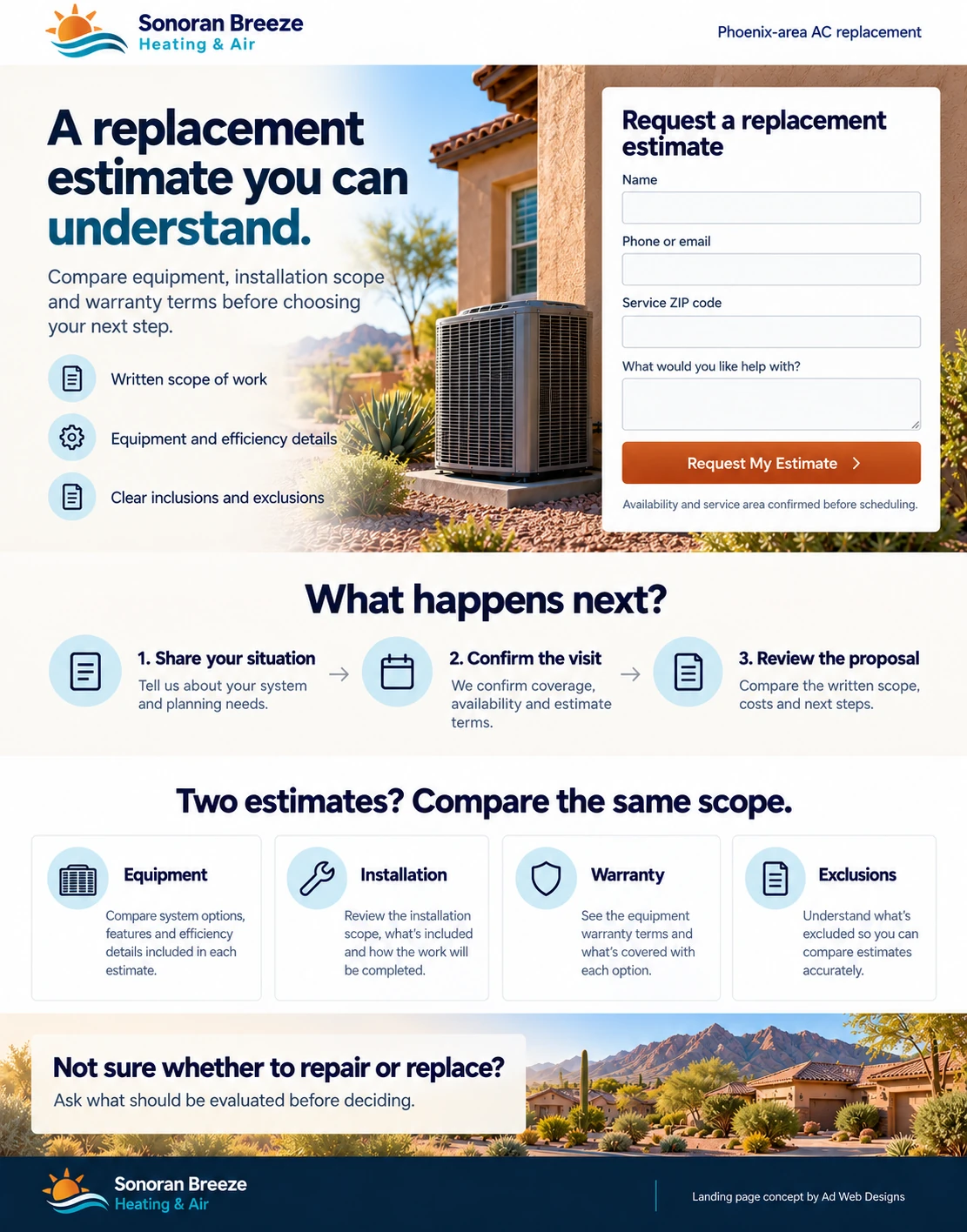
Lead with the promised estimate process. Show who the service is for, coverage, approved proof and what happens after submission. Ask for name, preferred contact method, service ZIP and a concise project description. Avoid asking homeowners to diagnose their equipment before they can request help. Tell them an appointment is confirmed only after scheduling, if that is how dispatch works.
8. The Pilot Budget: Allocate Deliberately
| Workstream | Amount | Purpose |
|---|---|---|
| Replacement search media | $7,000 | Test qualified replacement acquisition. |
| Repair search media | $2,000 | Fill confirmed service capacity. |
| Paid social/video distribution | $1,000 | Test one educational replacement creative concept. |
| Campaign management and optimization | $3,000 | Queries, budgets, experiments and decisions. |
| SEO, entity and source-content work | $2,000 | Improve priority pages and business information. |
| Creative production | $1,500 | Job photography, a short video and supporting assets. |
| Measurement and reporting | $1,500 | Tracking QA, outcome reconciliation and scorecard. |
| Total | $18,000 | $10,000 media; $8,000 services and production. |
This allocation is a proposed test design, not a universal percentage rule. Confirm what third-party software, call tracking, development and production expenses it includes before agreeing scope. The maximum three-month planning envelope is $54,000 in recurring campaign spending plus the illustrative $12,500 assessment: $66,500 before explicitly excluded and separately approved costs. It is a ceiling, not a direction to spend unused media. Days 1–30 establish facts and prepare the campaign; release advertising only after the launch gates pass. Document actual spending by month and the treatment of unspent allocations. The seven-installation example represents a fully deployed monthly replacement-media scenario, not a forecast of 21 installations during this pilot. Leads, completion and collections may fall in different months. Phase work rather than quietly exceeding the cap.
9. Social Media and Video: Explain the Buying Decision
Use social creative to help a homeowner understand a replacement decision before asking for a consultation. The first concept compares estimate contents rather than promoting an unsupported discount. Keep prospecting and returning-visitor activity distinguishable; use audience data only through appropriately configured, permitted processes.
Example Carousel: “Two AC Estimates. Two Different Scopes.”

- Cover: “Before you compare the price, compare what is included.”
- Equipment: show where the proposed model and capacity appear on an estimate; explain that a qualified contractor must assess the home.
- Scope: identify removal, installation, any proposed ductwork changes and permit responsibilities where applicable.
- Support: distinguish manufacturer terms, installation workmanship terms and optional maintenance.
- Next step: “Bring your questions to a replacement assessment.”
Caption example: “A lower number can describe a different job. Ask each contractor to explain the equipment, installation scope, exclusions and warranty terms. Compare the written scope before deciding which proposal fits your home.” Have the company’s technical lead approve the details.
Example 45-Second Video Brief
| Timing | Picture | Script |
|---|---|---|
| 0–5 seconds | Presenter beside two anonymized sample estimates. | “These two AC estimates have different prices. Are they quoting the same work?” |
| 5–18 seconds | Close-ups highlighting equipment and installation scope. | “Start with the equipment being proposed and the installation work included. Ask what your contractor checked before making the recommendation.” |
| 18–32 seconds | Three simple labels: scope, exclusions, support. | “Check removal, any additional work, exclusions and warranty terms. A useful estimate should help you understand what you are buying.” |
| 32–45 seconds | Presenter and clear estimate-request action. | “Have questions about replacing your system? Request an assessment and ask us to walk you through the proposal.” |
Produce a captioned vertical cut for mobile feeds and a horizontal version for the replacement page. Use original, permitted company footage where possible. Licensed stock may establish context, but must not masquerade as the example company’s technicians, installations or customer results. Compare creative on qualified actions and completed outcomes as well as attention metrics.
10. A 90-Day Roadmap With Launch Gates
| Phase | Work and owner | Gate before proceeding |
|---|---|---|
| Days 1–14: establish facts | Ad Web Designs reconciles a recent lead cohort; owner confirms margin and scope; dispatch confirms capacity. | Agreed definitions, access, cost inputs and responsibilities. |
| Days 15–30: build and verify | Ad Web Designs prepares replacement and repair paths, tracking and creative. Technical lead approves claims. Dispatch tests routing. | Test inquiries reach the right person; unique IDs and outcomes survive the handoff. |
| Days 31–60: controlled launch | Ad Web Designs releases media in stages, reviews queries and tests the estimate message. Staff record outcomes. | Spend, lead quality, response and capacity stay within agreed guardrails. |
| Days 61–90: evaluate and reallocate | Ad Web Designs and owner review matured cohorts, costs and contribution. Refresh useful content and address diagnosed bottlenecks. | Expand only where evidence and capacity support it; document the next test. |
Do not force a conclusive sales verdict on leads still inside the buying cycle. Show pending estimates separately and compare cohorts at similar ages. A 90-day pilot can establish a measurement process without proving the eventual value of a long-term maintenance relationship.
11. Measure the Whole Journey Without Double-Counting It
Connect inquiry, qualified lead, attended estimate, completed job and collected payment using stable internal identifiers. Keep the original source fields alongside cleaned classifications. Deduplicate a form followed by a call from the same prospect, and distinguish a new customer from an existing customer requesting service.
Our analytics, attribution and ROI approach keeps these sources distinct. GA4 describes observed website behavior. Ad platforms describe their attributed results. The CRM or job system records business progression. Finance confirms collected revenue and costs. Their totals may differ because of definitions, attribution windows, consent, identity gaps and timing; they should not be forced to agree by deleting inconvenient records.
Where appropriate, feed qualified and completed outcomes back into advertising through a supported integration. Google documents enhanced conversions for leads; implementation requires validation of the current setup, data requirements and applicable consent. A phone-number click is not proof that a call connected, and a connected call is not proof of a sale.
The Weekly Owner Scorecard
- Spend by service line, with media and other campaign costs separated.
- Unique qualified inquiries, response failures and attended estimates.
- Completed and collected jobs, cancellations, revenue and defined contribution.
- Media-only and fully loaded acquisition cost per completed customer.
- Available capacity and the next operational constraint.
- Relevant organic and AI visibility observations, including accurate mentions without clicks, reported separately from attributed revenue.
Decision Rules for This Pilot
Tracking failure: pause affected expansion until outcomes can be trusted. Capacity failure: reduce or redirect the relevant service-line spend when dispatch cannot fulfill the promise. Quality failure: investigate query, territory, creative and qualification mismatches before buying more of the same traffic.
Economic failure: evaluate matured cohorts against the agreed fully loaded acquisition allowance; change the offer, conversion process or allocation when contribution is insufficient. Positive evidence: increase a winning campaign in controlled steps and check marginal acquisition cost. A profitable average does not mean the next dollar is profitable.
12. RFP Variations: Change the Brief, Change the Plan
The same template should produce different recommendations when the business changes. These are alternative scenarios, not additional budgets layered onto the base plan.
| RFP version | Changed requirement | Ad Web Designs’ strategy adjustment |
|---|---|---|
| 1.1 — owner-operated shop | $5,000 monthly total cap; owner also answers calls; limited installation capacity. | Concentrate on a smaller territory, accurate local information, existing-customer follow-up and one tightly scoped acquisition test. Phase creative and content. Do not promise the base plan’s deliverables for a fraction of its budget. |
| 1.2 — repair schedule already full | Company wants replacement growth but cannot absorb more repair calls. | Remove repair acquisition from the pilot. Improve replacement qualification and sales follow-up; direct spend to confirmed installation capacity. |
| 1.3 — commercial service growth | Target property managers and recurring commercial maintenance agreements. | Rewrite the buyer journey around decision-makers, site requirements, response commitments, procurement and longer sales cycles. Track qualified accounts, proposals and contribution over the contract term. |
| 1.4 — multi-location expansion | A second genuine operating branch opens. | Validate branch coverage and profile eligibility; build location-specific proof, routing and reporting. Separate new territory acquisition from existing brand demand. |
Questions an HVAC Owner Should Ask Before Approving the Campaign
Should we launch all five specialties at once?
No. Covering the specialties in a strategy does not require equal spending or simultaneous launches. This example starts with economics, tracking, service pages and demand capture, then tests a limited creative concept.
Can we value future maintenance revenue today?
We can model it, but should label it as a forecast until retention, service costs and collected payments support it. Report first-job economics separately so a speculative lifetime value does not hide a weak acquisition program.
Is AI visibility useful without a click?
A relevant, accurate mention can introduce the business or support a later choice. Record that exposure as discovery evidence. Do not assign it sales credit simply because revenue subsequently increased.
Can another contractor copy this campaign?
The planning framework is reusable. The inputs must change: territory, costs, capacity, offer, competition, proof and customer journey. Those differences determine whether a campaign deserves investment.
What Does Your Next Marketing Dollar Need to Accomplish?
If your report stops at leads, the acquisition decision is unfinished. Ad Web Designs evaluates the connection between search discovery, qualification, conversion and business value before recommending where to invest.
Tell us your service mix, market, capacity and what your current reporting cannot explain. Start with the business problem.
Find My Opportunity or review AI Search & Visibility, Entity Optimization and Paid Search / PPC.
Platform references: Google Business Profile representation guidelines; Google Search’s generative AI optimization guidance; Google Ads guidance on enhanced conversions for leads. Linked in the relevant sections. Platform details should be checked again before a real deployment. This educational campaign is not technical HVAC advice.
