
Research, Experiments & Observations
Digital marketing has never stood still. Search engines change. Advertising platforms change. Measurement changes. Customer behavior changes. Now AI systems are changing how information is discovered, evaluated and recommended.
Ad Web Designs has been working through those changes since 1996.
Research is part of that work. We test assumptions, observe what actually happens, preserve evidence where possible and change our thinking when the evidence changes.
Experience tells us what questions to ask. Evidence helps us decide whether the answers are right.
The Technology Changes. The Need to Test It Does Not.
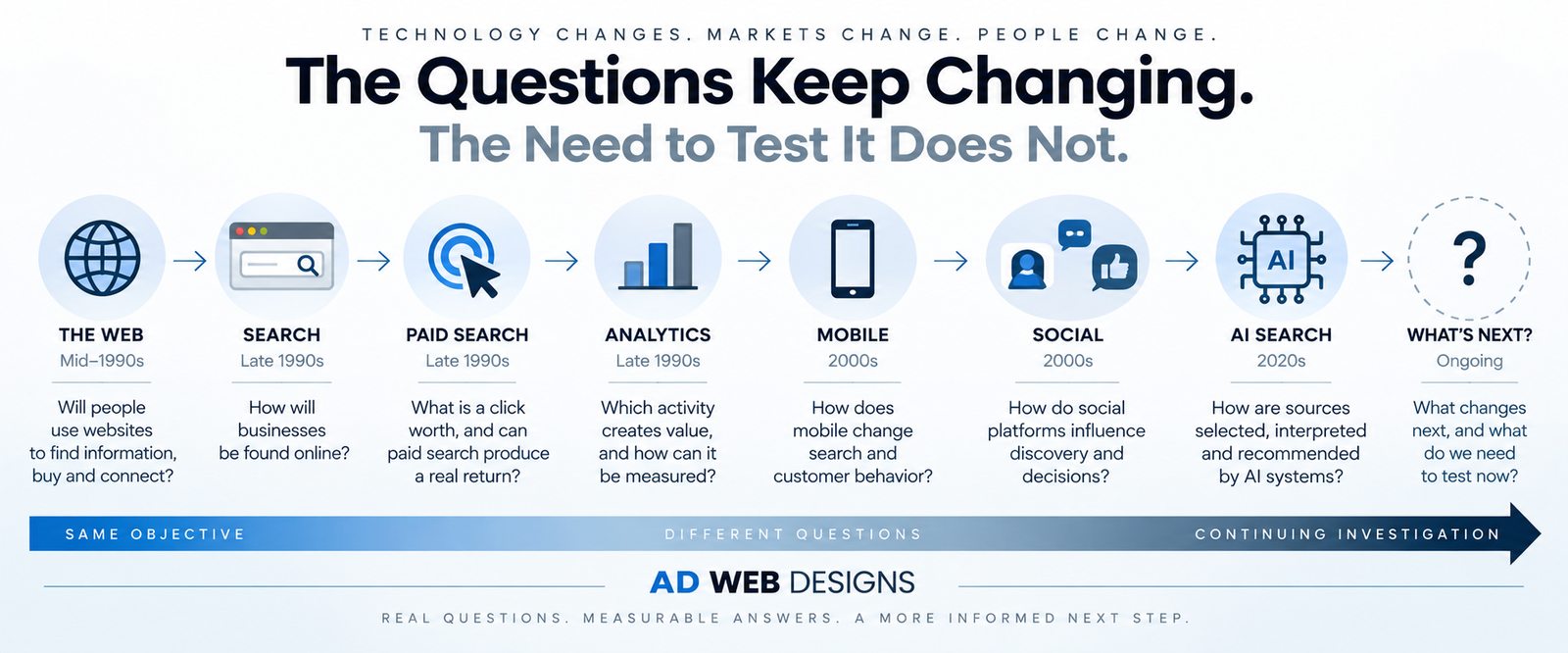
The early commercial web created questions about whether people would use websites to research companies, buy products or communicate with businesses.
Search engines created a different set of questions. SEO introduced another. Paid search made the economics of individual queries measurable. Analytics made more of the customer journey visible. Social platforms, mobile devices, video and automated advertising changed the environment again.
AI search and recommendation systems are the latest change, not the first.
Each transition produces confident predictions about what will happen next. We are more interested in finding out what actually happens.
That means testing, measuring and separating observation from assumption.
Start With the Question, Not the Answer
Good research does not begin by deciding what we want to prove.
It begins with a question.
What changed? What can we observe? What can we measure? What evidence existed before the change? What happened afterward? What else could explain the result? What remains unknown?
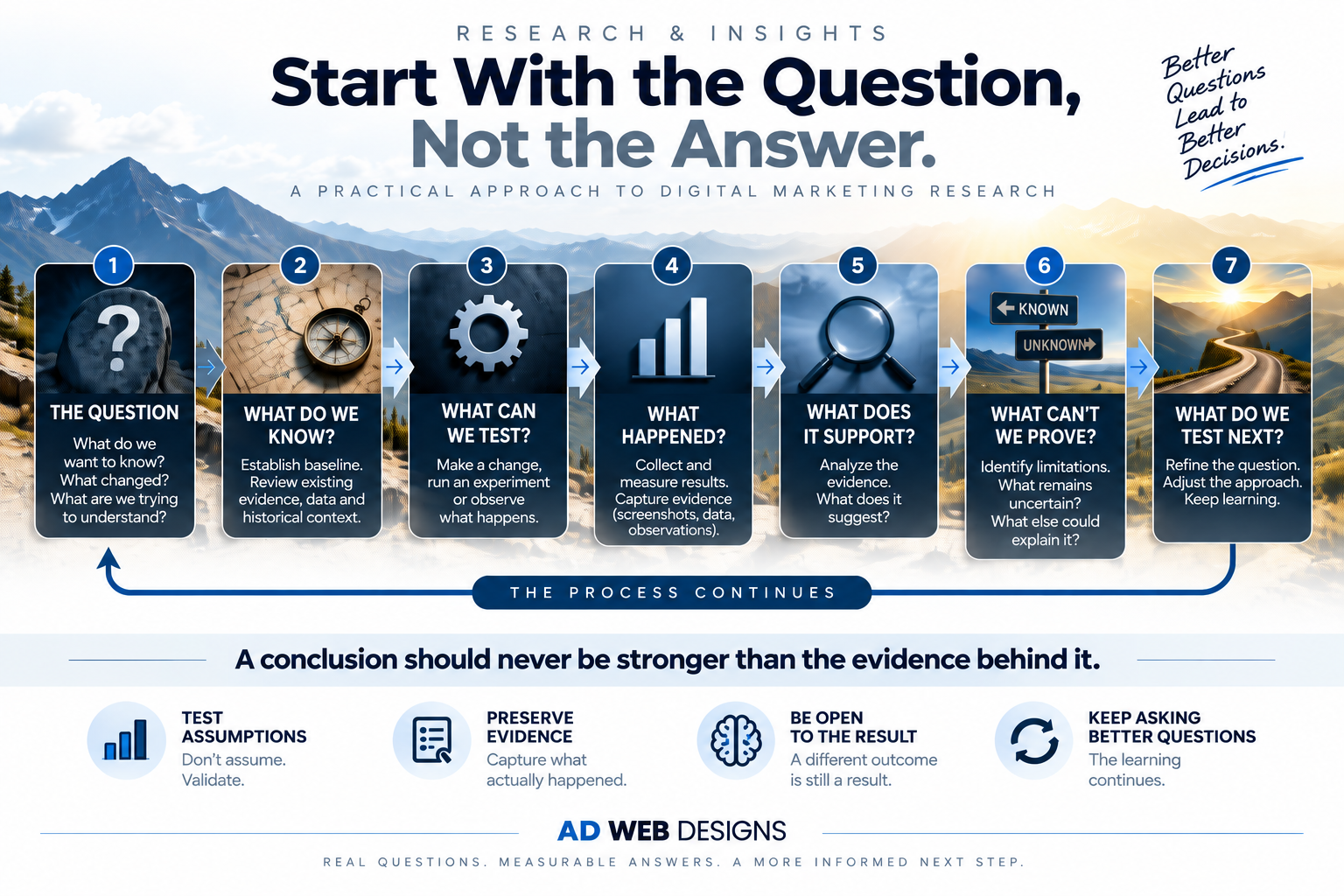
A useful research process can be surprisingly simple:
Question → Baseline → Observation or Test → Evidence → Analysis → Conclusion → Next Question
Sometimes the evidence supports the original hypothesis. Sometimes it weakens it. Sometimes the result is inconclusive.
All three outcomes are useful.
The purpose of an experiment is not to be right. It is to learn something.
What We Are Studying Now
The questions have changed considerably since 1996. Today, much of our research sits at the intersection of search, AI discovery, entity recognition, marketing economics and measurement.
AI Search & Recommendations
How businesses, people, products and information sources are discovered, interpreted, cited and recommended by generative systems.
Entity Recognition
How clearly defined entities, relationships, corroborating sources and first-party information may help machines understand who or what something is.
Search Behavior
How AI answers, zero-click experiences, traditional organic results, paid search, video and other discovery surfaces are changing the way people find information.
Citation & Source Selection
Which sources AI and search systems choose to reference, what those sources appear to have in common and what can actually be observed without pretending to know proprietary ranking systems.
Marketing Economics
How acquisition cost, conversion quality, customer value, paid-media economics and downstream outcomes affect decisions that surface metrics can obscure.
Attribution & Measurement
How much of a customer journey can be measured reliably, where attribution becomes uncertain and how better downstream data can improve marketing decisions.
The objective is not to manufacture a new acronym for every change in technology.
It is to understand what changed enough to affect a business decision.
What the Evidence Can Prove Matters
Digital marketing makes it easy to find two events that happened near each other and declare that one caused the other.
We try not to do that.
A page can change and rankings can improve. A citation can appear after an entity change. Traffic can increase after new content is published. Conversion rates can improve after a campaign adjustment.
Those observations may be important. They are not automatically proof of causation.
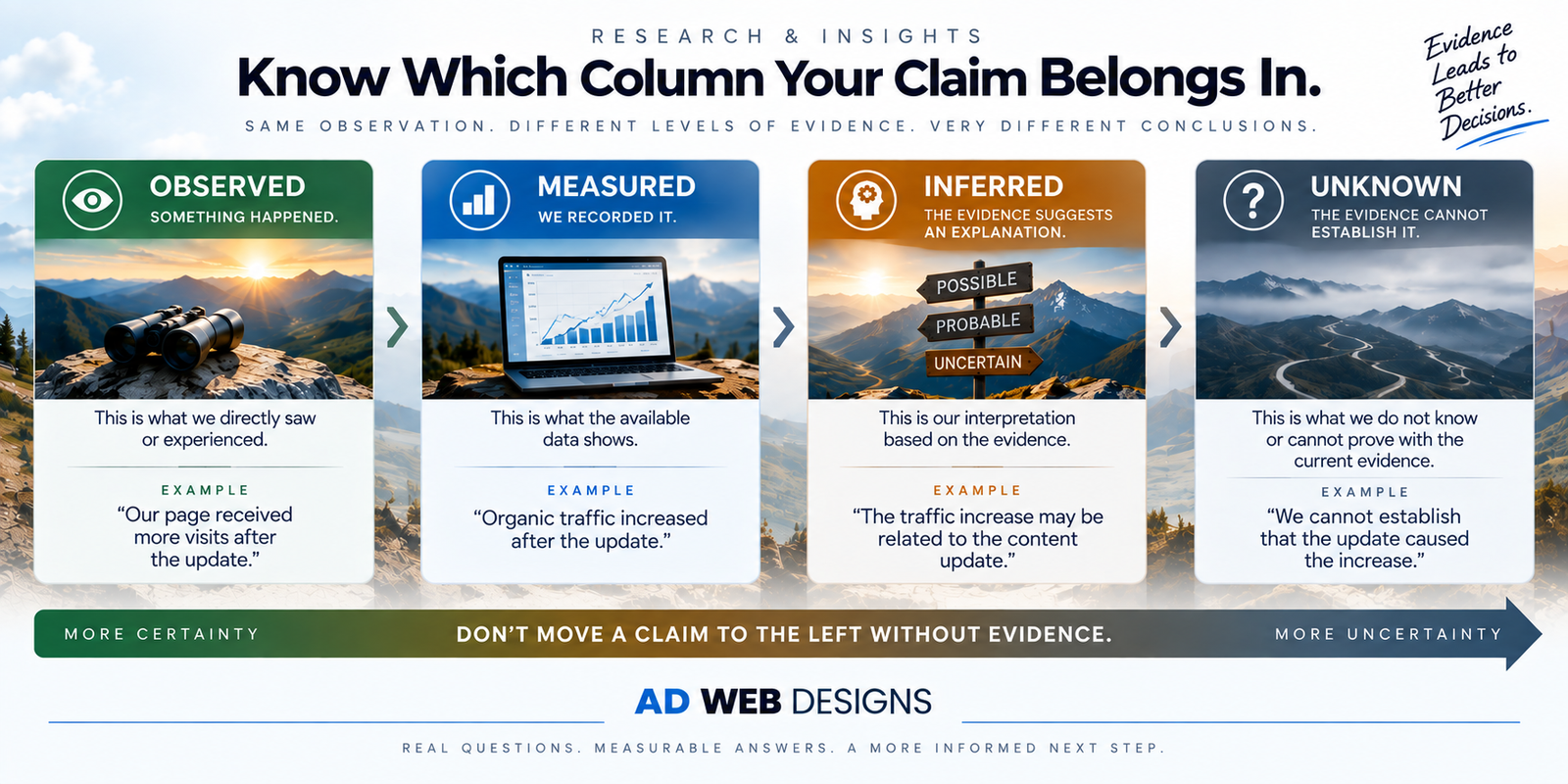
Research becomes more useful when the boundaries are stated clearly:
Observed: What actually happened.
Measured: What the available data recorded.
Inferred: What the evidence reasonably suggests.
Unknown: What the evidence cannot establish.
That distinction becomes especially important when studying AI systems whose internal retrieval, ranking and recommendation processes are not fully visible.
A strong conclusion should never be stronger than the evidence behind it.
Use the Web as a Laboratory
One advantage of working hands-on with digital marketing is that questions do not have to remain theoretical.
Websites can be changed. Search results can be observed. Advertising campaigns can be measured. Content can be tested. Entity information can be clarified. Crawl behavior can be monitored. Citations can be recorded. Forecasts can be compared with actual performance.
The web provides an enormous environment for controlled and semi-controlled observation.
Not every variable can be isolated. That is why baselines, dates, screenshots, source material and clearly stated limitations matter.
When conditions allow a stronger test, we use one.
When they do not, we describe the evidence for what it is.
Historical Evidence Can Answer Modern Questions
New technology does not make old evidence useless.
Historical search rankings, PPC reports, archived websites, campaign forecasts and analytics records can establish what existed at a particular point in time. Current observations can then be evaluated against a much longer history of digital change.
That matters because many supposedly new marketing questions have older equivalents.
How much is visibility worth?
Which traffic is valuable?
Does a ranking create a business outcome?
What should a business pay to acquire a customer?
Which source deserves credit?
What happens when the interface between a business and its customer changes?
The platforms change faster than many of the underlying business questions.
Ad Web Designs maintains a separate Results & Evidence archive for supporting artifacts, historical records and the boundaries around important claims.
Research asks the question. Evidence supports the answer.
Not Every Observation Is Ready to Become a Conclusion
Some of the most interesting observations happen before enough evidence exists to explain them confidently.
We think that distinction should remain visible.
Research may be described as developing when an observation has been recorded but the available evidence is not yet strong enough to support a broader conclusion.
That allows us to document something interesting without turning an early signal into a marketing claim.
More data may strengthen the hypothesis.
It may also kill it.
Both outcomes move the research forward.
Follow the Work, Not Just the Conclusion
Research & Insights is where Ad Web Designs publishes observations, analyses and findings about changes affecting digital discovery and marketing economics.
Individual research pieces can include the original question, available evidence, interpretation, limitations and what we think should be tested next.
The subjects will change because the digital environment will change.
The standard should not.
Show the evidence. Explain the reasoning. State the limitations.
What We Will Not Do
We will not turn correlation into causation because it makes a better headline.
We will not present a single search result as proof of a universal ranking factor.
We will not claim to know proprietary AI or search algorithms that we cannot see.
We will not convert modeled data into measured data without identifying the difference.
We will not turn an interesting observation into a proven strategy before the evidence supports it.
And when new evidence contradicts an earlier conclusion, we would rather change the conclusion than defend it.
Being wrong and finding out is more useful than being wrong and staying convinced.
Research Has to Become a Business Decision
Research is not valuable simply because something interesting was discovered.
For a business, the question is what the finding changes.
Should we invest more? Invest less? Test something? Stop doing something? Change how information is structured? Measure a different outcome? Protect an existing source of demand? Explore a new discovery channel?
Sometimes the correct decision is to act.
Sometimes it is to wait for better evidence.
Sometimes the research tells us that something receiving enormous industry attention is not yet important enough to justify the investment.
The research matters when it improves the decision.
Research & Insights FAQ
What does Ad Web Designs research?
Our research focuses primarily on digital discovery, search, AI recommendations, entity recognition, citations, marketing economics, attribution and measurement. The subjects evolve as the technology and business environment change.
Is Ad Web Designs’ research peer-reviewed academic research?
No. This is applied digital marketing research based on observable behavior, experiments, historical evidence, campaign data and other available sources. When evidence has limitations, those limitations should be stated.
How do you distinguish evidence from opinion?
We try to identify what was directly observed or measured, what can be supported by an artifact or source, what is an interpretation and what remains unknown.
Can one experiment prove how Google or an AI system works?
Usually not. Search and AI systems contain many variables that are not publicly observable. An experiment can provide useful evidence without revealing an entire ranking, retrieval or recommendation system.
What happens when an experiment does not support the hypothesis?
That is still a result. The hypothesis changes, the next question changes or the experiment ends.
Where can I see the evidence behind Ad Web Designs’ claims?
Supporting historical artifacts, screenshots and documented evidence are maintained in the Results & Evidence archive with context describing what each item does and does not establish.
Keep Testing the Assumptions
Thirty years of digital marketing does not provide thirty years of answers.
It provides thirty years of experience asking questions while the answers keep changing.
Search will change again. AI systems will change. Advertising platforms will change. Measurement will change. New intermediaries will emerge between businesses and customers.
The job is not to predict every change correctly.
It is to recognize when something important has changed, test what can be tested, preserve the evidence and adjust the strategy accordingly.
Platforms change. Evidence accumulates. The learning continues.
Find My Opportunity
Start with the business question, then determine what the available evidence can actually tell us.
