
BILL SCOTT · DIGITAL MARKETING SINCE THE EARLY COMMERCIAL WEB
How Bill Scott Became a Digital Marketing Pioneer
Three decades of search, advertising, ecommerce, video and experimentation started with a used lawnmower.
Before There Was a Commercial Web
I didn’t set out to become a digital marketer. There really wasn’t such a thing when I started.
Before Google, social media and YouTube—and before most businesses had even considered having a website—I was fascinated by the idea that computers could communicate with each other. My introduction to the online world wasn’t a website. It was modems and bulletin board systems.
They were painfully slow by today’s standards. Downloading a single image could take an absurd amount of time. You could start a download, go to bed and find out the next morning whether you had actually gotten what you expected. But the speed wasn’t what interested me. People and information could move across a network without being in the same place. That was fundamentally different.
There wasn’t much about my life at the time that suggested I was headed toward a 30-year career in digital marketing. Football was a serious part of my life. I modeled. I studied acting and went on movie auditions. I studied radio and television before eventually moving more deeply into marketing.

Football Could Have Taken Me Somewhere Else
I played free safety at Scottsdale Community College. In November 1989, the New York Giants were in Arizona and practiced at Scottsdale Community College. That part of the timeline can be independently documented.
What happened next I have to tell from memory.
During practice I made an interception that caught the attention of one of the Giants scouts. Afterward, he came up to me and told me it was one of the best interceptions he’d ever seen. He handed me his card. I kept that card for years, but somewhere along the way I lost it.
My friend and teammate Josh Miller was there during that period. Charlie Garner was part of the Scottsdale Community College football program as that period rolled into 1990. Both eventually made it to the NFL.
Football could have taken my life in a very different direction. It didn’t. Computers were becoming increasingly interesting to me.
Then somebody asked me to sell a lawnmower.
The Lawnmower Man
The first thing I remember selling online wasn’t a marketing service, a website or some revolutionary new technology. It was a used lawnmower.
Someone asked me to help sell it. I put it online, and it sold.
Because The Lawnmower Man had come out a few years earlier, my friends started calling me “The Lawnmower Man.” They were joking, but I was starting to realize we’d stumbled onto something much bigger.
As a marketing guy, what fascinated me wasn’t that I’d managed to put something on a computer network. It was that a seller and a buyer had found each other through this new medium. That changed the question for me. Instead of asking what computers could do, I started wondering what businesses could do with them.
I’ve essentially been asking versions of that question ever since.
Ad Web Designs — 1996
Ad Web Designs dates back to 1996. I am its current owner, and my work in Internet marketing also reaches back to that early commercial-web period.
At the time, this wasn’t an industry with a mature playbook. Businesses were beginning to realize they needed a presence on the web, and I was trying to understand what this new medium could actually do for marketing.
Websites were an obvious starting point, but another problem became apparent almost immediately: a website doesn’t have much business value if nobody can find it.
That problem pushed my work beyond simply putting things on the web and into Internet marketing—website promotion, search engines, directories, links and the early methods businesses used to become discoverable online.
Before We Agreed to Call It SEO
Today we have an entire vocabulary around SEO, paid search, conversion optimization, attribution, digital acquisition and now AI search. We didn’t have that vocabulary in 1996.
There were directories, early search engines, links, online communities, newsgroups, webrings and a lot of experimentation. So we experimented. How do people find websites? How do search engines decide what to show? How do you get a business listed? What words are people searching for? What makes somebody click? And eventually, what happens after they click?
By the time Fredrick Marckini’s Search Engine Positioning was published in 2001, I’d already been doing this stuff for about five years.
Back in 1996, we didn’t have a neat, universally accepted playbook for SEO. Hell, we weren’t even all using the same language to describe it. We were figuring out how search engines worked, how people found websites and how to get businesses in front of them.
I didn’t enter digital marketing after it became an industry. I was working in it while the industry was still figuring out what to call itself.
Getting Found Was Never Enough
One thing became clear very early: traffic wasn’t the business objective.
A thousand people visiting a website isn’t necessarily better than a hundred. What matters is what those people do. Do they call? Request information? Buy something? Become customers? And ultimately, do they generate enough economic value to justify what it cost to acquire them?
Technology has made answering those questions dramatically more sophisticated, but the underlying business question hasn’t changed much at all.
You don’t take clicks or leads to the bank. You take conversions to the bank.
When Websites Started Doing Business
The web quickly evolved from pages people read into systems people could interact with. I became involved with increasingly sophisticated commercial websites—online content, lead generation, memberships, ecommerce, secure transactions, downloadable media and eventually streaming video.
None of that sounds particularly remarkable today. It was different when consumers were still learning whether they trusted a computer enough to conduct business through it.
Over time, that became as interesting to me as the technology itself. We could spend all day studying browsers, search engines, websites and eventually algorithms, but ultimately the technology doesn’t click the button. A person does.
Studying People, Not Just Algorithms
Digital marketers spend enormous amounts of time studying algorithms: Google’s algorithm, advertising algorithms, social algorithms, recommendation algorithms and now AI systems.
Those systems matter, but there’s another system on the other side of the screen that matters even more: the human being.
One of my favorite books on the subject is Susan Weinschenk’s Neuro Web Design: What Makes Them Click? It explores motivation, decision-making, persuasion and the psychological factors that influence what people do online. That’s a much bigger marketing question than simply figuring out what an algorithm wants.
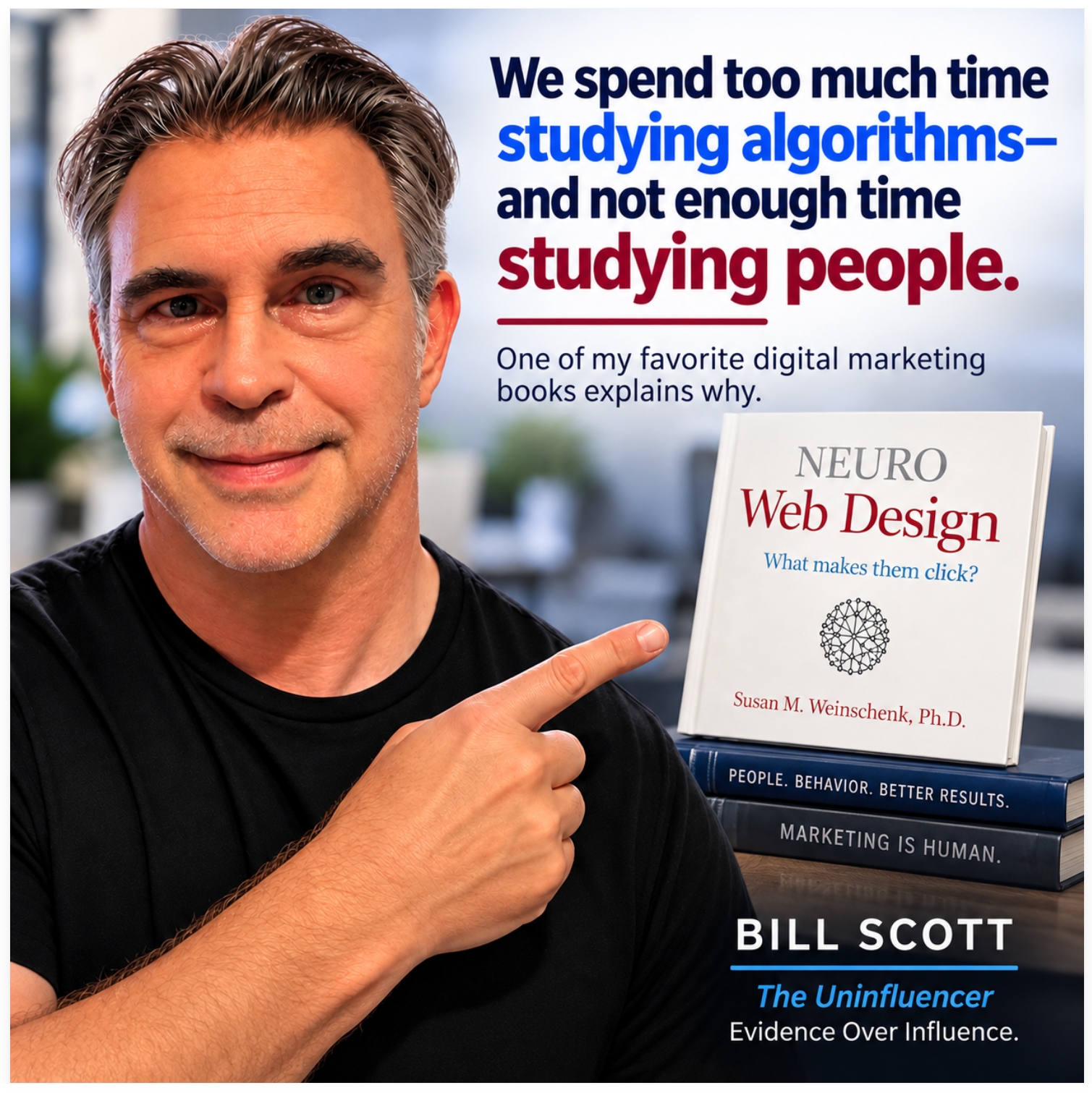
That idea has influenced how I think about search, advertising, landing pages, video, conversion optimization and now AI. Algorithms influence what gets presented. People ultimately determine whether it matters.
Video Before YouTube
Video interested me long before it became an obvious digital marketing channel. In the late 1990s, I was involved with commercial web projects experimenting with downloadable and streaming video.
Bandwidth was terrible compared with today. There was no YouTube, no creator economy and nobody talking about Shorts, subscribers or recommendation algorithms. The question was much simpler: could the Internet become a distribution medium for video?
It could.
Years later at ITM Trading, I found myself having essentially the same argument in a different technological era. I pushed for creating more YouTube content when not everyone was convinced there was much value in it. By January 2017, I was celebrating that the content had accumulated roughly 117,000 views on what I jokingly described at the time as “a pretty dry topic.”
Different technology, same lesson: don’t decide what an audience wants based solely on what you think they should want. Test it.
“The Internet Is Just a Fad”
I’ve heard variations of that objection for most of my career.
One of my favorites came from people associated with the traditional telephone-directory business. I was told, directly and confidently, that the Internet was just a fad. That prediction didn’t age particularly well.
Another came when I proposed using a website to order pizza. I still remember the condescending response: “Bill, no one is ever going to buy a pizza online.”
They weren’t stupid people. They were evaluating a new technology through the economics and consumer behavior of the existing world.
I’ve tried to remember that whenever another supposedly revolutionary technology appears. Don’t automatically assume the new thing changes everything, but don’t assume the old way survives forever either. Watch what people actually do.
Search Became Paid Search. Then an Economic System.
Eventually search became a massive advertising marketplace, and I moved deeply into PPC, SEO, conversion optimization, analytics and acquisition economics.
The budgets got larger, the clicks got more expensive and the measurement became more sophisticated. The businesses changed too—from ecommerce and precious metals to RVs, agencies, higher education and personal-injury law—but the underlying process remained remarkably familiar: find demand, earn attention, create action and measure the business result.
At one point you’re selling a lawnmower. At another, you’re managing advertising programs involving millions of dollars. The arithmetic gets considerably more consequential, but the basic question doesn’t change:
Did the marketing produce something worth more than it cost?
Google Is a Vendor, Not Your Marketing Department
Years of managing paid search taught me something else. Platforms have objectives, and advertisers have objectives. Those objectives can overlap without being identical.
Google knows more about its advertising platform than I ever will. But Google doesn’t know a particular advertiser’s business better than that advertiser should.
So when Google—or any other platform—makes a recommendation, I treat it as an input, not an instruction. That’s not anti-Google. It’s simply recognizing incentives.
The platform’s job is to optimize its ecosystem. The marketer’s job is to optimize the business outcome.
What 30 Years Changed
Experience is useful. It isn’t a superpower.
If anything, being around this long has made me more suspicious of absolute statements. I’ve watched supposedly permanent strategies disappear, ridiculous ideas become normal and technologies that were supposed to change everything amount to very little. I’ve also been wrong plenty of times myself.
That’s why my operating philosophy today is pretty simple: use the best data available, state the assumptions, make the best decision the evidence supports, measure what happens and change the decision when better evidence arrives.
I don’t expect somebody to believe a claim simply because I’ve been doing this for 30 years. I’d rather show the work.
Old expertise expires if you stop testing it.
From Search Engines to AI Systems
Today I’m asking another version of the question I started asking in the 1990s.
Back then, I wanted to understand how people would find businesses on the Internet. Then the question became how search engines would find and rank businesses, followed by how businesses could profitably acquire customers through those search engines.
Now I’m asking: How will AI systems understand, evaluate and recommend businesses?
That’s why much of my current work involves AI search visibility, entity clarity and machine-mediated discovery. Modern discovery isn’t confined to a Google results page anymore. Customers can encounter a business through traditional search, AI assistants, maps, reviews, social platforms, paid media and systems they may not even consciously recognize.
I don’t pretend anybody has completely solved this. We’re testing it, documenting what happens, separating evidence from assumptions and changing the strategy as the evidence changes.
That feels very familiar.
The Platforms Changed. The Business Question Didn’t.
Looking backward, my career doesn’t feel like a series of unrelated technologies. BBSs, websites, search engines, ecommerce, streaming video, SEO, paid search, YouTube, social media, analytics, OTT and now AI are different manifestations of the same underlying change.
Technology changes how businesses and people find each other.
My job has been to figure out what changed, determine what actually matters and connect the technology to an economic result.
It started, somewhat improbably, with a used lawnmower.
Thirty years later, I’m still experimenting. I’m still testing. I’m still changing my mind when the evidence tells me I’m wrong.
And I’m still asking essentially the same question:
Did it work?
