
Search Is No Longer Just a List of Links.
For most of the commercial web, visibility meant earning a position on a search results page and getting the click. That still matters. It is no longer the entire discovery environment.
Search engines generate answers. AI systems summarize information, compare alternatives and recommend businesses. Paid advertising is beginning to appear inside these environments as well. The question is no longer simply whether a page ranks.
The questions now include whether these systems understand the business, retrieve the right information, consider it relevant to the conversation, cite or recommend it, surface competitors instead, and whether paid AI exposure can produce acceptable economics.
Ad Web Designs treats AI visibility as part of a larger customer-acquisition system. The objective is not to collect AI mentions. The objective is to understand how discovery is changing, improve the business’s ability to compete inside that environment, and connect the work to measurable business outcomes.
Your Customers May Discover the Answer Before They Discover Your Website.
A customer’s research process can now begin and sometimes advance substantially without a traditional website visit. Search results may summarize the subject. AI systems may answer the question directly. A conversational system may compare several alternatives before the customer ever sees a company’s homepage.
That changes what businesses compete for. They are still competing for rankings and clicks, but they are also competing for understanding, retrieval, recommendation, attention and ultimately the customer.
A company can rank well and remain weak in AI-mediated discovery. It can also appear in AI answers for informational questions while remaining invisible for the commercial questions that matter most. Visibility has to be evaluated against the actual customer journey, not against a new vanity metric.
Search Has to Understand More Than the Page.
Traditional SEO remains important. Pages still need to be accessible, understandable, relevant and useful. But modern discovery increasingly depends on systems understanding the companies, people, products, services and locations represented by those pages.
Ad Web Designs uses entity optimization to improve that identity layer. The objective is to make important facts and relationships easier to understand, corroborate and distinguish from conflicting or ambiguous information.
That is a conceptual progression, not a guarantee. Strong technical SEO does not automatically produce an AI recommendation, and clear entity information does not guarantee that a business will be selected for every relevant question. Each layer can affect whether the next layer has enough evidence to work with.
Related Problems, but Not the Same Problem.
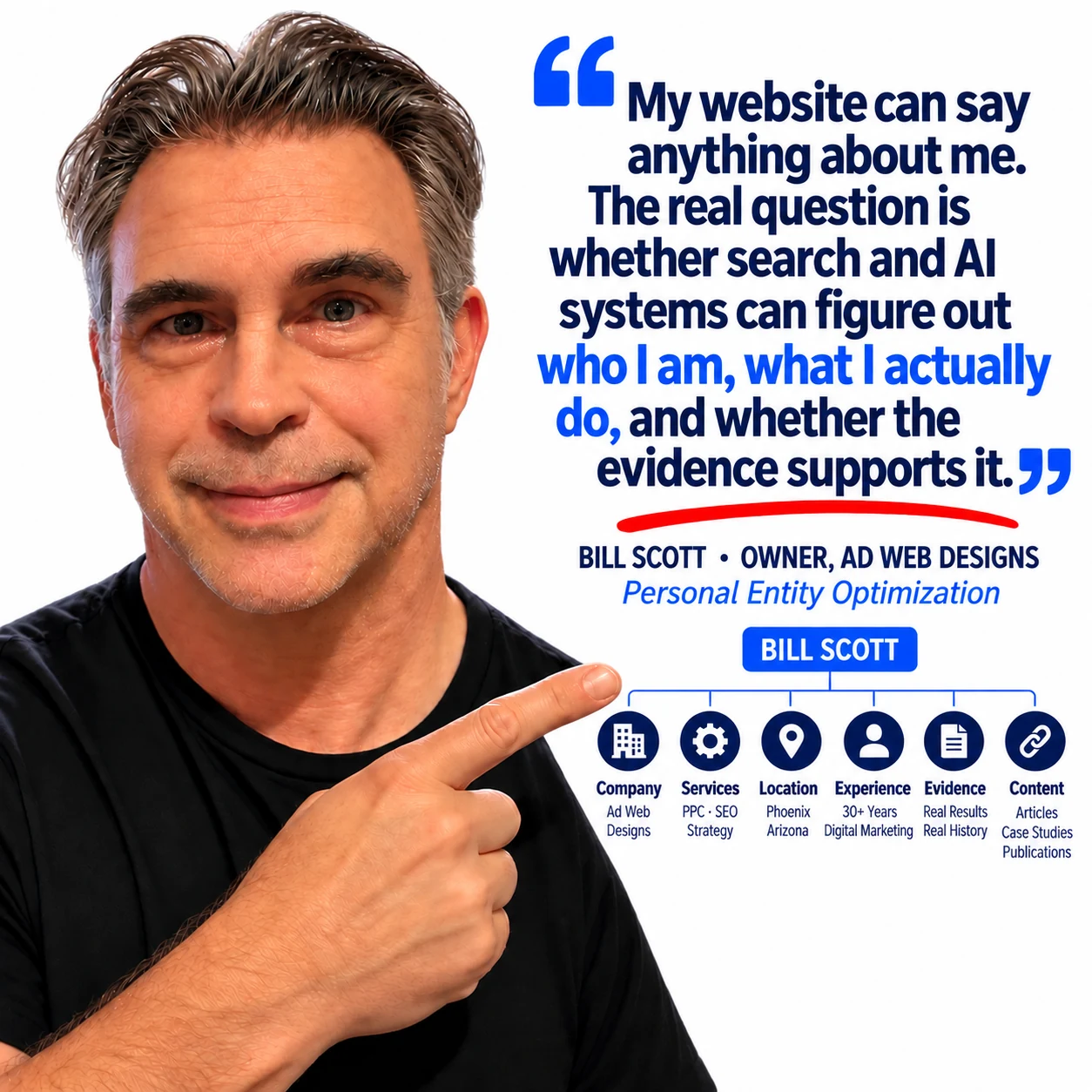
Entity Optimization focuses on identity, facts, relationships, corroboration and conflicts. It asks whether search and AI systems can determine who or what the entity is and whether the surrounding information agrees.
AI Visibility focuses on discovery. It asks where the business appears, which questions retrieve it, when it is mentioned, cited or recommended, where competitors appear instead and whether that visibility contributes to a commercial outcome.
A business can be understood correctly and still not be selected. It can also be visible while being described incorrectly. Understanding and selection are related, but they are not interchangeable.
That distinction matters because solving the wrong problem wastes time. If the identity layer is broken, publishing more pages may not solve it. If the identity is clear but competitors provide stronger answers to important customer questions, the problem is visibility and content advantage rather than entity ambiguity.
Baseline. Diagnose. Improve. Deploy. Measure. Learn.
Ad Web Designs does not begin with a promise to make a business appear in an AI answer. We begin by establishing what can actually be observed.
We document current visibility, investigate why the business may or may not be appearing, improve the information environment where evidence supports a change, deploy the work, measure what happens and compare the results with the baseline.
The purpose of that loop is not to manufacture certainty where none exists. It is to reduce uncertainty through evidence and make better decisions with the information available.
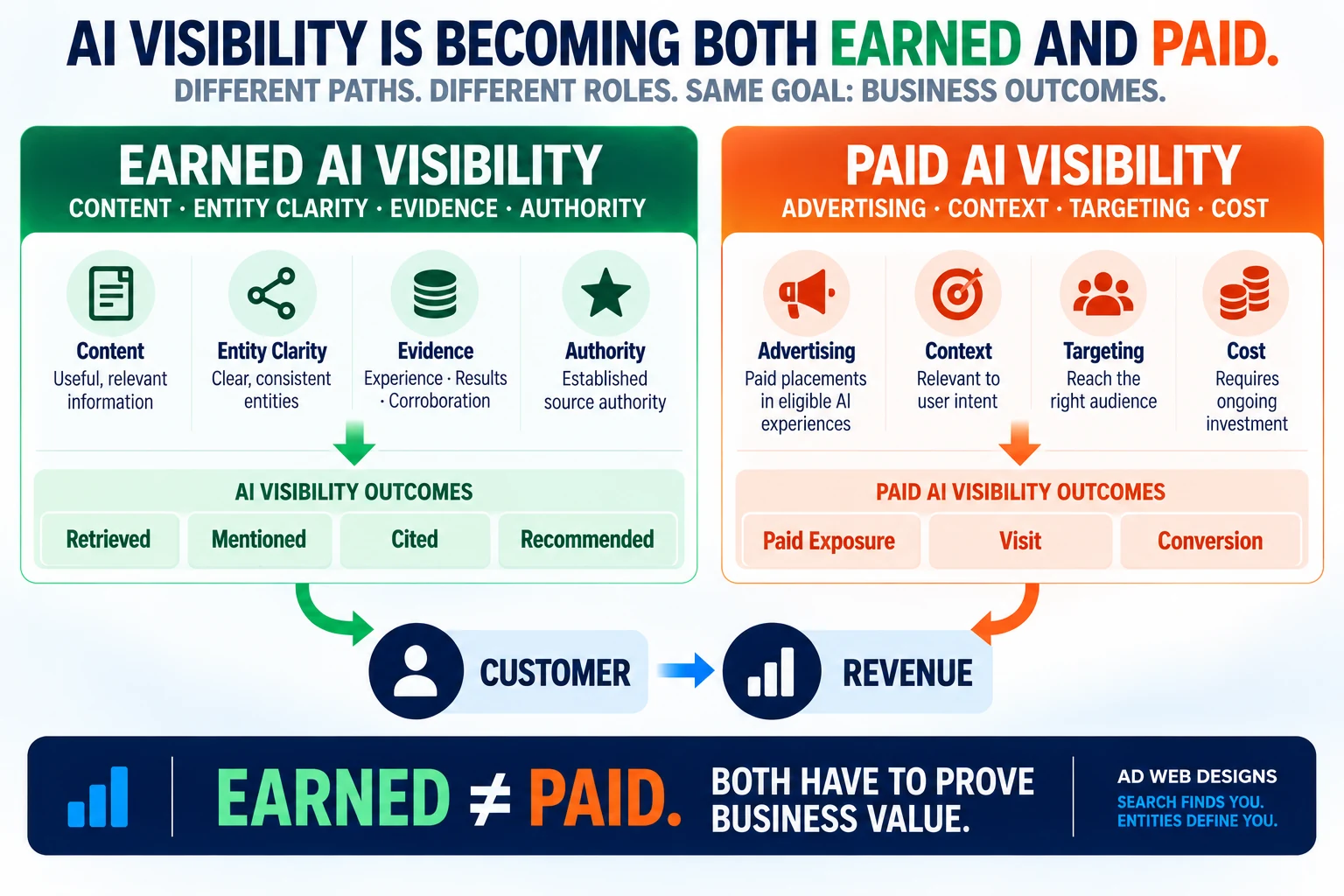
AI Visibility Is Becoming Both Earned and Paid.
AI-mediated discovery is developing two distinct paths for businesses.
Earned AI visibility occurs when a system retrieves, mentions, cites or recommends a business or its information because that material is relevant to the user’s task and the system selects it.
Paid AI visibility occurs when an advertiser purchases eligible exposure within an AI or conversational advertising environment.
These are different mechanisms and they should be measured separately. Paid exposure does not turn into earned authority because money changed hands, and an earned recommendation does not mean the business purchased the placement.
SEO and PPC have always required that distinction. AI visibility needs the same discipline.
The Advertising Environment Is New. The Economics Are Not.
New advertising environments create new inventory, not new rules for business economics. The useful questions remain familiar: how much exposure was purchased, how much qualified traffic or opportunity did it produce, what did the customer cost, and what was that customer worth?
Ad Web Designs evaluates paid AI discovery the same way we evaluate other paid channels. We test the opportunity, measure the downstream behavior and compare the economics with other places the next marketing dollar could be invested.
A new advertising product may deserve exploration capital because the business can learn something valuable from the test. That does not mean it automatically deserves expansion capital.
New does not mean profitable. Different does not mean better. The channel still has to earn the investment.
The Conversation May Tell Us More Than the Original Query.
Traditional paid search often begins with the query. Conversational systems can add context around that query as the customer explains what they need, asks follow-up questions, compares alternatives and narrows the decision.
That additional context may create new opportunities to understand intent and match advertising or content to a more developed customer need. It may also create new measurement problems because the discovery process can span several interactions before the customer reaches a website.
Conversational intent does not eliminate keyword-driven paid search. It adds another information layer to the discovery environment.
Being Recommended and Buying Attention Create Different Advantages.
Paid visibility can create immediate exposure when the inventory, targeting and economics make sense. It cannot repair an unclear entity, resolve conflicting facts or manufacture independent authority.
Earned AI visibility can place a business or its information inside a research process without purchasing that specific exposure. It does not guarantee that the business will appear in every relevant conversation or that the customer will ultimately choose it.
The strategic decision is therefore not whether earned or paid AI visibility is universally better. The decision is where each can contribute to the customer journey, what evidence supports the investment and how the economics compare with other channels.
From AI Visibility Assessment to Deployment.
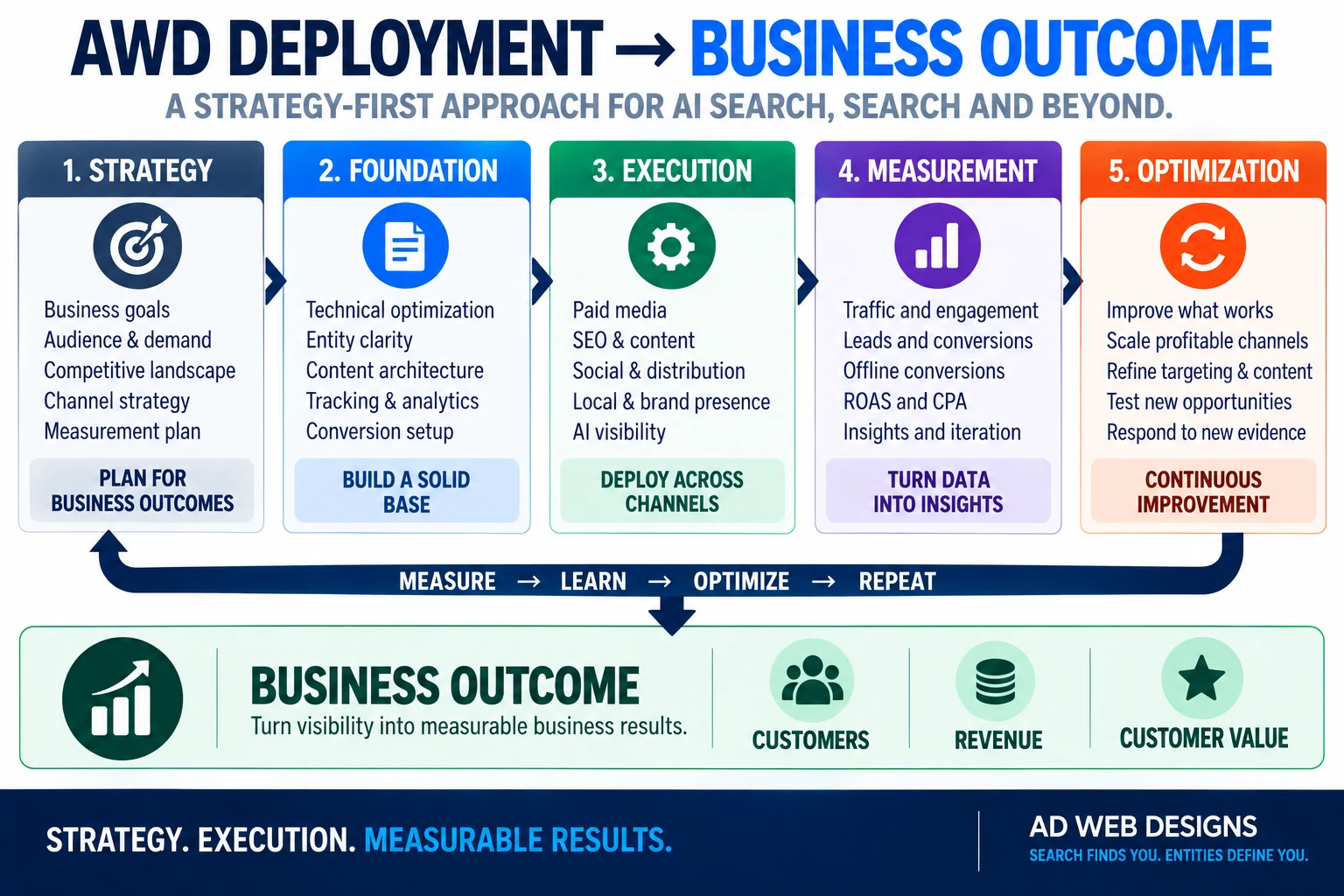
- Establish the baseline. Document current visibility, important questions, citations, mentions, recommendations, traffic and observable competitive presence.
- Evaluate entity clarity. Identify ambiguity, conflicting information, weak relationships and missing corroboration that may affect accurate understanding.
- Evaluate retrieval, citations and recommendations. Determine where the business is being surfaced, where it is absent and what sources appear instead.
- Identify the competitive gap. Compare the information, evidence, structure and usefulness of competing sources against the business’s own material.
- Improve the information environment. Strengthen source content, entity relationships, technical accessibility, evidence, internal connections and other elements supported by the diagnosis.
- Deploy and test. Publish improvements and, where the economics justify exploration, test paid discovery opportunities separately from earned visibility.
- Measure downstream behavior. Connect observable discovery signals to visits, qualified opportunities, customers and revenue wherever the attribution design supports it.
- Compare and reallocate. Scale what produces evidence of value, modify what needs improvement and stop allocating resources where the economics do not justify continued investment.
Visibility Is an Intermediate Outcome.
A citation can be useful evidence. A recommendation can be useful evidence. An AI referral visit can be useful evidence. None of those signals automatically proves business value.
Ad Web Designs separates discovery signals from commercial outcomes. The measurement chain may look like this:
Not every customer journey will expose every step, and attribution has limits. The objective is to connect as much of the journey as the evidence supports without pretending that an intermediate signal proves causation.
The Platforms Will Change. The Decision Process Should Survive.
AI discovery systems, interfaces, advertising products, reporting tools and retrieval methods will continue changing. Some measurements available today may disappear. New ones will emerge. Platform documentation will change. Customer behavior will change with it.
That makes permanent tactical answers dangerous.
Thirty years of experience does not give us thirty years of permanent answers. It gives us experience recognizing when the questions have changed and when new evidence requires a different decision.
The durable advantage is not memorizing today’s interface. It is having a process for establishing what is known, identifying what is unknown, testing what matters and changing the allocation when the evidence changes.
Search, AI, Entities and Paid Media Are Becoming Parts of the Same Discovery Environment.
Customers do not care which marketing discipline gets credit for helping them find a business. They search, ask questions, compare alternatives, investigate companies, encounter recommendations and advertising, and eventually make a decision. The marketing architecture has to reflect how that customer journey actually works.
SEO and paid search still matter, but they are no longer the entire discovery environment. Entity clarity and AI visibility have become additional parts of that environment, and paid AI discovery is creating another way for businesses to compete for attention.
The strategic question is not which of these deserves the newest acronym. It is which combination can help produce the business outcome and deserves the investment.
Frequently Asked Questions
Does AI visibility replace SEO?
No. SEO remains part of the discovery foundation. AI visibility expands the problem beyond traditional rankings and clicks into retrieval, mentions, citations, recommendations and conversational discovery.
Is Entity Optimization the same as AI visibility?
No. Entity Optimization focuses on identity, facts, relationships, corroboration and ambiguity. AI visibility focuses on where and how the entity or its information is retrieved, mentioned, cited or recommended. The two can affect one another, but they are different problems.
Can businesses buy AI visibility?
Paid advertising is becoming part of AI-mediated discovery, but paid exposure and earned AI visibility are different systems. Purchasing advertising does not mean a business has purchased an organic citation, recommendation or authority signal.
Should every business invest in paid AI advertising?
No. A new advertising environment deserves investment only when the opportunity, testing value and economics justify it. Ad Web Designs evaluates it against the same question as every other channel: what happens to the next marketing dollar?
Is there one AI visibility metric we should track?
No. Useful signals can include retrieval, mentions, citations, recommendations, referrals, qualified opportunities, customers and revenue. The correct measurement depends on the business objective and what can be observed credibly.
What does Ad Web Designs actually do to improve AI visibility?
We establish the baseline, diagnose entity and visibility problems, evaluate competing sources, improve the information environment, deploy changes, test paid opportunities separately where appropriate, measure downstream behavior and reallocate resources based on evidence.
Find My AI Opportunity
The first question is not whether your business needs another AI tactic. It is where the opportunity actually exists, what is preventing the business from capturing it and whether solving that problem is likely to produce enough value to justify the investment.
That is what we look for first.
