Digital Marketing Strategy
Identify the objective, economics, market conditions, competition and constraint before selecting tactics.
Ad Web Designs is a digital marketing strategy and consulting company that helps businesses identify where the real opportunity is—then determine what combination of search, paid media, conversion, analytics and AI visibility can turn that opportunity into business value.
Sometimes you need more traffic.
Then again, you may already have plenty.
We start with the business problem.
Those are business problems. They don’t tell us what the solution is.
A traffic problem could actually be a conversion problem. Expensive PPC could be an advertising problem—or what happens after the click. Falling organic traffic could be rankings, changing demand, stronger competitors, a changing search results page or bad measurement.
We’d rather find out before selling you the solution.
Give Us the Problem. Not the Solution.
You don’t need to decide whether you need SEO, PPC, CRO, analytics, entity optimization or AI visibility before talking to us.
That’s what strategy is supposed to determine.
SEO doesn’t operate independently of PPC. PPC doesn’t operate independently of conversion. Conversion changes what traffic is worth. Attribution changes what appears to be working. Search engines and generative AI systems increasingly depend on understanding exactly who and what a business is.
Ad Web Designs connects those disciplines around the business objective.
Identify the objective, economics, market conditions, competition and constraint before selecting tactics.
Build search visibility around the searches, subjects and services capable of creating meaningful business opportunities.
Acquire qualified opportunities through Google Ads and other paid channels while managing acquisition costs and measuring what happens beyond the click.
Improve how search engines and generative AI systems identify, understand and represent the business, its people, services, expertise, locations, relationships and supporting evidence.
Improve what happens after someone arrives. More traffic is considerably more useful when more of it becomes business.
Connect marketing activity with meaningful outcomes so decisions are based on evidence—not whichever dashboard happens to look best this month.
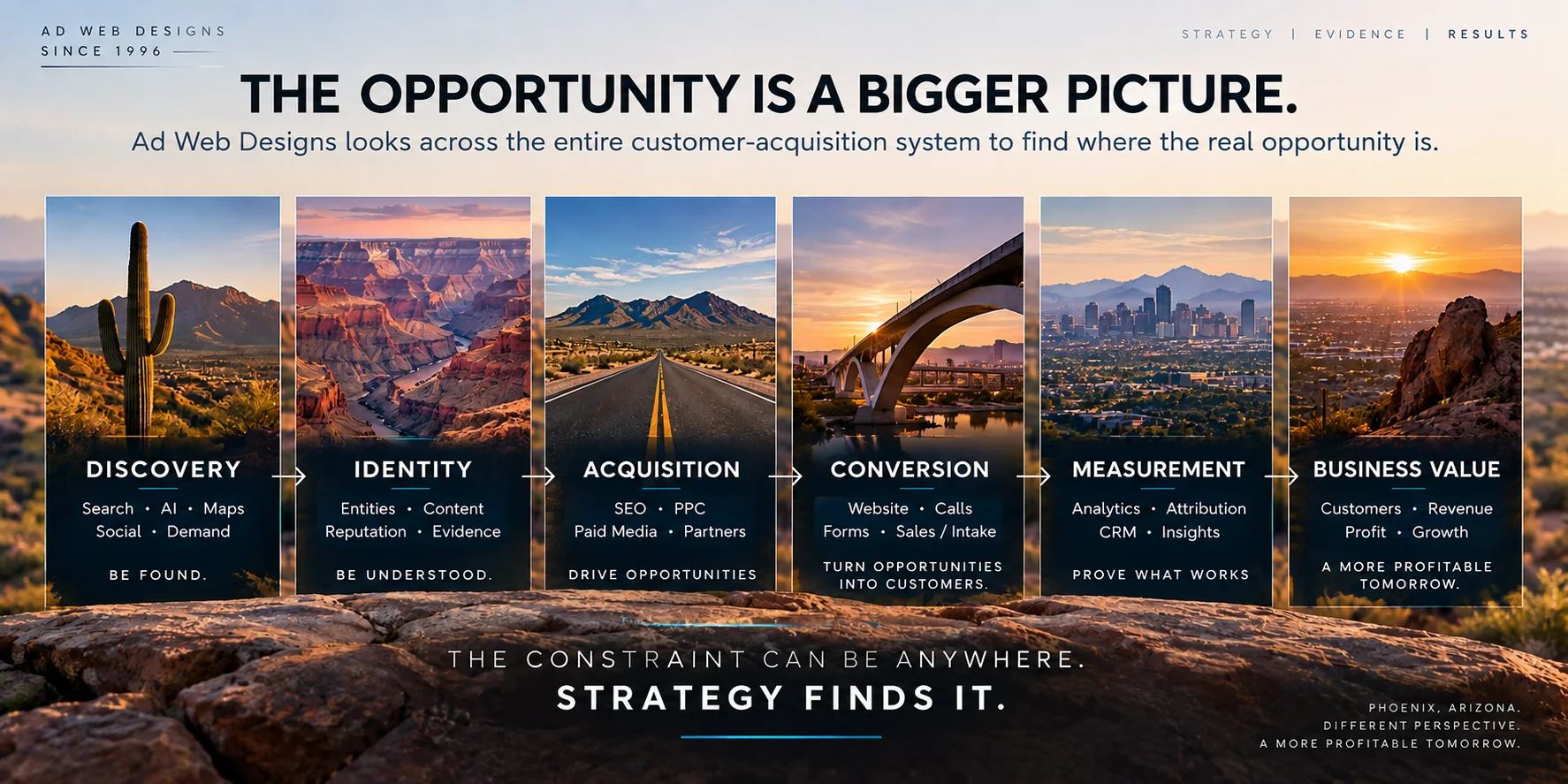
Search • AI • Maps • Entities • Content • Evidence
Visibility now depends on more than ranking. Can customers—and the systems they use—find your business, understand what it does and determine when it may be relevant?
SEO • PPC • Paid Media • Social • Websites • Calls • Forms
Can that visibility efficiently create qualified opportunities, and can those opportunities become customers?
Analytics • Attribution • CRM • Customers • Revenue • Profit
Can we determine what actually created business value?
Visibility matters when it creates business value.
You don’t take clicks or leads to the bank. You take conversions to the bank.
Traffic dropped?
Maybe you need SEO. Maybe demand changed. Maybe competitors improved. Maybe Google changed the SERP. Maybe AI changed search behavior. Maybe your measurement is wrong.
We’d like to know which one before recommending more SEO.
Google Ads getting expensive?
Spending more isn’t a strategy. Neither is endlessly rearranging campaigns while ignoring what happens after the click.
We ask:
What changed? Where is the constraint? What does the evidence support? What would fixing it be worth?
Sometimes the answer is more traffic. Sometimes it’s better traffic. Sometimes it’s conversion or measurement.
And sometimes the smartest marketing recommendation is to stop spending money on something that isn’t working.
Then we talk tactics.
Sometimes the problem isn’t your marketing partner.
Ad Web Designs can independently review current agencies, consultants, media partners, lead providers, proposed vendors and marketing strategies to determine whether their recommendations, economics, measurement and performance hold up under scrutiny.
We’re not looking for a reason to replace a good partner.
If they’re doing a great job, we’ll tell you that too.
If something doesn’t make sense, we’ll tell you that as well—and explain why.
The objective isn’t to sell you another service. It’s to help you make a better marketing decision.
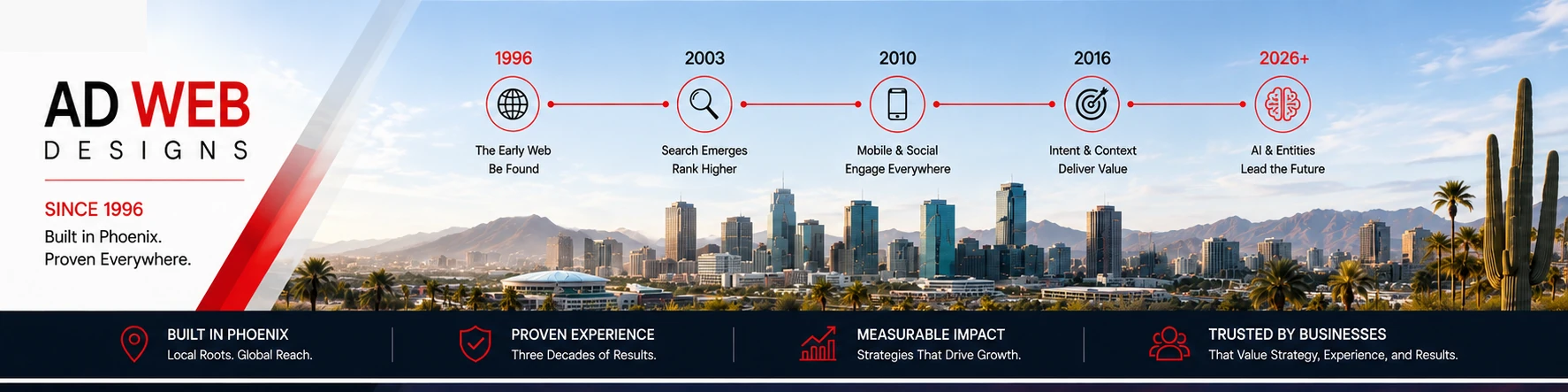
Ad Web Designs went online in 1996.
Back then there wasn’t much of a digital marketing playbook. Half the things we were doing didn’t have names yet.
We built websites. Managed servers. Worried about bandwidth. Built ecommerce. Bought traffic. Worked with early search engines and improved conversions before anyone decided to call it CRO.
Thirty years later, we’re still testing things.
Today that means modern SEO, paid search, analytics, attribution, automation, entity optimization, AI search—and whatever comes next.
The acronyms changed. The platforms changed. The interfaces definitely changed.
The job didn’t.
Figure out what’s happening. Find the opportunity. Test the assumption. Measure what matters. Change course when the evidence says you’re wrong.
Ad Web Designs is owned and operated by Bill Scott, a hands-on digital marketing strategist whose experience includes both consulting for businesses and working inside operating companies responsible for marketing performance.
Thirty years is a long time to make claims about what you’ve done.
So where the evidence still exists, we preserve it.
Archived websites. Historical marketing material. Search results. Advertising forecasts. Performance results. Analytics.
Some of it is polished.
Some of it looks exactly like you’d expect something from 1996 to look.
That’s kind of the point.
Surviving artifacts document Ad Web Designs and digital marketing work extending back to the early commercial web.
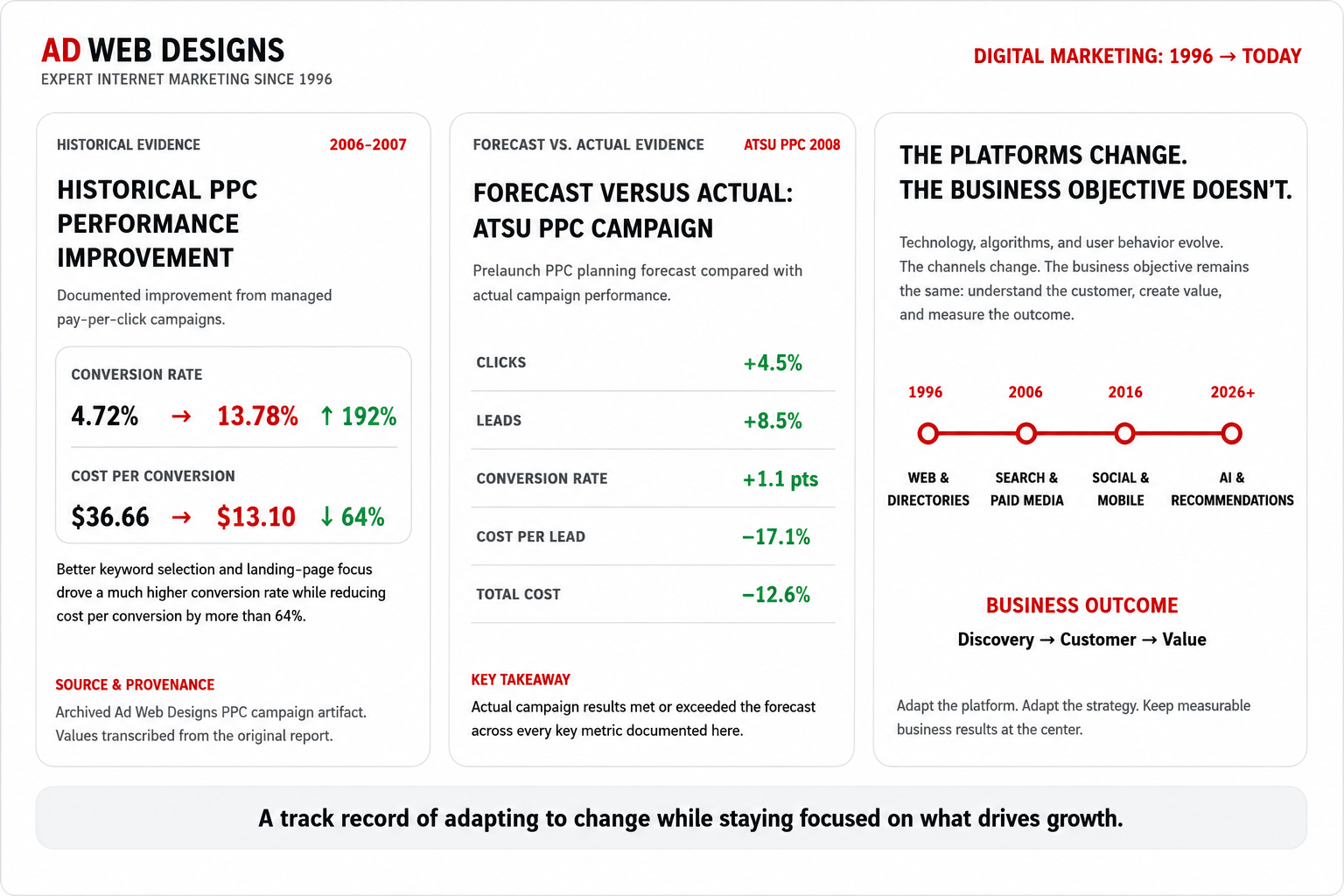
Where the evidence exists, compare what was predicted before execution with what actually happened.
Documented examples of search, paid media and digital marketing performance.
Customers are no longer discovering businesses only through a traditional list of search results.
Search engines, AI assistants and generative search systems can interpret information from multiple sources, construct answers, cite sources and recommend businesses without following the traditional search-results path.
That creates a different kind of visibility problem.
A business can rank well in traditional search and still be poorly understood or represented by AI systems.
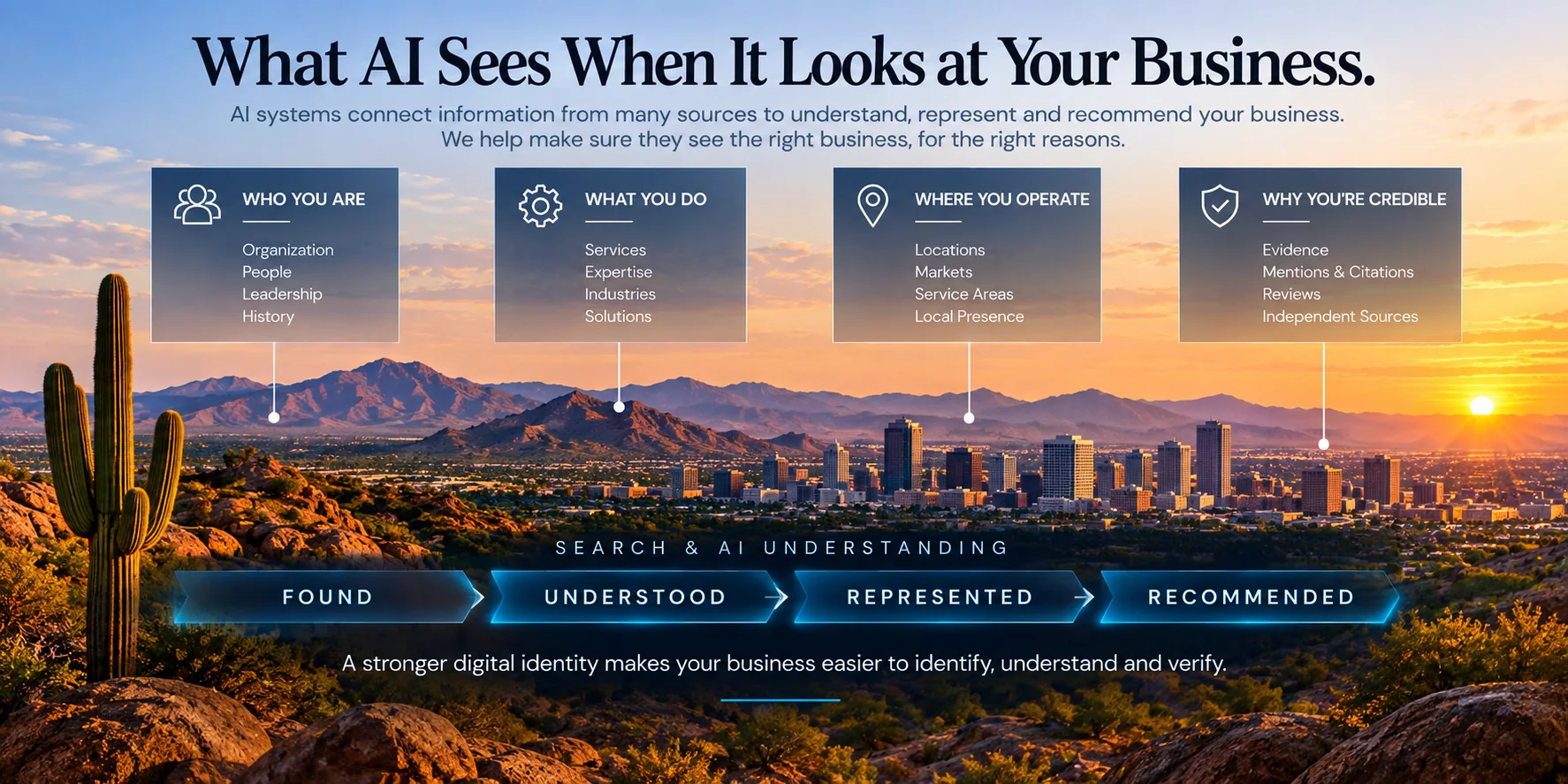
These systems need enough consistent, credible information to determine who the business is, what it does, who is associated with it, where it operates, what it is known for and what evidence supports those conclusions.
If that digital identity is incomplete, inconsistent or ambiguous, the business may be overlooked, incorrectly represented or absent from relevant answers and recommendations.
We examine and strengthen the signals that help search engines and generative AI systems understand the business.
That can include the website, organization and person entities, service relationships, structured data, content, citations, authoritative references, business profiles, directories, reviews, external mentions and other supporting evidence.
The objective isn’t to scatter more mentions of your company around the internet.
It’s to make the business easier to identify, understand and verify.
We start with a baseline and measure what can actually be measured.
That can include relevant AI and search visibility, citations and mentions, accuracy of business representation, branded discovery, referral traffic from measurable AI platforms, assisted conversions, leads and downstream business outcomes where attribution is available.
Where revenue can be attributed, we measure it.
Where it can’t, we don’t manufacture an ROI number.
A ranking isn’t a business outcome.
A click isn’t a business outcome.
An AI citation isn’t a business outcome.
What happens next is what matters.
A click doesn’t have the same value everywhere. Neither does a lead.
A signed legal case is different from a university enrollment. A real estate transaction is different from an ecommerce purchase.
Customer value, buying cycles, competition, conversion paths and acceptable acquisition costs all change.
Digital strategy, search, paid media, attribution and acquisition economics for highly competitive legal markets.
Student acquisition strategy connecting search demand, paid media, program economics and enrollment funnels.
Search visibility, paid acquisition, lead generation and digital strategy for competitive real estate markets.
Maybe you need more SEO.
Maybe paid search needs work.
Maybe your conversion rate is quietly making every advertising channel more expensive.
Maybe attribution is giving credit to the wrong thing.
Maybe competitors understand something you don’t.
Maybe AI is changing how customers discover your business.
Or maybe the biggest opportunity is somewhere nobody has looked yet.
Tell us what’s happening, what you’re trying to accomplish and what you’ve already tried.
We’ll start there.
