SEO & Search
SEO is the work of making useful information easier to discover through organic search and ensuring the page deserves the visibility it receives.
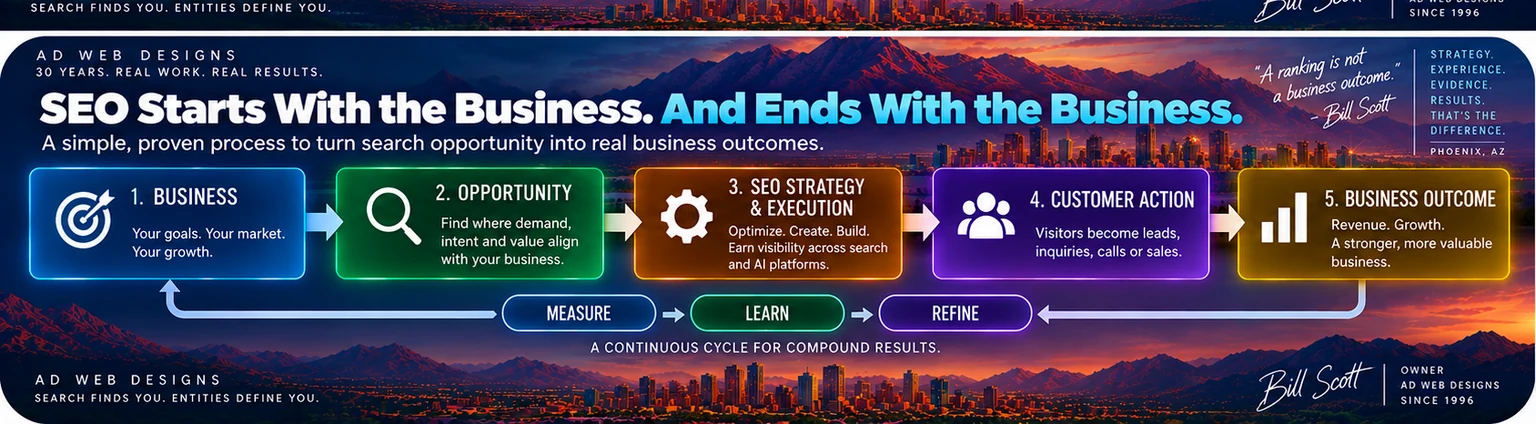
At Ad Web Designs, SEO starts with the business. We look at what the organization is trying to accomplish, what customers are searching for, what the existing data tells us, where competitors are strong or weak, and which search opportunities have enough commercial value to justify the work.
Technical eligibility matters. Rankings matter. Traffic matters. But none of them is the final objective. The objective is to turn organic visibility into something useful for the business.
Search Visibility Is a Business Decision
SEO is often presented as a list of tactics: keywords, titles, links, content, technical fixes and rankings. Those things can matter, but they are not the strategy by themselves.
The strategy starts earlier.
What does the business sell? Which products or services matter most? Which customers are valuable? Which markets are priorities? What does a qualified customer look like? What is the economic value of a lead, sale, appointment or signed case? What does the company already know from paid search, analytics, sales, customer conversations and previous marketing?
Those questions determine which search opportunities deserve attention.
A keyword with more search volume is not automatically a better keyword. A ranking that creates little business value is not automatically a better ranking. Ad Web Designs looks for the intersection between search demand, customer intent, competition, business economics and the organization’s ability to satisfy the search better than the alternatives.
SEO Is Bigger Than Rankings
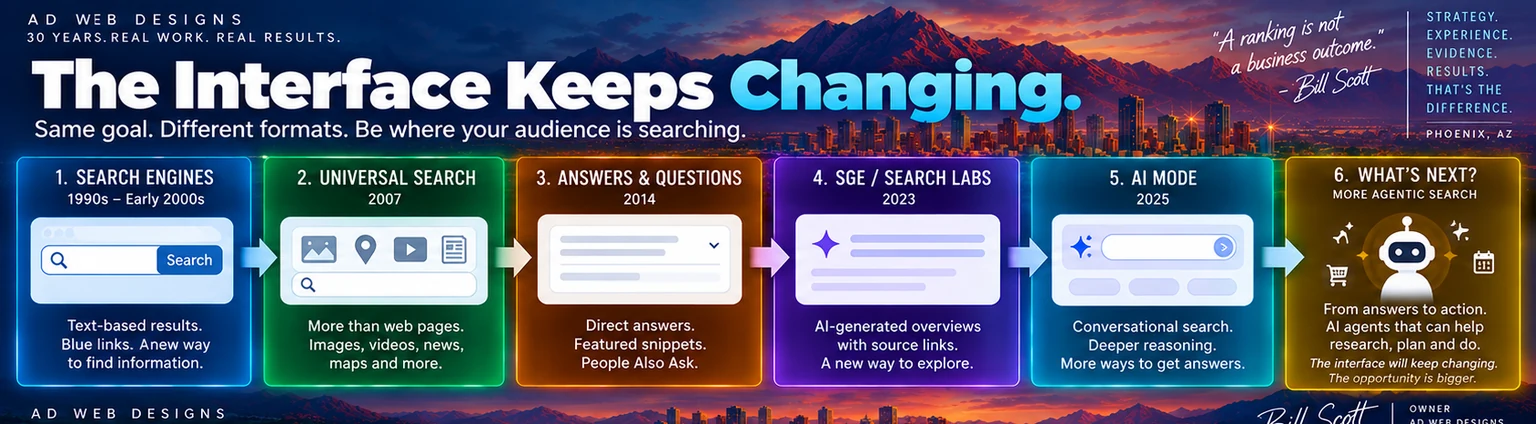
Traditional search engine optimization focused heavily on improving a page’s ability to rank in a list of search results. That foundation still matters, but the search environment has expanded.
Search results can now include traditional organic listings, maps, images, videos, featured answers, People Also Ask results, shopping features, AI-generated summaries and conversational search experiences. The interface changes, but the underlying challenge remains familiar: help the right audience discover the right information at the right time.
That means modern SEO requires more than placing keywords on pages. Search engines need to access the content, understand what it is about, connect it to the correct organization or person, determine whether it satisfies the searcher’s task, and decide whether the source deserves visibility.
The business then has another job. Once visibility is earned, the page still has to persuade the visitor to do something useful.
Technical SEO Determines Whether the Opportunity Is Even Available
Strong content cannot compete if search engines cannot reliably access, render, understand or index it.
Important pages need to be crawlable, internally discoverable and technically eligible for search. Canonicals, redirects, status codes, robots directives, XML sitemaps, JavaScript rendering, duplicate URLs, broken links, mobile issues and site architecture can all interfere with otherwise useful pages.
Technical SEO is therefore not separate from content strategy. It establishes whether the content strategy has a chance to work.
Ad Web Designs reviews the technical condition of the site first because optimization built on unstable technical foundations creates unnecessary work. A page should not be rewritten three times when the actual problem is that Google is indexing the wrong version of the URL.
Search Intent Is More Than a Keyword
The same phrase can represent research, comparison, navigation or immediate commercial action. Two keywords with similar wording can have very different economic value.
Ad Web Designs evaluates what the searcher appears to be trying to accomplish and what kind of page is best suited to that task. We also look at the search results themselves. The existing results often reveal what Google believes the query requires: a service page, product page, local result, comparison, guide, calculator, video, answer or another format.
The goal is not to mechanically repeat the query. The goal is to own the search task.
That distinction matters most in competitive markets. If ten competitors already publish nearly identical information, producing an eleventh version may add little value. A stronger opportunity may require better evidence, better organization, first-hand experience, a more useful decision framework, original data, clearer explanations or stronger alignment with what the customer is actually trying to decide.
Clear Topic Ownership Prevents a Site From Competing With Itself
When several pages attempt to satisfy the same intent, the site makes the reader and the search engine decide which version matters.
Ad Web Designs gives each important topic a clear primary page. Supporting content should deepen the subject, answer adjacent questions or provide evidence rather than duplicate the primary page.
This is especially important as websites grow. Years of blog posts, old landing pages, service variations, location pages and campaign pages can create overlapping topic ownership. The result can be cannibalization, weak internal linking, diluted authority and confusing search signals.
A strong SEO architecture makes the relationships explicit. The service page owns the commercial service. Supporting content explains the subject. Evidence supports claims. Person and organization pages establish authorship and identity. Related services connect where the relationship is useful.
More Content Is Not Automatically Better Content
A longer page is not automatically more useful, and publishing more pages is not automatically a better SEO strategy.
The stronger opportunity is often replacing generic material with something the competing pages do not provide. That may include first-hand expertise, original analysis, examples, tools, local knowledge, historical perspective, real evidence, better comparisons or a clearer explanation of the decision the customer is trying to make.
Ad Web Designs looks for information gain rather than commodity expansion.
If twenty pages already explain the basic definition of a topic, repeating the same definition in slightly different words does not create much competitive advantage. The useful question is what the organization knows, can demonstrate or can explain that improves the searcher’s understanding.
SEO Does Not Have to Operate in a Vacuum
Organizations with existing marketing history often possess information that can improve SEO decisions.
Paid search can reveal which queries attract clicks, which terms cost the most, which searches produce leads and which traffic ultimately converts. Analytics can show landing-page behavior, conversion paths, geographic differences and the relationship between channels. Sales and CRM data can identify which leads actually become customers.
That does not mean PPC data automatically determines SEO strategy. Paid and organic search behave differently. But real customer behavior is often more useful than building an SEO plan entirely from keyword-volume estimates.
Ad Web Designs has used this principle for years: learn from the data already being generated, identify commercially important demand, then decide where organic visibility can reduce acquisition dependence, expand reach or strengthen the overall marketing system.
A search term that costs significant money to acquire through advertising may deserve a closer look organically. A high-volume phrase that generates poor customers may deserve less attention than its keyword volume suggests.
The SEO Starting Point Depends on What the Business Already Knows
A startup and an established company should not automatically receive the same SEO plan.
A startup may have limited historical data. Search strategy begins with hypotheses about the market, customer, language, competition and acquisition economics. Measurement has to be designed early because the business still needs to learn which assumptions are correct.
An established company may already have years of search data, advertising history, analytics, CRM information, existing rankings, backlinks, content and technical baggage. The first job is often to understand what is already working, what is wasting resources, which assets should be preserved and where the largest incremental opportunity exists.
An established company entering a new market or launching a new service may require a hybrid approach. The organization has historical knowledge, but the new opportunity still contains unknowns that need to be tested.
The principle is simple: determine what is known, what is unknown and what needs to be proven based on where the business is in its lifecycle.
SEO Begins With Diagnosis, Not a Predetermined Package
The first step is understanding the business and the existing search environment.
Ad Web Designs reviews the site, priority products or services, markets, competitors, current search visibility, technical condition, existing content, internal architecture, available analytics and any useful paid-search or conversion data.
From there, we identify where the opportunity appears to be.
That may mean fixing technical problems before creating more content. It may mean consolidating competing pages. It may mean rebuilding weak commercial pages. It may mean improving internal links, clarifying entities, expanding topic coverage, strengthening local visibility, incorporating evidence or targeting valuable search demand that the business is currently paying to acquire.
The recommendation follows the problem. The problem does not get forced into a predetermined SEO package.
Typical early-stage work can include:
- Business and market review
- Search-demand and competitive analysis
- Technical SEO audit
- Indexation and crawl review
- Existing-page and content inventory
- Keyword and search-intent mapping
- Primary-page ownership analysis
- Internal-link architecture review
- Entity and authorship review
- Local-search review where relevant
- Conversion-path review
- Analytics and measurement assessment
The output should be a prioritized search strategy, not a pile of disconnected recommendations.
Once the Opportunity Is Clear, Execution Becomes More Focused
Execution can include technical corrections, page architecture, content development, on-page optimization, internal linking, local optimization, entity clarification, structured data, digital PR, authority development and conversion improvements.
Not every project needs every tactic.
A site with strong authority but poor architecture may need consolidation and internal linking more than new content. A technically sound site with weak commercial pages may need better page strategy. A local business may have significant opportunity in Google Business Profile and location relevance. A company entering AI-mediated discovery may need clearer entities, authorship, evidence and source relationships.
The work should follow the opportunity identified during diagnosis.
Internal Linking Is Architecture, Not Decoration
Internal links help readers understand what to explore next, and they help search systems understand relationships between pages.
A strong internal-link structure connects the organization, people, services, industries, supporting information, evidence, research and conversion paths in a way that reflects how those concepts actually relate.
Ad Web Designs does not treat internal linking as a requirement to insert a certain number of links on every page. The purpose is to create useful relationships.
On this site, for example, SEO connects naturally to AI Search & Visibility, Entity Optimization, Conversion Optimization, Analytics, Attribution & ROI and Results & Evidence. Each page owns a different part of the subject rather than repeating the same page under multiple URLs.
Traditional Search Foundations Still Matter in AI-Mediated Discovery
AI search does not eliminate the need for technical accessibility, useful information, strong source material or clear relationships between people, organizations, services and evidence.
It does increase the importance of clarity.
A business should be identifiable. Important people should be attributable. Services should have clear ownership. Claims should have evidence. Pages should explain relationships rather than leave them implied.
That is where SEO increasingly intersects with entity optimization and AI-search visibility.
Ad Web Designs treats those disciplines as connected but not interchangeable. SEO remains the broader organic-search discipline. Entity optimization reduces ambiguity about identifiable things and their relationships. AI-search work evaluates how those same sources may be discovered, interpreted, cited or recommended through newer interfaces.
The platforms change. The requirement to be understandable and useful does not.
SEO Claims Should Be Supported by Something Better Than Confidence
SEO is full of claims that are easy to publish and difficult to prove.
Ad Web Designs uses an evidence standard that separates documented facts, professional experience, historical artifacts, measurements, interpretation and assumptions.
A ranking screenshot can establish visibility at a particular point in time. It does not automatically establish traffic, leads or revenue. Analytics can establish measured activity during a period. It does not automatically establish causation. Employer work should be attributed to the employer rather than presented as an Ad Web Designs client result.
The same discipline applies to strategy. We want to know what the evidence actually supports, where the boundaries are and what still needs to be tested.
That approach is documented in the Results & Evidence archive.
Visibility Matters When It Creates Business Value
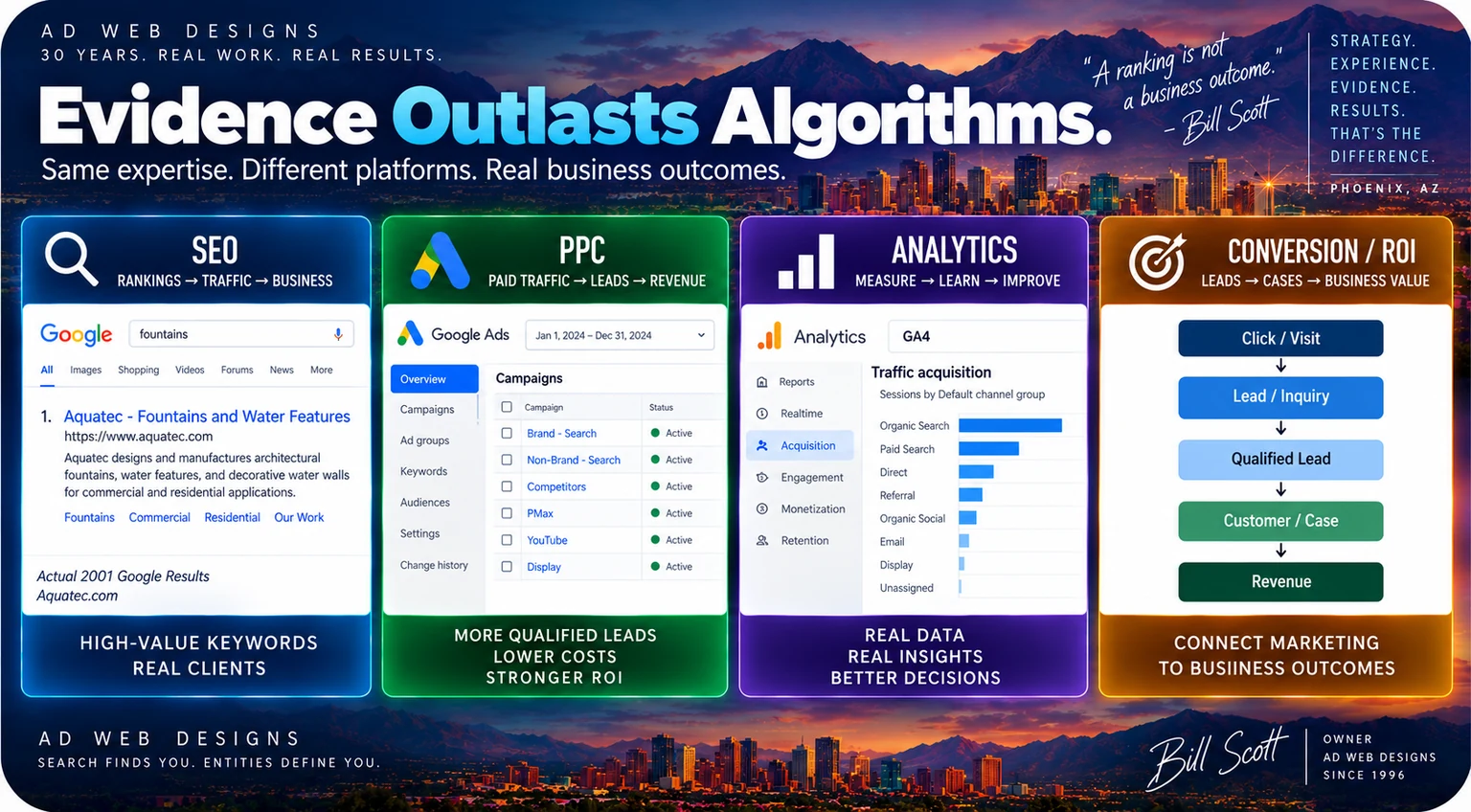
Rankings are useful diagnostic signals, but rankings are not the bank deposit.
Organic performance may include qualified traffic, calls, forms, purchases, consultations, appointments, assisted conversions, branded demand, index coverage and visibility for strategically important searches.
The correct measurement depends on the business model.
A local professional-services business may care about qualified calls and consultations. Ecommerce may care about revenue, margin and customer acquisition. A long-consideration business may need to understand assisted conversions rather than expecting every organic visit to convert immediately.
Ad Web Designs tries to connect marketing activity to the deepest reliable business outcome available.
You don’t take clicks or leads to the bank. You take conversions to the bank.
SEO Is an Operating Process, Not a One-Time Checklist
After the initial strategy and major corrections, ongoing work depends on the opportunity and the rate at which the market is changing.
Monthly work can include reviewing search performance, monitoring indexation, updating priority pages, expanding useful content, strengthening internal links, resolving technical issues, analyzing competitors, improving local visibility, adding evidence, refining conversion paths and responding to changes in search interfaces.
The work should not continue simply because a calendar says another month has passed.
Each cycle should answer a useful question: What changed? What did we learn? What is now the highest-value opportunity?
That creates a continuous loop of measurement, learning and refinement rather than a recurring checklist of activity.
SEO Audit Areas
- Crawl and index eligibility
- Canonical and redirect integrity
- Status codes and broken links
- XML sitemap and robots controls
- Rendering and mobile usability
- Search-demand opportunity
- Intent ownership and cannibalization
- Commercial value of target queries
- Content usefulness and information gain
- Primary-page architecture
- Internal-link relationships
- Entity clarity and authorship
- Evidence and claim quality
- Local search visibility where relevant
- Structured data where useful
- Page experience and conversion paths
- Organic conversions and downstream outcomes
- Analytics and measurement integrity
SEO Works Best When the Business Wants Decisions, Not Activity
Ad Web Designs is a better fit for businesses that want to understand why SEO work is being recommended and how it connects to the business.
That often includes organizations operating in competitive markets, companies spending meaningful amounts on paid acquisition, businesses with existing search history that has never been fully analyzed, and leadership teams trying to connect SEO to revenue rather than treating it as a separate technical department.
It can also fit businesses preparing for AI-mediated discovery and wanting to make sure their organization, expertise, services and evidence are clearly represented across the web.
The goal is not to sell the largest possible SEO package. The goal is to identify the highest-value search opportunity and determine what work is justified by that opportunity.
Frequently Asked Questions
What is SEO?
SEO improves a website’s technical eligibility, relevance, usefulness and discoverability in organic search. Ad Web Designs also evaluates whether the resulting visibility contributes to meaningful business outcomes.
What happens first if I hire Ad Web Designs for SEO?
We begin by understanding the business, search opportunity, existing website, competition, available data and current technical condition. Recommendations are then prioritized around the highest-value problems and opportunities.
Do you start with keyword research?
Keyword research is part of the process, but it is not the starting point by itself. Business economics, customer intent, competitive conditions and existing performance data help determine which search demand actually matters.
Do you use PPC data to guide SEO?
When reliable paid-search and conversion data exists, it can provide useful evidence about customer language, commercial intent and acquisition economics. It is one input into SEO strategy rather than an automatic substitute for organic-search analysis.
Does AI search make SEO obsolete?
No. Technical accessibility, useful information, source quality and clear entities remain important. AI interfaces add new discovery and measurement questions, which Ad Web Designs addresses separately through AI Search & Visibility and Entity Optimization.
How long should an SEO page be?
Long enough to satisfy the task and no longer. Information gain matters more than word count. A shorter page that answers the question better can be more useful than a long page filled with repeated commodity information.
How is SEO different from entity optimization?
SEO is the broader organic-search discipline. Entity optimization specifically reduces ambiguity about identifiable organizations, people, services and their relationships.
How do you measure SEO success?
The measurement depends on the business. Rankings and traffic can be useful diagnostic signals, but stronger measurements include qualified inquiries, calls, purchases, consultations, assisted outcomes and other business conversions where reliable attribution is available.
Build Search Visibility That Compounds
Ad Web Designs treats SEO as a durable business asset rather than a collection of rankings.
Technical eligibility, search intent, information gain, entity clarity, evidence, internal relationships, conversion and measurement work together to make useful information easier to discover and more capable of producing business value over time.
The tactics will continue changing because the search interface will continue changing.
The business question remains much more stable: where is the opportunity, what will it take to earn visibility, and did that visibility produce something valuable?
