

The Changing Economics of Search · Follow-up analysis · October 29, 2026
Opinion and analysis by Bill Scott, owner of Ad Web Designs
This article explains a business-model thesis and the author’s stated investment opinion. It does not report a stock transaction or offer a personalized investment recommendation. Illustrative scenarios are not forecasts.
Back in August, I wrote Google Doesn’t Have to Lose Search. It Only Has to Lose Searches. I also discussed the argument on LinkedIn.
The point was never that people would stop looking for information, or that Google would suddenly disappear. The point was that the economics underneath information discovery could change while Google remained a very successful company.
Now the question is becoming more concrete: what happens if usage grows faster than the revenue produced by that usage, while the infrastructure needed to serve it demands substantial investment?
Why I Watch the Economics of Search
I manipulate search for a living. I’ve spent 30 years helping businesses get found through paid search and organic search. I know search engines. I know Google. When I question its future economics, I’m looking at the machinery I’ve worked with since 1996—and asking what happens when AI changes how people use it.
I published this argument in 2026. That isn’t when I started thinking about it. Like doing SEO before I knew people called it SEO, I was too busy doing the work to put a label on it.
That experience informs my perspective. The evidence and reasoning still have to support the prediction.
What Changed on October 29
Alphabet’s Class A shares, GOOGL, closed at $283.82, down $41.07, or 12.64%, on October 29, 2026. Daily price history records the move. Reuters’ market commentary linked the selloff to results below expectations and increased AI-spending concerns. That is a market reaction to several factors, not a controlled test of my theory.
On the earnings call, management said lower monetization in AI Mode contributed to Search’s growth deceleration. It identified currency as the largest driver of the slowdown, alongside advertising changes in particular industries. Management also described AI Mode activity as largely incremental and expressed confidence in its advertising expansion. The earnings-call transcript contains both the monetization concern and the counterargument.
Those distinctions matter. Lower monetization is not the same thing as an unprofitable interaction. Slower revenue growth is not declining revenue. And an internal Google AI interaction is not a customer lost to a competing platform.
The Need Survives. The Intermediary Changes.
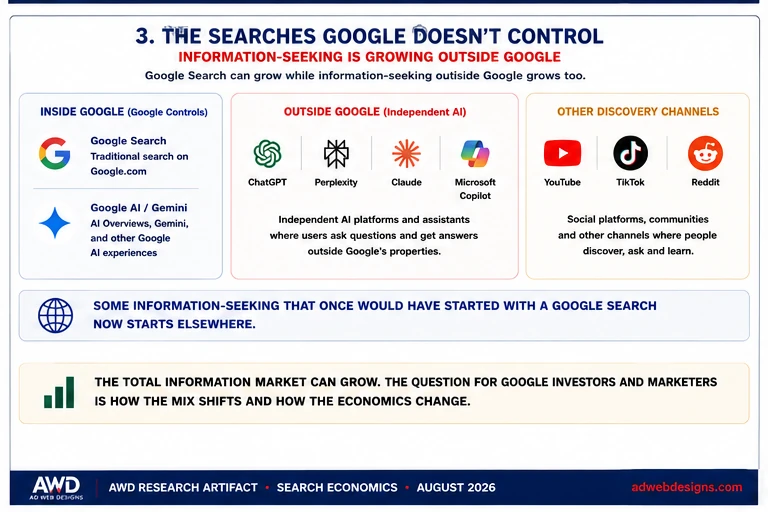
Someone researching a complicated purchase may once have searched for options, visited websites, compared products, searched again, checked reviews and finally made a decision. Some of that work can now happen inside an AI conversation.
I described one possible consequence as query compression. The customer still has the problem. They still want to make a decision. But they may use fewer conventional searches to get there.
Not every prompt replaces a search. Some conversations create new questions. People move among Google, AI assistants, video, forums and websites. The relevant question is which activity substitutes for another activity and which is genuinely additional.
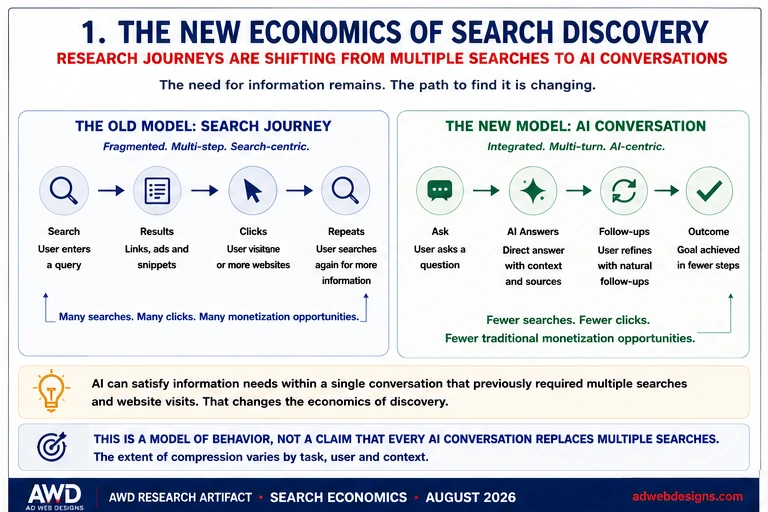
Google Search vs. Google AI: Competing for the Same Research Task
Google can remain the leader in search and still face a search economics problem. The competition is not only Google versus another company. It can also be traditional Google Search versus Google’s own AI experience, competing to serve the same visitor and complete the same research task.
A customer who once used several conventional searches may now complete some of that work in Google’s AI experience. Google may retain the visitor while changing the number and type of search interactions, the opportunities to show ads, and the cost of delivering the answer. That is potential internal cannibalization: keeping the customer does not necessarily mean preserving the economics of the customer’s previous behavior.
This is a plausible mechanism, not a claim that every AI interaction replaces a traditional search or produces less profit. AI can also create new activity and new advertising opportunities. The business question is whether the additional value and efficiency gains outweigh any displaced value and additional costs.
Three Different Outcomes—Three Different Economic Questions
Internal substitution: a traditional Google interaction moves into Google’s own AI experience. Google retains the user, but its revenue and cost per interaction may change.
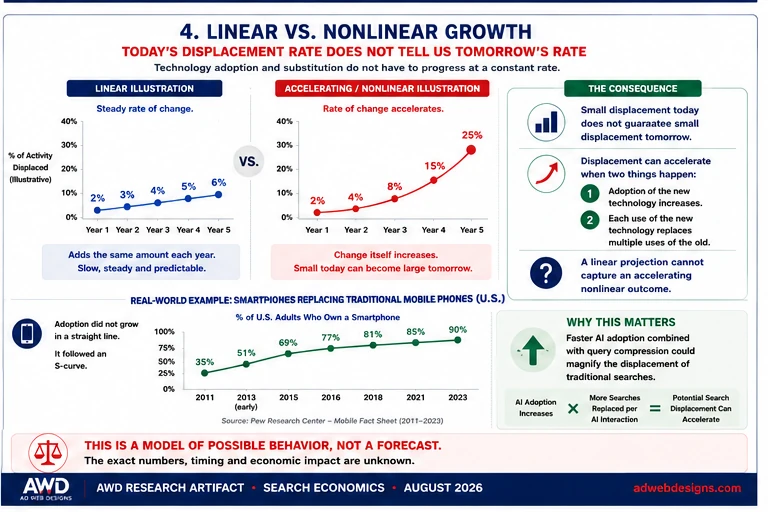
External displacement: an interaction that otherwise would have taken place on Google happens through an independent platform. The question is what commercial opportunity Google would otherwise have captured and what, if anything, it recaptures elsewhere.
New demand: AI enables activity that would not otherwise have happened. That can expand the information market. It does not automatically establish the profitability of serving the new activity.
Adding these categories together and calling the result “AI growth” conceals the economic differences.
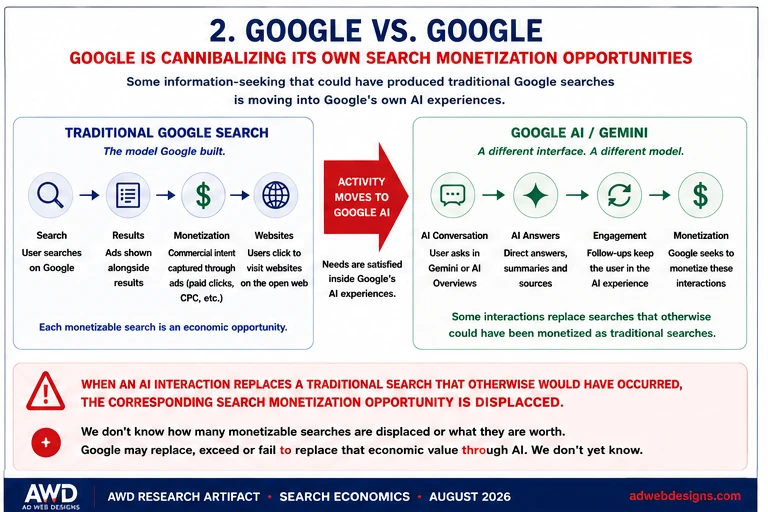
Why a Straight-Line Forecast Can Miss the Risk
AI adoption need not progress at a constant rate. Better products, lower costs, easier interfaces and distribution through everyday software can accelerate use. Habit, trust, mistakes, pricing and regulation can slow it. Adoption can accelerate and later saturate; nonlinear does not mean exponential growth forever.
There are also two separate variables: how many research tasks move, and how many traditional searches each moved task would otherwise have generated.
Consider an illustrative baseline of 100 research tasks, each producing five Google searches. That is 500 searches. If 20 tasks move entirely to an independent AI platform, 100 baseline Google searches are displaced, leaving 400. If only half the Google activity on those 20 tasks is replaced, displacement is 50, leaving 450.
Those examples assume no new tasks, no return visits to Google and a constant five searches per task. They illustrate the arithmetic, not measured adoption or a revenue forecast.
The broader relationship is: baseline tasks × migrated task share × baseline searches per migrated task × substitution fraction. Do not multiply a general AI-user count by an arbitrary number of searches and call it Google’s revenue loss.
The Commercial Mix Matters More Than a Raw Query Count
A weather query and a search associated with a major purchase do not necessarily offer the same monetization opportunity. Neither does every AI conversation carry commercial intent. Losing a fraction of commercially important journeys could matter disproportionately; gaining low-monetization activity could make query growth look stronger than the associated economics.
For the business model, I would examine interactions by type, revenue per interaction, delivery costs and the investment needed to sustain the system. For shareholders, operating earnings, capital expenditure and cash flow all matter. Capital spending is not simply an immediate operating expense: cash leaves before depreciation is recognized over time.
That creates several potential pressures without requiring Google Search to collapse: a less favorable revenue mix, substantial infrastructure cash requirements, and spending needed to defend distribution and improve the product.
Whether those pressures overwhelm AI revenue growth or efficiency gains is an open question. The mechanism is worth analyzing; its eventual magnitude is not established by a single quarter.
The Strongest Argument Against My Bearish View
Google has the distribution, advertiser relationships, engineering capability and capital to compete. AI could increase useful activity, improve advertiser outcomes and become cheaper to serve. Commercial monetization could catch up with usage. Cloud and other businesses could also create value that outweighs pressure on conventional search.
Google’s published CEO remarks emphasize expanding usage and growth. That is relevant evidence. A bearish thesis that ignores the company’s ability to adapt is incomplete.
I would weaken or revise my position if durable cash generation, improving AI economics and credible acquisition and retention evidence showed that Alphabet was capturing more value than the transition was costing it. A changing interface is not automatically a broken business.
My Position Has Become More Bearish
In August, I wrote that I was not betting against Google. My position has changed.
If I owned Alphabet stock, I would sell all of it. That is my current view of the uncertainty around its AI future—not a claim that Google is finished, and not a statement that I have executed a sale.
A company can produce impressive technology and still offer a risk-and-reward profile I would choose not to own. The stock price already reflects expectations about future results. Identifying a business risk does not, by itself, establish the correct valuation or the timing of a market move.
I am not treating one day’s fall as proof of every part of the theory. It is a reason to examine the economics more closely.
What This Means for Business Owners
Your customer’s need survives even when the intermediary changes. The practical response is to build information worth finding, make your business and services understandable and give buyers useful evidence wherever they research.
That is why Ad Web Designs connects organic search, AI visibility, entity clarity, paid acquisition and downstream measurement. Google remains important. It does not define every opportunity on the internet.
My original question still stands: how often does commercially important discovery move, how quickly could that behavior change, and who captures the value afterward?
Google doesn’t have to lose search. The economics can change while it is still winning.
Let’s watch the stock ticker and see what the future holds. I’ll be watching the search economics behind it, too.
Original framework and graphics: Bill Scott / Ad Web Designs, August 2026. Follow-up opinion dated October 29, 2026. Existing graphics are reused as historical explanatory artifacts; they are not financial forecasts or evidence of actual displaced revenue.
