

A $20 click looks expensive next to a $5 click. A $100 click can look outrageous, and in some industries advertisers routinely encounter commercially important searches costing hundreds of dollars per click. The natural reaction is to look at the CPC column and decide the expensive keywords are the problem.
Maybe they are. But cost per click does not tell you whether a keyword is expensive. It only tells you what the click costs.
I’ve managed PPC campaigns since the early days of paid search, and this is one of those lessons that hasn’t changed much even though the platforms have changed enormously. A cheap click that rarely produces a customer can be much more expensive than a high-priced click that consistently produces profitable customers. You don’t know which one is actually expensive until you follow the money far enough through the business.
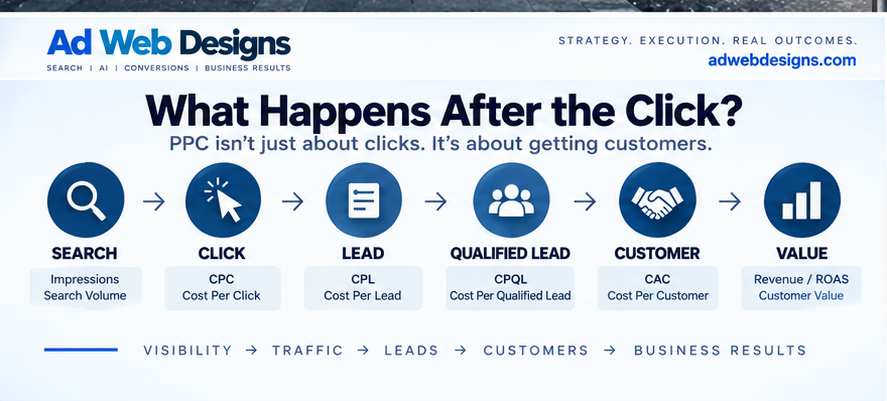
That’s where a lot of PPC analysis goes wrong. We have become very good at measuring impressions, clicks, CTR, conversion rates and cost per lead. All of those numbers are useful, but businesses don’t make money because somebody clicked an ad or filled out a form. The real question is what it cost to acquire the customer and what that customer was worth.
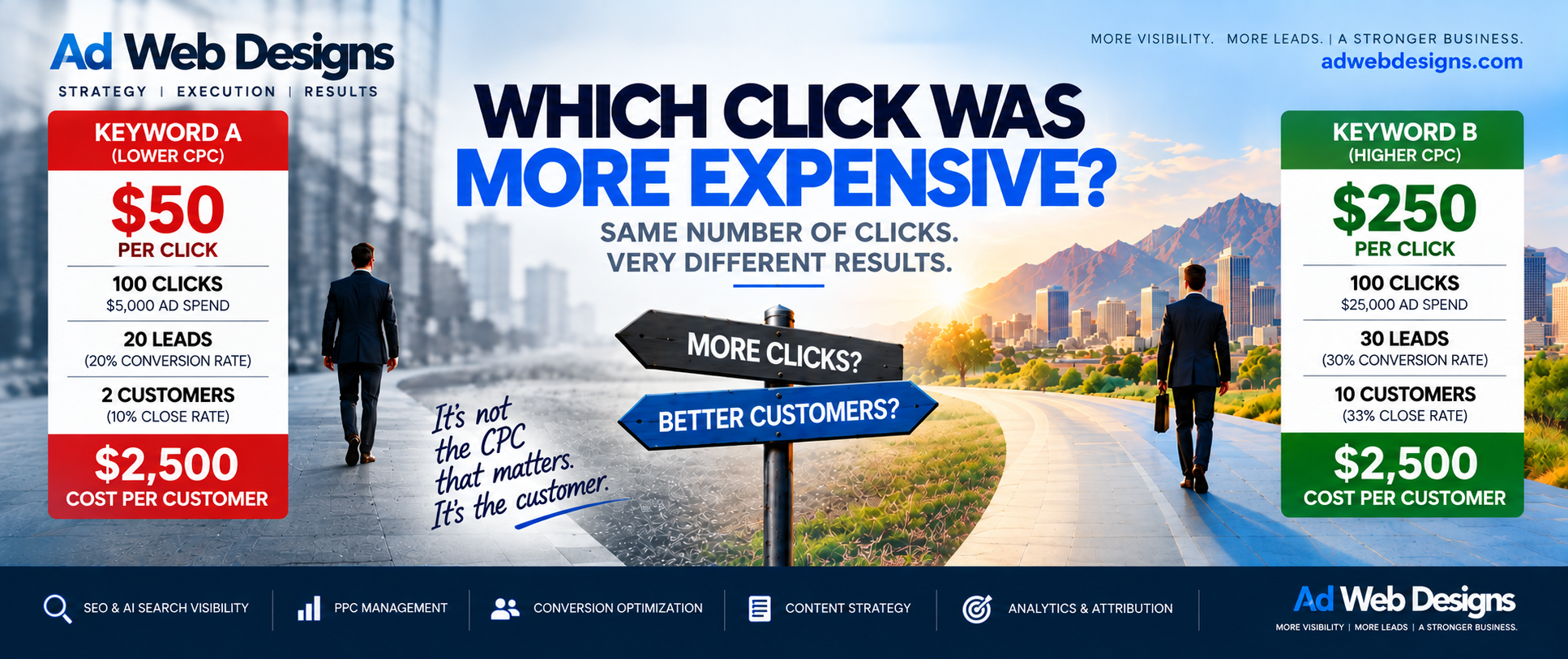
The $50 Click Versus the $250 Click
Here’s a deliberately simple example. Suppose Keyword A costs $50 per click and Keyword B costs $250. If I showed you nothing else, almost anyone would say Keyword A is the better buy. It costs 80% less to bring somebody to the website.
Now let us buy 100 clicks from each keyword.
| Metric | $50 Keyword | $250 Keyword |
|---|---|---|
| Cost Per Click | $50 | $250 |
| Clicks | 100 | 100 |
| Advertising Cost | $5,000 | $25,000 |
| Leads | 20 | 30 |
| Cost Per Lead | $250 | $833 |
| Customers | 1 | 10 |
| Cost Per Customer | $5,000 | $2,500 |
| Customer Value | $13,500 | $13,500 |
| Revenue | $13,500 | $135,000 |
| Revenue / Ad Spend | 2.7x | 5.4x |
The $250 keyword looks worse for quite a while. The CPC is five times higher, total media cost is five times higher, and even the cost per lead looks terrible: $833 compared with $250.
Then we get to customers. The supposedly cheap keyword costs $5,000 to acquire a customer. The expensive keyword costs $2,500. If each customer represents $13,500 in value, the $50 keyword generates 2.7 times advertising spend while the $250 keyword generates 5.4 times spend.
The click that cost five times more produced customers for half the acquisition cost. That example is hypothetical, but the economics behind it are not. Change the CPC, conversion rates, close rates and customer values to the actual numbers for a business and the same calculation tells you something much more useful than simply ranking keywords from cheapest CPC to most expensive.
Cheap Traffic Can Be Very Expensive
There is something psychologically satisfying about inexpensive traffic. More clicks fit inside the budget, dashboards look busier, CPC goes down and everyone feels like the campaign became more efficient. I have seen the same thing happen with cost per lead. If CPL drops, it is very easy to declare victory before determining what happened to the quality of those leads.
The problem is that two people can search for very similar things and have completely different economic value to the advertiser. One person may be doing research. Another may be comparing companies. A third needs the service today. One may never buy anything. Another could become a customer worth tens of thousands of dollars.
This becomes especially important in competitive markets. Expensive auctions aren’t automatically evidence that advertisers have lost their minds. Sometimes the CPC is high because several businesses have independently determined that the customers behind those searches are valuable. That doesn’t mean you should automatically pay the market price, but it does mean you should understand the economics before deciding the price is too high.
The auction tells us what the market is charging for access to that search. Our business data has to tell us whether we should pay it.
Work Backward From the Customer
I prefer to start PPC planning with the economics of the business rather than a generic CPC benchmark. What is a new customer worth? What percentage of leads become customers? Does the customer buy once or repeatedly? What gross margin or contribution does the customer produce? How much can the company reasonably spend to acquire one? How much additional business can the company actually handle?
Once those questions are answered, we can work backward toward advertising. Suppose a new customer represents $10,000 in economically relevant value and the business is willing to spend $2,000 to acquire that customer. If one out of ten qualified leads becomes a customer, the business can afford roughly $200 per qualified lead. If one out of ten relevant clicks becomes a qualified lead, a $20 CPC could work under those assumptions.
Change the close rate and the allowable CPC changes. Improve the landing-page conversion rate and it changes again. Increase customer value and it changes. Reduce margin and it changes in the other direction.
That’s why I’m skeptical when someone tells me that a particular CPC is ‘good’ or ‘bad’ without telling me anything about the business behind it. There is no universal good CPC. There is a CPC that works within a particular acquisition model and one that doesn’t.
We Were Asking These Questions Years Ago
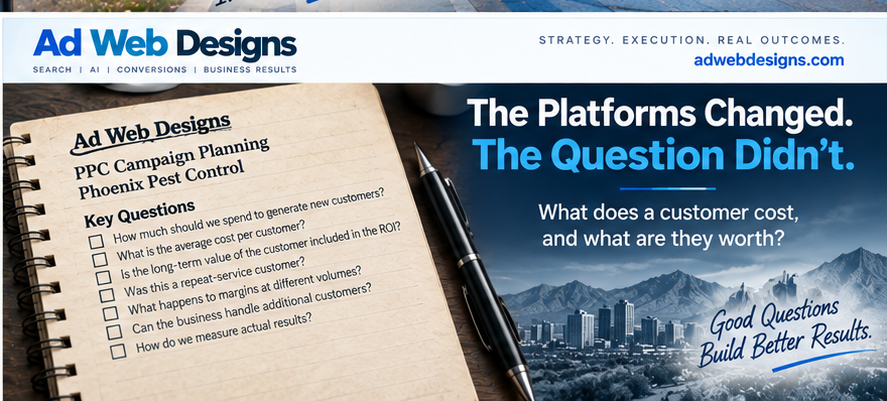
I went back through some old Ad Web Designs material while rebuilding this site and found a PPC planning document for a local pest-control business. It’s useful because it shows how little the underlying business question has changed.
One model projected approximately $932 in click spend. A more aggressive version projected about $4,132, with individual keyword CPCs reaching roughly $16 to $21. Instead of simply deciding that the higher bids were too expensive, the planning document asked how much the company should spend to acquire 100 new customers, how average customer acquisition cost was being calculated, whether long-term customer value belonged in the ROI calculation and whether repeat service changed what a new customer was worth.
Those are still the questions I would ask today. Google Ads is almost unrecognizable compared with the paid-search systems we were managing years ago. Automated bidding, machine learning, audience signals, offline conversions and value-based optimization have changed what is possible. But none of that changed the fundamental business equation. Advertising has to acquire enough economic value to justify what was spent acquiring it.
Cost Per Lead Can Fool You Too
Moving from CPC to cost per lead is an improvement, but it still isn’t far enough downstream for many businesses.
Imagine two campaigns. One generates leads for $200 and the other generates leads for $600. The $200 campaign looks dramatically better until we discover that only 5% of those leads become customers while 25% of the $600 leads become customers. The first campaign is acquiring customers for $4,000. The supposedly expensive campaign is acquiring them for $2,400.
This is why lead quality matters so much. A campaign can improve its reported CPL while the economics of the business get worse. If the system finds more people willing to submit a form but fewer people likely to buy, the dashboard can look better at exactly the same time the campaign is becoming less valuable.
That problem becomes even more important as advertising platforms automate more decisions. An automated bidding system can only optimize toward the information it receives. If we tell the system every lead is equally valuable when the business knows they are not, we should not be surprised when it becomes very efficient at generating the wrong kind of conversion.
Get the Measurement Closer to the Business Outcome
One of the biggest improvements in paid search has been our ability to connect advertising activity with events that happen after the website conversion.
A click can produce a phone call or form submission, but the important business event may happen hours, days or weeks later. The lead gets qualified. A salesperson talks to the prospect. A contract gets signed. A legal case is accepted. A vehicle is sold. A student enrolls. Revenue is collected.
Those later outcomes are where we begin learning what the original traffic was actually worth. Google Ads supports conversion values and the import of offline outcomes, making it possible in appropriate situations to send better information back into the advertising system. Instead of telling Google only that a lead occurred, the advertiser can potentially distinguish outcomes much closer to actual business value.
We have built this type of attribution around identifiers such as GCLIDs so an advertising interaction can ultimately be connected to a downstream outcome. That changes the PPC conversation. Instead of asking which keyword produced the cheapest form fill, we can start asking which search produced customers, cases, sales or revenue.
High CPC Does Not Excuse Bad PPC
None of this is an argument for paying whatever Google asks. In fact, expensive traffic makes good campaign management more important because mistakes become costly very quickly. Weak search-term control, irrelevant queries, poor landing pages, bad geography, slow follow-up, broken tracking and low-quality conversion signals can burn through a substantial budget before anyone realizes what happened.
If I’m paying $200 for a click, I want to know a lot more than how many people clicked the ad. I want to know what they searched, whether the search represented the intent we wanted, what happened on the landing page, whether they contacted the business, whether they were qualified, whether they became a customer and, when practical, what that customer was worth.
The purpose of understanding downstream value isn’t to rationalize high CPC. It’s to know when a high CPC is justified and when it isn’t.
Sometimes the PPC Problem Isn’t PPC
There is another reason I don’t like evaluating keywords strictly by CPC: the advertising account doesn’t control everything that happens after the click.
Suppose we’re paying $100 per click and 5% of those visitors become qualified leads. If changes to the landing page improve that rate to 10%, the CPC didn’t move at all. The same keyword, the same auction and roughly the same media cost now have very different acquisition economics.
The same thing can happen farther down the funnel. If the intake team answers more calls, salespeople respond faster or the company improves its close rate, the amount it can economically afford to pay for qualified traffic may increase.
This is why paid search, conversion optimization and attribution should not live in completely separate boxes. Sometimes what looks like an expensive-keyword problem is really a landing-page problem. Sometimes it is a sales problem. Sometimes it is an attribution problem. And sometimes the keyword really is too expensive. The numbers should tell us which one we are dealing with.
Search Terms Tell You Something About the Market
Search advertising has another advantage that is easy to overlook: people tell us what they want. Search-query data can reveal urgency, geography, product preference, price sensitivity, problem severity and commercial intent. It can show us how prospective customers describe a problem rather than how the company describes its own service. That information can improve PPC, but it can also inform SEO, landing pages, content, offers and broader marketing strategy.
This is another reason I would not automatically eliminate an expensive keyword simply because it is expensive. First I want to understand what kind of demand is sitting behind it and what happens to that demand after we buy it.
If the keyword consistently produces poor customers, reduce it or eliminate it. If it consistently produces profitable customers, it may deserve more investment. If it is close to working, perhaps the opportunity is improving conversion rather than abandoning the traffic.
The Metric I Care About Changes as the Data Gets Better
Early in a campaign, we may have to make decisions using CPC, search terms, conversion rate and cost per lead because that is the data available. As the campaign matures and attribution improves, I want the measurement to move closer to the business outcome.
That progression matters because every step gives us a better answer to the question we were trying to solve in the first place: Did spending this advertising dollar create enough economic value to justify spending it?
That is also a much better conversation to have with a business owner or marketing director. “Average CPC increased 18%” may be important operational information. But it does not tell management whether marketing performance improved or deteriorated. “Customer acquisition cost decreased 12% while average customer value remained stable” tells us considerably more.
So What Is an Expensive Keyword?
After nearly three decades of doing this, my definition is pretty simple. A keyword becomes expensive when the cost of acquiring the customers it produces no longer makes economic sense for the business. A keyword is not cheap simply because its CPC is low, and it is not expensive simply because its CPC is high.
There are plenty of reasons to fight for lower CPCs. There are plenty of keywords that deserve to be paused. There are also auctions where paying substantially more than the average advertiser would ever consider can be perfectly rational because the customers are worth substantially more.
The trick is knowing the difference. That requires following the advertising far enough past the click to understand what happened to the money.
You do not take clicks or leads to the bank. You take conversions to the bank. And sometimes the most expensive click on the screen turns out to be the cheapest customer in the account.
You do not take clicks or leads to the bank. You take conversions to the bank.
Related Ad Web Designs resources
Paid Search / PPC · Analytics, Attribution & ROI · Conversion Optimization
About Bill Scott
Bill Scott is the owner of Ad Web Designs and has worked in digital marketing since 1996. His work has included PPC, SEO, conversion optimization, analytics and attribution across local services, higher education, automotive, financial and highly competitive professional-service markets.
Ad Web Designs evaluates paid search as a customer-acquisition system, connecting search demand with conversion performance and downstream business economics rather than judging campaigns by isolated platform metrics.
