

I’ve been working in search marketing since the early commercialization of the web, and rankings have always been one of the easiest things in SEO to show a client.
“You were #18. Now you’re #6.”
Great. I’d rather be #6 than #18 too.
But what did it do for the business?
That second question is where the conversation gets more interesting.
A ranking is important. Traffic is important. Leads are important. I’ve spent most of my career trying to improve all three. But none of them, by themselves, are the final business outcome.
You don’t take rankings to the bank. You don’t take clicks to the bank. Ultimately, a business needs customers, cases, sales, revenue or some other economically meaningful result.
That doesn’t make rankings unimportant. It means we need to understand what a ranking is actually worth.
Being #1 Doesn’t Automatically Make It Your Best Keyword
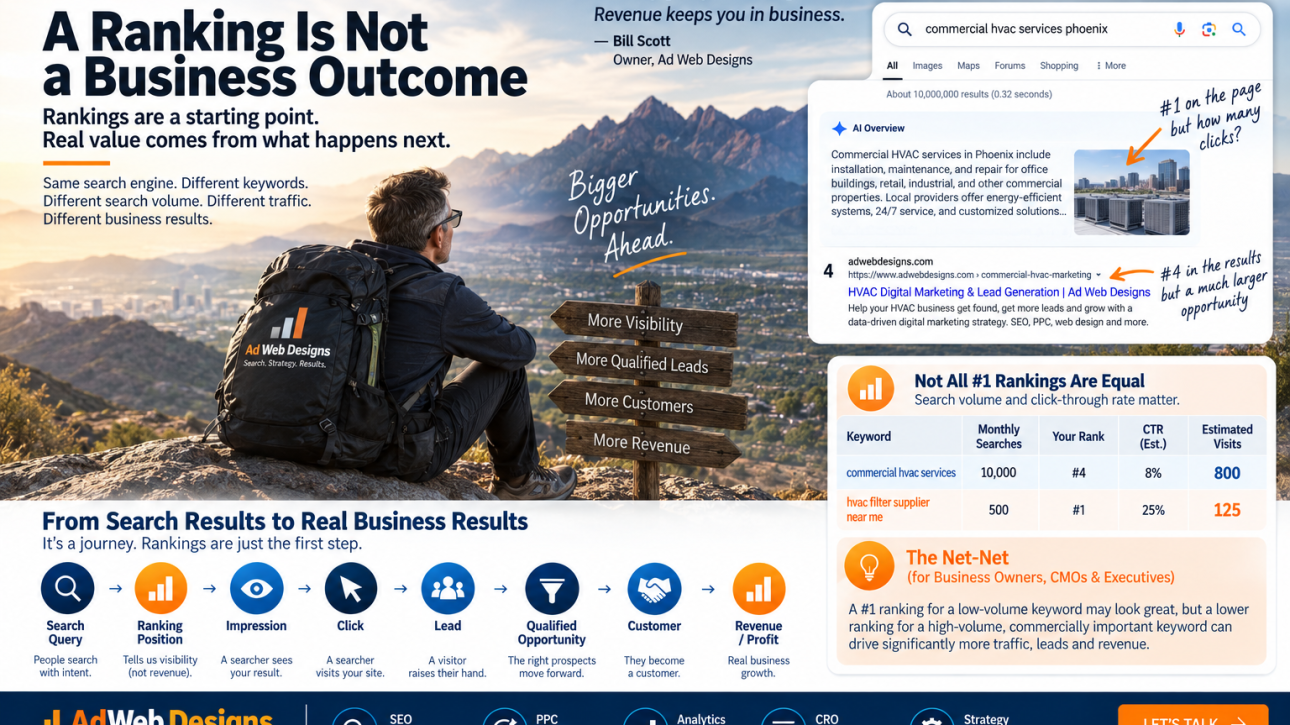
Here’s a simple example. Suppose you’re #1 for Keyword Y and it gets about 500 searches a month. Now suppose you’re only #4 for Keyword X, but Keyword X gets 10,000 searches a month.
Which ranking would you rather have? You don’t have enough information yet. That’s the point.
For illustration, let’s say the #1 result for Keyword Y gets a 25% click-through rate. That could produce roughly 125 visits. Now let’s say your #4 result for Keyword X gets only an 8% click-through rate. Because the search volume is so much greater, that could produce roughly 800 visits.
So you can be #1 for one keyword and #4 for another—and the #4 ranking can potentially send more than six times as much traffic.
The CTR percentages in this example aren’t intended as universal Google benchmarks. Actual click-through rates vary by query, intent, SERP layout, ads, local results, AI features, brand recognition and plenty of other factors. Search-volume numbers are estimates as well; they aren’t a count of guaranteed available clicks.
Ranking position without search demand doesn’t tell you how much opportunity you’re actually capturing.
And we’re still only talking about traffic.
Share of Search Demand Matters Too
Let’s take the same example one step further. Suppose all of the commercially relevant searches we’re tracking in our simplified keyword set total 20,000 searches per month.
Keyword X has 10,000 searches. That’s 50% of the measured search demand in this example. Keyword Y has 500 searches, representing only 2.5%.
So which would you rather have: #1 for a keyword representing 2.5% of the measured demand, or #4 for one representing 50%?
Again, we still don’t have enough information. We need to know what those people are actually looking for and what they do after they reach the website.
That’s why I don’t like judging SEO by simply counting #1 rankings or even Top-10 rankings. A hundred ranking improvements on searches representing very little relevant demand may be less important than moving three commercially important terms that represent a substantial portion of the search opportunity.
The objective isn’t to own the most rankings. It’s to capture the greatest economically useful share of relevant search demand.
Now Let’s Make It a Business Question
This is where SEO reports sometimes lose the business owner.
The report says organic traffic increased 42%. Thirty-eight keywords moved into the Top 10. Impressions increased. Average position improved. All good things.
But if I’m the person paying for the marketing, I have another question: What happened next?
Suppose Campaign A generates 4,800 visits, 96 inquiries, 18 qualified opportunities and four customers. Campaign B generates only 2,100 visits and 71 inquiries—but those become 29 qualified opportunities and 11 customers.
If the average customer in this simplified example is worth $10,000, Campaign A generated $40,000 while Campaign B generated $110,000.
Campaign A won the ranking report. Campaign B won the business.
I’ll take Campaign B.
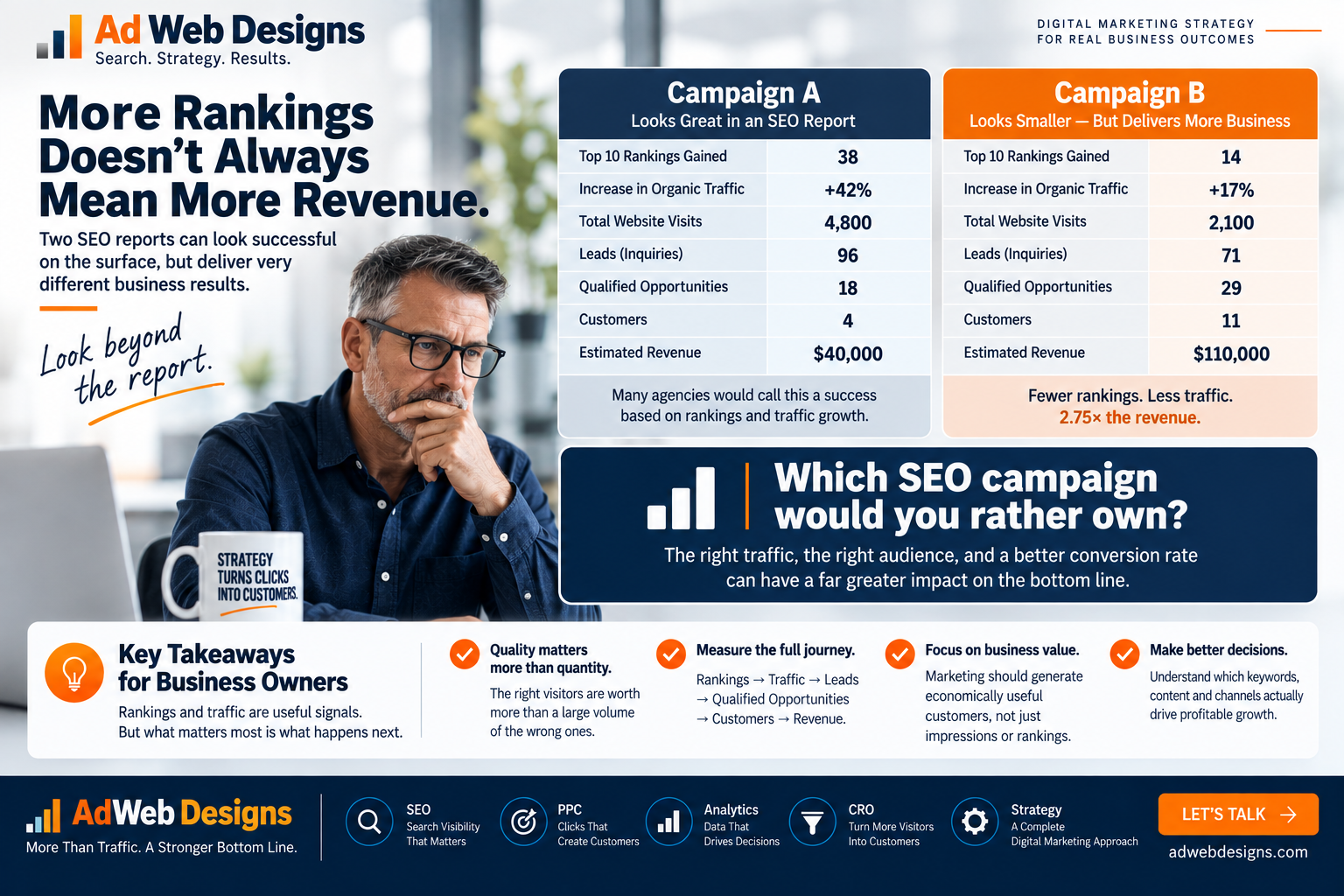
The Campaign A and Campaign B numbers above are illustrative examples, not Ad Web Designs client results.
And even customer count isn’t necessarily the end of the analysis. Ten $500 customers and three $20,000 customers obviously don’t have the same economic value. Depending on the business, margin, lifetime value, repeat business, capacity and other factors can change the answer again.
That’s why the farther downstream we can measure reliably, the more useful the analysis can become.
The Net-Net for a Business Owner
If you’re a business owner, CEO or marketing executive and don’t spend your day inside Google Search Console, GA4 and SEO software, the takeaway is fairly simple: Don’t ignore rankings. Just don’t stop there.
When somebody tells you your SEO is improving, you should understand which searches are improving, how much demand those searches represent and whether they are relevant to what your company actually sells.
Then keep following the customer. Are those searches bringing the right people to the website? Are those people becoming legitimate opportunities? Are those opportunities becoming customers? What are those customers worth?
In plain English: Are the people finding us the people we actually want as customers, and is that visibility producing enough business to matter?
Now we’re talking about marketing.
I Prefer to Measure the Chain Backward
Most marketing reports naturally start at the top:
There is nothing wrong with measuring it that way. We need those numbers to understand where the system is working and where it isn’t.
But when I’m trying to determine what is actually producing value, I also like to work backward:
Start with the result and trace it back. Where did the revenue come from? Which customers produced it? Where did those customers originate? Which leads were actually qualified? Which searches brought those people to us? Where were we visible for those searches?
That changes the discussion considerably. Instead of asking only, “How many keywords went up?”, we can start asking, “Which ranking improvements actually contributed to useful business?”
That’s a much better question.
PPC Taught Us This Lesson a Long Time Ago
Paid search taught us the same lesson years ago.
A $10 click isn’t necessarily better than a $100 click. If the $10 clicks produce poor leads and the $100 clicks consistently produce profitable customers, the expensive traffic can actually be the cheaper customer-acquisition source.
The same principle applies to organic search. Cheap traffic isn’t automatically good traffic. More traffic isn’t automatically better traffic. And a higher ranking isn’t automatically a more valuable ranking.
The value depends on what happens downstream.
I still have PPC reports in the Ad Web Designs archives going back nearly 20 years. In one historical example, conversion rate improved from 4.72% to 13.78% while cost per lead fell from $36.66 to $13.10 after changes to keyword targeting and landing pages.
Different platform. Different era. Same lesson: traffic only becomes valuable when something useful happens after the click.
The platforms have changed enormously since then. The underlying business question hasn’t: What did the traffic produce?
AI Search Makes the Ranking Number Even Less Complete
Search is changing again.
A traditional organic ranking used to have a relatively understandable relationship with traffic. Someone searches, your listing appears, they may click, and they visit your website.
Today’s search result can contain ads, Maps, videos, forums, shopping results, AI-generated answers, traditional organic listings and other features. A company can also be mentioned, summarized, recommended or cited inside an AI-generated answer without receiving the traditional website visit at all.
Think about what that means for a ranking report.
You could remain #1 organically for an important query. Technically, your ranking didn’t change. But if the search experience above and around your result changes substantially, the amount of attention and traffic associated with that #1 position can change.
Same ranking. Different opportunity.
This is another reason ranking reports alone aren’t enough anymore.
The broader search industry is increasingly discussing the same measurement problem. In 2026, we’re seeing more attention paid to connecting SEO visibility and traffic with leads, sales and revenue rather than assuming a ranking improvement proves business value.
I think that’s a healthy change.
Rankings Still Matter
I want to be clear about this because saying “rankings don’t matter anymore” would be just as foolish as treating rankings as the only thing that matters.
Of course rankings matter. If nobody can find you, it becomes considerably harder for search to produce business.
Rankings help us understand visibility. Search volume helps us estimate potential demand. Impressions tell us whether that visibility is actually occurring. Click-through and traffic help us understand how much of the opportunity we’re capturing. Website behavior and conversions tell us what visitors do next.
Leads and qualified opportunities tell us whether we’re attracting people who might actually become customers. Customers, revenue and profit start telling us whether all that activity created something economically useful.
Each number answers a different question. The mistake is asking one number to answer all of them.
One More Number Isn’t the Answer
There’s another mistake we shouldn’t make: replacing rankings with some other single metric and declaring the measurement problem solved.
Revenue without understanding margin can mislead. Leads without qualification can mislead. Conversion rate without customer value can mislead. ROAS without understanding attribution can mislead.
I’m not arguing that marketers need one better number. I’m arguing that we need to understand the system connecting search visibility to the business result.
Sometimes our measurement will be excellent. Sometimes attribution will be incomplete. Some businesses can connect a search all the way to a sale or signed customer; others can’t reliably connect every step.
That’s fine. I’d rather know where the evidence becomes uncertain than pretend we know something we don’t.
What I Actually Want SEO to Do
I don’t want to collect the most rankings.
I want the business to capture the greatest economically useful share of relevant search demand that we can reasonably earn.
Sometimes that means fighting hard to move from #4 to #1. Sometimes #4 is already producing substantial business and the next marketing dollar is better invested somewhere else.
Sometimes a low-volume keyword turns out to produce extraordinarily valuable customers. Sometimes the keyword with enormous search volume produces a lot of people we don’t want.
That’s why strategy can’t end at the ranking report.
A ranking tells us where we appear.
Search demand tells us the size of the opportunity.
The customer tells us whether we reached the right person.
The business outcome tells us whether any of it was worth doing.
I’ve been working with search since the early commercialization of the web. The technology has changed, the search results have changed, and now AI is changing the interface again.
But the question I ultimately want marketing to answer hasn’t changed very much:
What did it do for the business?
Owner, Ad Web Designs
