

For the last couple of years, one question has dominated discussions about AI and search: Will AI replace Google?
I think that’s the wrong question.
Google can remain the world’s dominant search engine. Google Search can continue growing. Gemini can become enormously successful. And Google can still face an economic problem.
Google doesn’t have to lose search. It only has to lose searches.
I’ve spent roughly 30 years working in digital marketing, long enough to watch technologies that initially looked incremental change consumer behavior, advertising markets and sometimes entire industries. I’m not predicting Google’s demise. Quite the opposite. Google may be one of the companies best positioned to benefit from AI. But Google doesn’t own the Internet, and it doesn’t own AI.
The more interesting question is what happens when some percentage of the information-seeking behavior that historically occurred on Google starts happening somewhere else. That percentage doesn’t have to be 100%. It just has to be greater than zero.
Google Can Win Search and Still Lose Searches
Imagine 100 information-seeking activities that historically would have started with Google. Now imagine five of them begin and end on ChatGPT, Claude, Perplexity or another independent AI platform. Google still has 95. In this hypothetical example, Google remains overwhelmingly dominant. Nothing resembling the “death of Google” has occurred.
But something economically important has happened. Those five interactions are no longer potential Google Search monetization opportunities.
We don’t know what they’re worth. Some might have displayed advertising. Others wouldn’t. Some could have represented valuable commercial intent. Others might have had almost no direct economic value. Google could also replace some of that value elsewhere.
But the value cannot reasonably be assumed to be zero. Some searches displaced to competing AI platforms would have produced advertising revenue for Google. We don’t know how much. Google probably has better information for estimating that than anyone else. But “we don’t know how much” shouldn’t be confused with “the amount is zero.”
Google doesn’t have to lose the search market for the economics underneath search to begin changing.
Searching for Information Is Changing
For most of the commercial Web’s history, “searching online” became nearly synonymous with using a search engine. AI has now created another way to search for and work with information.
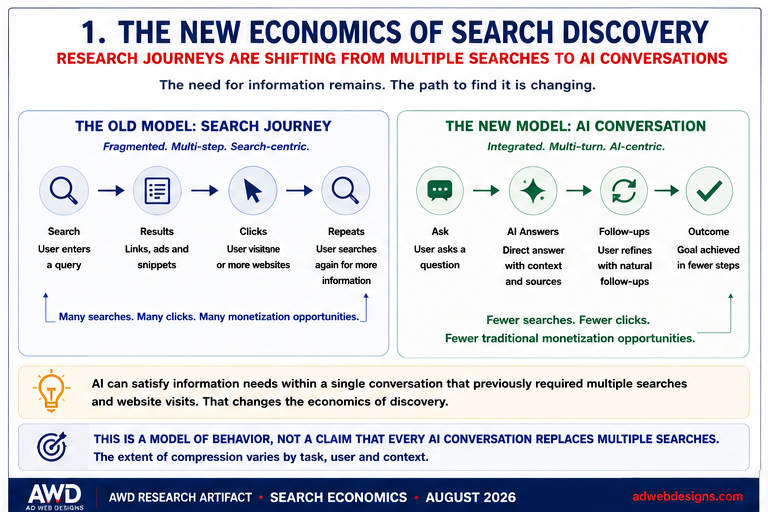
Consider someone researching a complicated purchase. Historically, that might have required searches for the best product, comparisons between two products, reviews, known problems, prices and places to buy. Today, some portion of that research can happen inside a single AI conversation.
The person hasn’t stopped searching for information. They’ve stopped necessarily using a search engine to do it.
I’ve started thinking about one consequence of this as query compression.
Question → Google Search → Website → Google Search → Website → Google Search → Decision
If I was doing SEO right, hopefully Google sent you from one of my sites to another one of my sites somewhere along the way.
An AI-assisted journey can potentially look more like:
Question → AI Conversation → Follow-up → Comparison → Decision
That doesn’t mean one AI conversation always replaces multiple searches. Sometimes AI will create more questions. People will move between AI, Google, YouTube, Reddit and websites. Some AI interactions represent entirely new information-seeking that wouldn’t otherwise have occurred.
But query compression doesn’t need to happen every time to matter.
Suppose 100 research tasks historically generated an average of five Google searches. That’s 500 potential Google searches. Now suppose 20 of those tasks move primarily to competing AI systems. Under the same assumptions, the remaining 80 tasks generate 400 potential Google searches.
That’s 100 potential search interactions displaced in our hypothetical example.
I’m not forecasting 20% displacement, and I’m deliberately not assigning a dollar value to those searches. The point is simpler: if AI substitutes for information-seeking that otherwise would have occurred on Google, Google loses potential Search monetization opportunities with it.
The Number Isn’t Zero. The Velocity Isn’t Necessarily Constant.
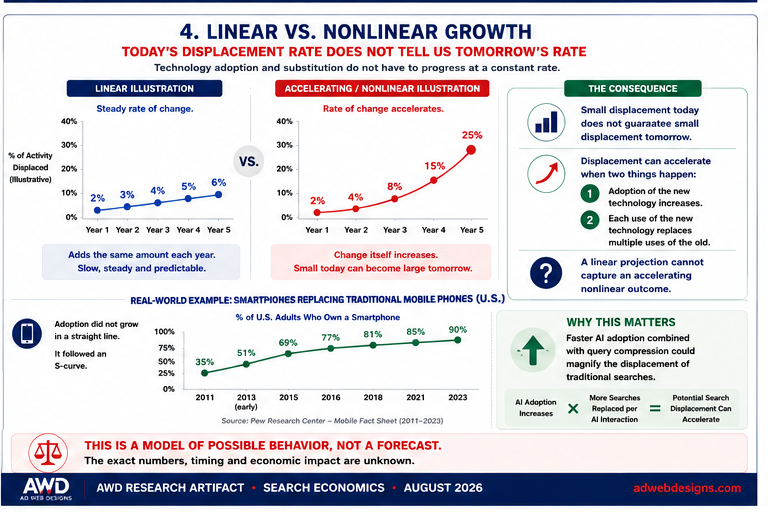
The next mistake would be assuming that whatever displacement exists today will grow in a straight line.
Technology adoption and substitution do not have to progress at a constant rate. Products improve, costs fall, distribution expands and interfaces get easier. New technology gets built into phones, browsers, operating systems and everyday workflows. Then behavior can change surprisingly quickly.
I’ve been around the Internet long enough to remember when plenty of very smart people weren’t convinced consumers would ever be comfortable putting their credit card number into a website. That prediction didn’t age particularly well.
We’ve watched nonlinear adoption patterns with technologies such as smartphones, ecommerce, streaming video and social media. So if competing AI systems hypothetically displaced 2% of some category of Google searches today, there’s no rule saying the progression must be 2%, 3%, 4%, 5%.
It could accelerate.
Maybe it becomes 2%, 4%, 8%, 15%. Those numbers are illustrative, not a forecast. The point is that today’s displacement rate does not tell us tomorrow’s rate.
Query compression could magnify the effect. If more people adopt AI while some AI interactions replace multiple conventional searches, potential search displacement could grow differently from AI adoption itself. History doesn’t tell us that will happen. It tells us we shouldn’t casually assume it can’t.
The Disruptor Becomes the Incumbent
This is where the current transition starts to feel familiar.
New technology frequently doesn’t eliminate the underlying human need. It changes how that need gets satisfied. Digital photography didn’t eliminate photography; it transformed the economics of film and photo processing. Streaming didn’t eliminate music; it changed distribution and monetization. Online marketplaces didn’t eliminate buying and selling; they transformed portions of retail and classified advertising. YouTube didn’t eliminate television; it captured an enormous amount of viewing time and advertising attention.
The need survives. The intermediary changes.
People aren’t going to stop wanting information because AI exists. The question is increasingly which intermediary they use to get it.
Google knows this story better than almost anyone. Google didn’t invent people’s need to find information or businesses. Before Google, consumers used directories, newspapers, Yellow Pages, portals and earlier search engines. Google built a dramatically better intermediary. Consumer behavior moved. Advertising followed.
Google didn’t destroy advertising. It changed where enormous amounts of advertising money went.
Then Google participated in another major disruption through YouTube. YouTube didn’t need to kill television to change television economics. It needed to capture attention. Advertising followed the attention.
Somewhere along the way, the company that disrupted everybody else became the company with something worth disrupting.
Funny how that works.
Google vs. Google
Google isn’t sitting still while AI develops around it. It owns Gemini. It’s integrating AI directly into Google Search. It has extraordinary distribution, enormous advertising infrastructure and decades of experience monetizing human intent.
If consumers are going to replace some traditional searches with AI conversations, Google would obviously prefer those conversations to happen inside Google’s ecosystem rather than someone else’s.
So Google may ultimately decide that the best company to disrupt Google is Google.
You really can’t make this stuff up.
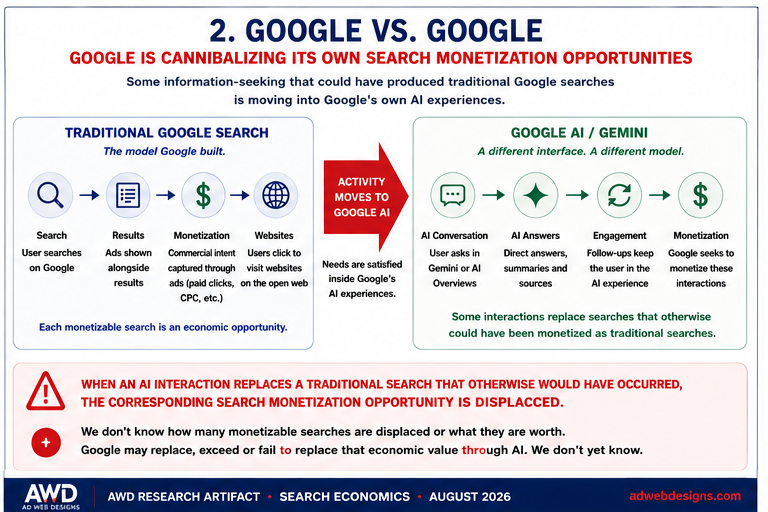
There are at least three possible economic outcomes. A traditional Google Search can become a Google AI or Gemini interaction, meaning Google changes the interface but keeps the user. In that case, Google may cannibalize a traditional Search monetization opportunity while retaining the opportunity to monetize the interaction differently. An interaction that otherwise might have occurred on Google can instead move to an independent AI platform, which is genuine external displacement. Or AI can create new information-seeking activity that probably wouldn’t have happened as a traditional search at all.
Those aren’t the same thing. AI usage doesn’t automatically equal Google loss, but it doesn’t automatically equal market expansion either. The important question is the mix.
Google also has a very good counterargument.
Its own evidence currently points in the opposite direction from a collapsing search business. Google says AI Mode has surpassed one billion monthly users, AI Mode queries have more than doubled every quarter since launch, and overall Search queries recently reached an all-time high. Alphabet’s Search advertising business has also continued to grow.
That matters. AI could expand the amount of information-seeking rather than simply redistribute existing searches.
Conversational interfaces can generate follow-up questions instead of compressing them. Google can integrate AI directly into Search. A long AI conversation could eventually reveal considerably more commercial intent than a short keyword query.
Google also has something the AI newcomers don’t: decades of advertiser relationships and one of the most sophisticated advertising systems ever created. Maybe Google becomes extraordinarily good at monetizing conversations. Maybe AI expands the entire information market.
Maybe this isn’t Google’s Kodak moment. Maybe it’s another YouTube moment.
That’s entirely possible.
But Google’s success incorporating AI into Google Search doesn’t answer a different question: what happens when an interaction that otherwise would have occurred on Google happens on an independent AI platform instead?
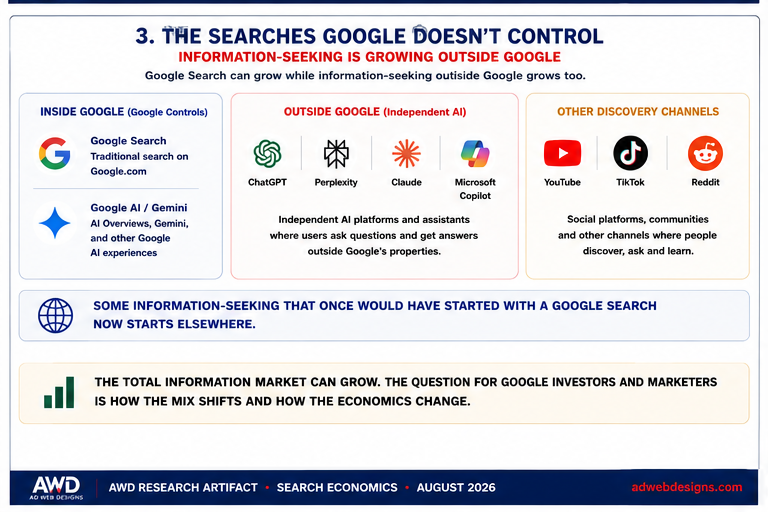
Google controls Google’s AI. It doesn’t control everyone else’s.
Google Won Search. Now It Has to Compete for AI.
Google doesn’t decide whether someone opens ChatGPT instead of Google. It doesn’t determine how Claude answers a question. It doesn’t control how Perplexity retrieves or cites information, and it can’t require every future AI-mediated commercial interaction to pass through Google’s advertising marketplace.
Google didn’t own the Web when it built Search. It built an extraordinarily effective interface between people and the information on the Web.
Now AI companies are building another interface.
Google doesn’t own the Internet. It won one of the Internet’s great interfaces: search. Now it has to compete for the next one: AI.
Winning the previous interface doesn’t guarantee ownership of the next one.
Google may win a huge share of AI. Google Search may continue growing. Gemini may become one of the dominant AI platforms. Google may ultimately make more money from AI-enhanced information discovery than it ever did from conventional search.
I’m not betting against Google. I’m questioning the assumption that Google’s historical position automatically transfers to the next interface.
Google doesn’t have to disappear for the economics to change. It doesn’t have to become the number-two search engine. It doesn’t even have to stop growing.
Google doesn’t have to lose search. It only has to lose searches.
The question I’m watching isn’t whether AI can displace searches that otherwise might have occurred on Google. It can.
The more important questions are how often that happens, how quickly the behavior changes and where the commercial intent behind those searches goes next.
Sources & Further Reading
The core argument in this article is opinion and analysis. These sources support factual statements and examples discussed above:
- Google Search’s I/O 2026 updates — Google reports AI Mode surpassed one billion monthly users, queries more than doubled every quarter since launch, and overall queries reached an all-time high.
- Alphabet 2025 Form 10-K — Alphabet describes paid clicks and cost-per-click as monetization metrics for Google Search & other and reports Search & other revenue.
- Google confirms deploying goto URL redirects to search results links — August 26, 2026 reporting on Google’s confirmation and stated anti-abuse rationale.
- Google Search rolling out google.com/goto tracking parameters — additional reporting and examples of the rollout.
- Pew Research Center: Mobile Fact Sheet — historical U.S. smartphone adoption data used only as an example of nonlinear technology adoption.
The Changing Economics of Search · Coming Next
When a Citation Replaces a Click, Who Gets Paid?
This is Part 1 of The Changing Economics of Search, an ongoing opinion and analysis series examining how AI may change search, advertising, web traffic and online publishing.
Part 2 looks at another piece of the changing economics. AI systems can answer questions using information created by publishers without necessarily sending the user to the original source.
For decades, the hyperlink helped connect information, traffic and economic value. What happens when an AI citation acknowledges the source but the user never needs to click it?
Part 2: When a Citation Replaces a Click, Who Gets Paid?
About the Author
Bill Scott is the owner of Ad Web Designs, a digital marketing strategy and consulting company established in 1996. His experience spans roughly three decades of SEO, paid search, digital advertising, analytics, conversion and customer acquisition.
