
Business Outcomes Determine the Strategy. Evidence Determines the Next Move.
Digital marketing strategy should not begin with SEO, paid search, social media, AI or any other channel.
It should begin with the business.
What is the business trying to accomplish? What is a customer worth? What is preventing growth? Where could an advantage be created? What does the business already know? What still needs to be proven?
Only then should we decide which marketing capabilities deserve time and money.
Ad Web Designs approaches digital marketing strategy as a business allocation problem. We identify the outcome, understand the economics, evaluate the evidence, examine the competitive environment and determine where the next dollar and the next hour have the greatest potential value.
The strategy determines the tactics. The tactics do not determine the strategy.
Strategy Begins Before the Channel
A business does not have an SEO problem simply because its rankings could improve. It does not have a paid search problem simply because competitors are advertising. It does not have an AI visibility problem simply because AI search is receiving attention.
It has business objectives, opportunities and constraints.
The first job of strategy is to understand them.
That means looking beyond marketing activity to the underlying business: customers, revenue, margins, acquisition economics, competitive position, operational capacity, historical performance and the outcomes management actually wants to change.
Sometimes the answer requires more marketing.
Sometimes it requires better marketing.
Sometimes the highest-value decision is to fix something else before buying another visitor.
The question is not which channel should we use. The question is what should the business accomplish next, and what is most likely to help accomplish it?
Strategy Depends on What the Business Already Knows
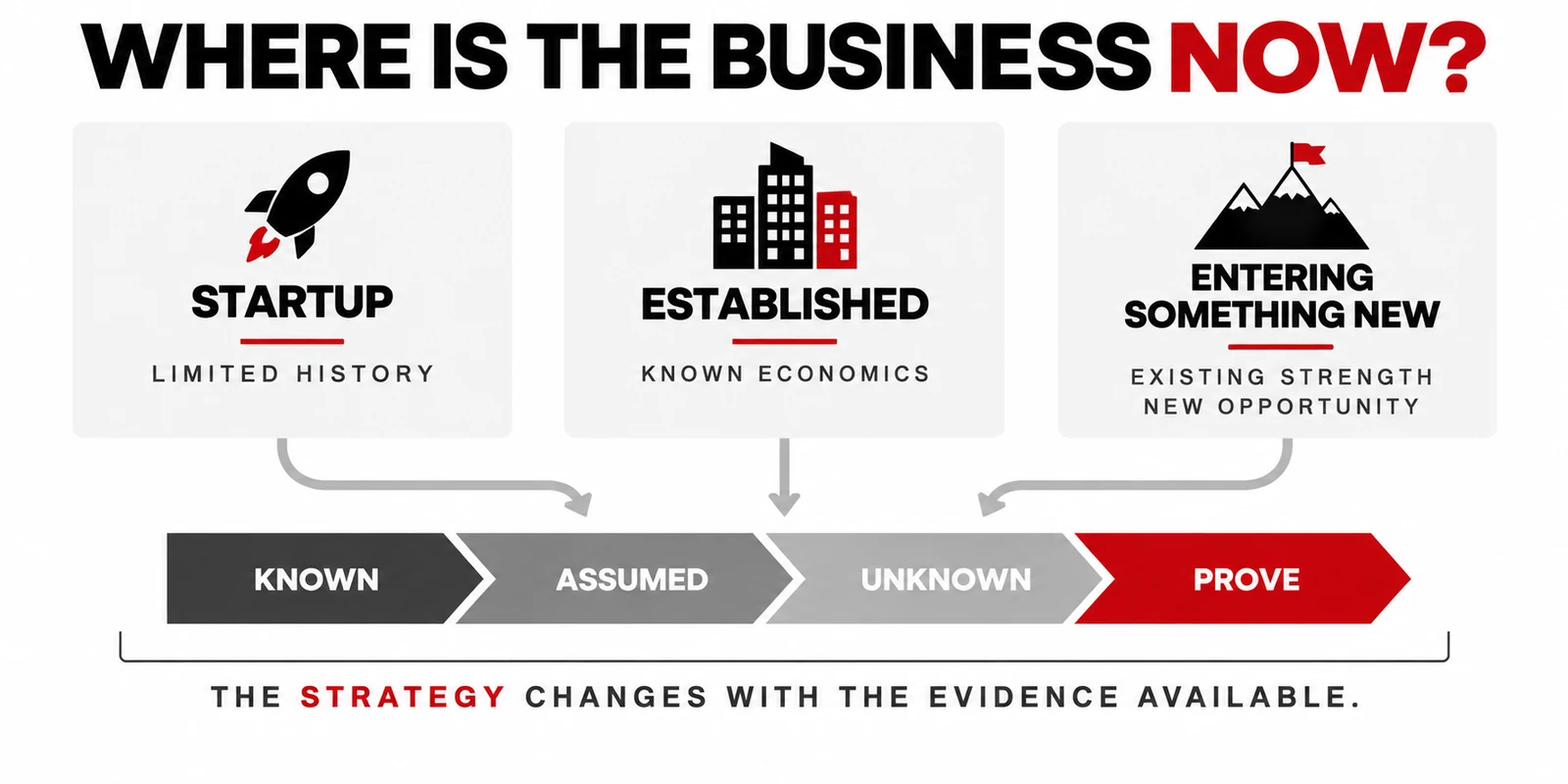
A startup and an established company should not begin with the same assumptions.
An established business may have years of customer, sales, search, advertising and conversion data. That history can reveal customer economics, seasonality, channel performance, operational constraints and previous successes or failures.
A startup may have little more than a product, a market hypothesis and assumptions about who will buy it.
An established company entering a new market, launching a new product or pursuing a different customer segment falls somewhere between the two. The company may possess substantial institutional knowledge while having very little evidence about the new opportunity.
The strategy should reflect those differences.
For an established business, the first opportunity may be hidden inside evidence that already exists.
For a startup, the first investment may need to buy information before it buys scale.
For a business entering something new, the strategy may need to protect the proven operation while testing the new opportunity independently.
We determine what is known, what is unknown and what needs to be proven based on where the business is in its lifecycle.
Start at the Bank and Work Backward
Digital marketing produces an enormous amount of measurable activity.
Impressions. Rankings. Clicks. Visits. Video views. Form submissions. Phone calls. Leads.
Those metrics can be useful, but they are not automatically business outcomes.
The economic chain usually continues:
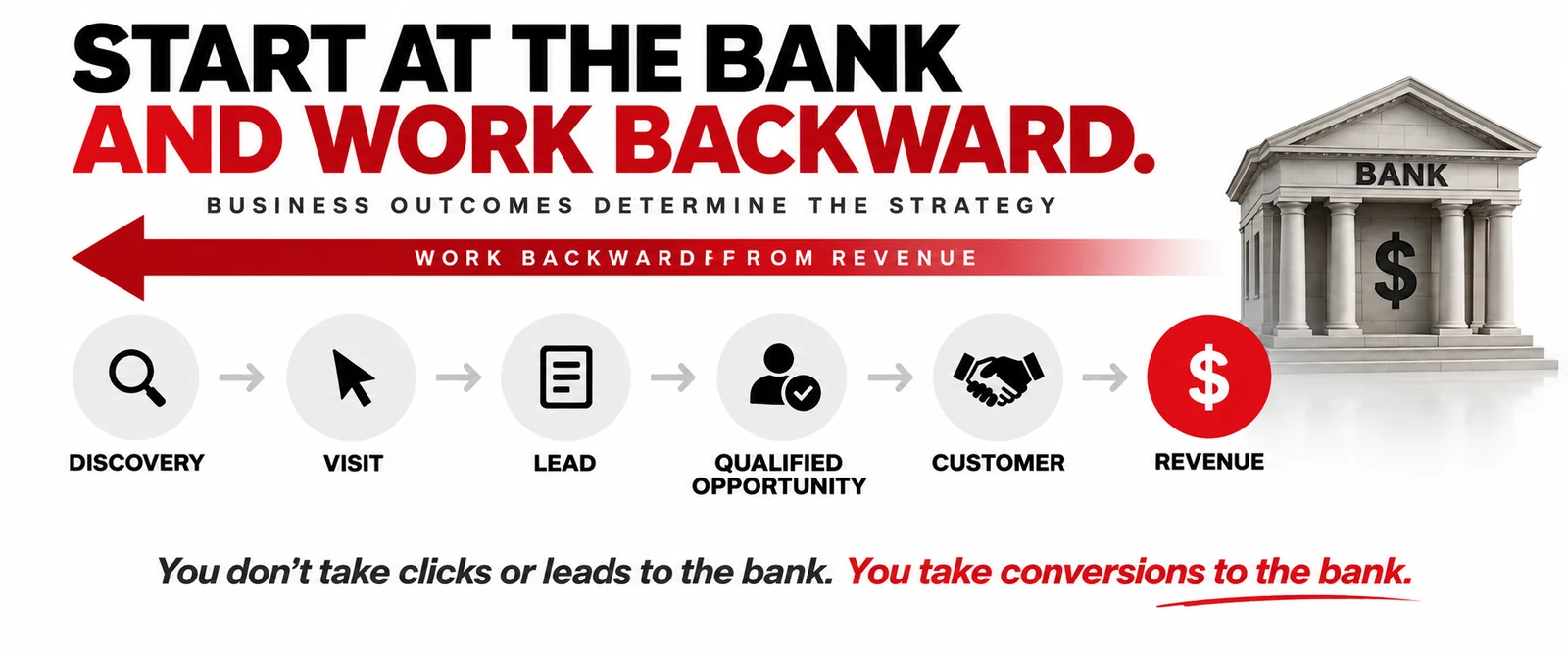
Revenue / Customer → Conversion → Qualified Opportunity → Lead → Visit → Click / Impression / Discovery
Working backward changes the questions.
Instead of asking only what a click costs, we can ask what it costs to acquire a customer.
Instead of asking how many leads a campaign produced, we can ask how many became customers.
Instead of asking whether organic traffic increased, we can ask whether the additional traffic produced economic value.
Instead of asking whether visibility improved, we can ask whether the visibility matters to the business.
As we have said for years:
You don’t take clicks or leads to the bank. You take conversions to the bank.
Know What a Customer Is Worth Before Deciding What Traffic Is Worth
Traffic acquisition becomes much easier to evaluate when the economics downstream are understood.
What is a customer worth?
What can the business afford to spend to acquire one?
What percentage of inquiries become qualified opportunities?
What percentage become customers?
How long does conversion take?
What are the margins?
Does the customer generate repeat or lifetime value?
Does the business have the operational capacity to serve additional demand?
A $50 lead can be expensive.
A $500 lead can be cheap.
The answer depends on what happens afterward.
That is why Ad Web Designs tries to connect marketing decisions as far downstream as reliable data allows.
Cheaper does not necessarily mean better. More does not necessarily mean more valuable.
Your Business Does Not Compete Against Its Own Dashboard
Marketing performance cannot be evaluated entirely in isolation.
Customers have choices.
Someone may already own much of the search demand. A competitor may dominate paid visibility. Another may have stronger reviews, better content, a better offer, stronger brand recognition or a more effective conversion process.
New discovery systems add additional competitive surfaces. Search engines, video platforms, AI systems, marketplaces and recommendation environments can all influence which businesses enter the consideration set.
Strategy therefore requires understanding not only how the business performs, but where it stands relative to the alternatives available to the customer.
Where are competitors strong?
Where are they weak?
Where is demand underserved?
Where is the business already advantaged?
Where could an advantage realistically be created?
The objective is not simply to improve marketing. It is to improve the business’s competitive position.
Find What Is Limiting Growth or Could Create It
Not every business needs another marketing channel.
Sometimes the greatest opportunity is removing a constraint.
Traffic may be sufficient while conversion is weak.
Lead volume may be adequate while customer acquisition is poor.
Paid search may generate demand while intake loses the opportunity.
Organic visibility may be strong while measurement cannot connect it to meaningful outcomes.
A company may already have substantial demand but lack the operational capacity to serve more customers.
Other times, nothing is fundamentally broken. The opportunity may be a competitor weakness, underserved search demand, a new geographic market, a profitable customer segment, an emerging discovery environment or a better way to deploy existing assets.
That gives strategy two jobs:
Remove constraints that destroy value.
Identify opportunities that can create value.
Do Not Sacrifice Proven Value to Chase an Interesting Theory
Businesses frequently focus on what they are not doing.
That can cause them to overlook what is already working.
Existing organic visibility, profitable paid search, strong branded demand, valuable content, established customer relationships, effective referral sources and other proven assets deserve protection.
New opportunities should be evaluated against those assets, not automatically prioritized above them.
A strategy that produces a 20 percent improvement in something unimportant may be less valuable than protecting an existing source responsible for a substantial portion of the business.
The order matters:
Protect proven economic value → identify leakage → improve performance → expand intelligently.
Innovation matters.
So does not breaking the machine that already makes money.
Separate Evidence From Belief
Every strategy contains uncertainty.
The mistake is pretending otherwise.
We separate information into categories:
Known: Supported by reliable evidence.
Assumed: Reasonable enough to use temporarily, but not established.
Unknown: Information we do not currently have.
Testable: Something we can investigate through measurement, experimentation or observation.
This matters particularly when entering new markets, launching products, evaluating AI discovery or working with startups where historical evidence may not exist.
Assumptions are not inherently bad.
Unidentified assumptions are dangerous.
The objective is to replace important assumptions with evidence whenever doing so improves the decision.
Give Reality Something to Argue With
A forecast does not have to predict the future perfectly to be useful.
It establishes expectations.
For paid acquisition, we might model cost per click, conversion rate, lead quality, close rate, customer acquisition cost, customer value and expected return.
For another initiative, the inputs and outputs may be different.
Then the work begins.
Actual performance can be compared with expected performance:
Expected → Actual → Variance → Explanation → Adjustment
If reality behaves differently than the model, that is useful information.
The purpose of the forecast is not to prove that we were right.
It is to make the assumptions visible enough that we can discover where we were wrong.
Sometimes the First Return on Investment Is Learning
When uncertainty is high, the purpose of the first investment may not be maximizing immediate profit.
It may be answering the question that determines whether a larger investment should be made.
We can think about this as two different uses of capital.
Exploration capital buys information.
It tests the market, economics, customer response or underlying hypothesis.
Expansion capital buys growth.
It is deployed when sufficient evidence suggests that increasing investment has a reasonable probability of producing additional value.
Confusing those stages can cause businesses to scale an unproven idea or abandon a useful test before enough has been learned.
Test small enough to survive being wrong. Scale when the evidence earns it.
Make Every Channel Compete for the Next Dollar
SEO can be valuable without deserving the next dollar.
Paid search can produce positive returns without deserving additional budget.
AI visibility can be strategically interesting without yet being economically important.
Conversion optimization can sometimes create more value than acquiring additional traffic.
The question is not whether something is good.
The question is whether it is better than the available alternatives for the resources required.
Ad Web Designs evaluates opportunities using factors such as:
Expected Value → Confidence → Cost → Time → Dependencies → Reversibility → Priority
Money is not the only scarce resource.
Management attention, development time, creative resources, sales capacity and organizational bandwidth all have value.
That is why we also ask:
Where should the next dollar go?
And:
Where should the next hour go?
A Good Strategy Should Eliminate Work
A strategy that recommends everything is not much of a strategy.
Prioritization requires saying no.
Do not increase paid search if the conversion process is destroying the economics.
Do not rebuild a website simply because a new website sounds appealing.
Do not add another acquisition channel when the business cannot reliably evaluate the channels already operating.
Do not chase traffic when customer acquisition economics are the actual constraint.
Do not invest heavily in a new technology simply because the industry is talking about it.
Sometimes the correct recommendation is:
Not yet.
Sometimes it is:
Stop.
Resources released from lower-value work can be moved toward higher-value opportunities.
Decide What Success and Failure Mean Before the Test
Experiments become difficult to evaluate when success is defined after the results arrive.
Whenever practical, establish the decision rules beforehand.
What result causes us to scale?
What result causes us to continue?
What result suggests a modification?
What result tells us to stop?
That creates four useful outcomes:
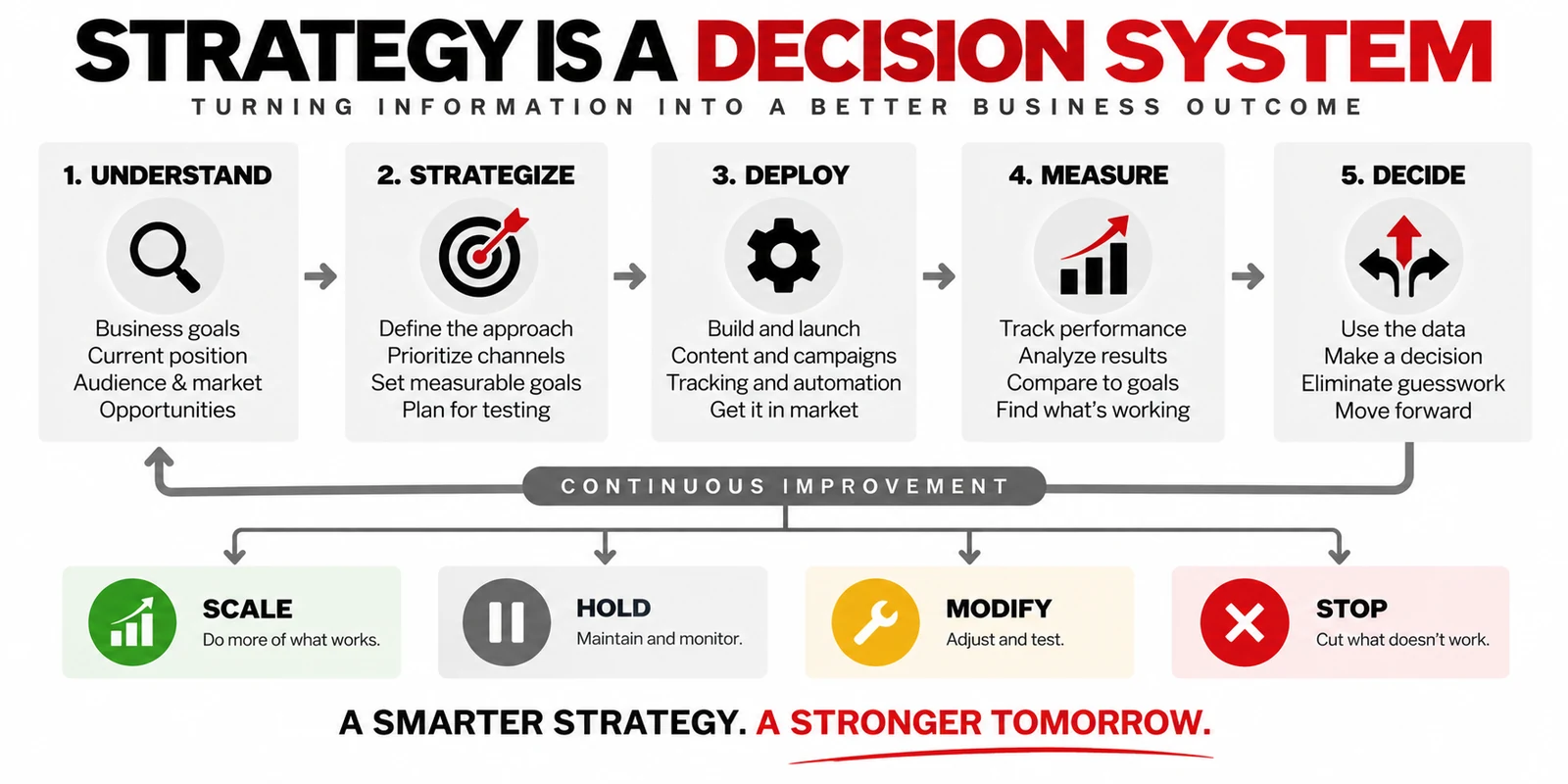
Scale → Hold → Modify → Stop
Stopping is not necessarily failure.
A controlled test that prevents a business from making a much larger bad investment can produce substantial value.
The objective is not to keep every initiative alive.
The objective is to make better decisions.
Strategy Has to Become Action
A strategy document does not improve a business outcome by itself.
The work has to be deployed.
Ad Web Designs helps translate strategy into an operating plan by determining what should happen first, what depends on something else, what should be tested, what should be measured and what should not receive resources yet.
Depending on the business, that may involve paid search, organic search, AI visibility, entity optimization, analytics, attribution, conversion optimization, content, competitive research or improvements to the connection between marketing activity and downstream business outcomes.
The tactics depend on the problem.
We do not begin with a predetermined package of services and work backward to justify it.
How We Put the Strategy to Work
1. Diagnose
Understand the business, lifecycle, customers, economics, competitors, existing marketing, available data, constraints and objectives.
2. Prioritize
Identify the problems and opportunities with the greatest expected business value.
3. Model
Where appropriate, establish the economics, assumptions, forecasts and thresholds that will be used to evaluate the work.
4. Build the Plan
Define the work, sequence, dependencies, resources, measurement requirements and decision rules.
5. Deploy
Ad Web Designs implements the work within our capabilities and coordinates with the client’s internal team or other specialists where necessary.
That can include restructuring campaigns, developing search strategies, improving content and discovery, strengthening entity information, implementing measurement, improving conversion paths and testing new acquisition opportunities.
6. Measure Downstream
Evaluate performance as close to the real business outcome as reliable data permits.
That may extend beyond traffic and leads to qualified opportunities, customers, revenue, customer acquisition cost, customer value and return.
7. Compare Reality With Expectations
Determine what performed as expected, what did not and why the difference matters.
8. Reallocate
Scale what works.
Improve what can be improved.
Stop what fails.
Protect what already creates value.
Move resources toward stronger opportunities.
Then repeat.
Strategy is not a document. It is a decision system.
Measure. Learn. Reallocate.
Markets change.
Competitors respond.
Advertising costs change.
Search behavior changes.
Conversion rates change.
AI systems change.
Customer economics change.
A strategy built once and protected from new evidence eventually becomes an assumption.
Our approach is iterative:
Business Objective → Economics → Evidence → Competitive Environment → Constraint or Opportunity → Hypothesis → Deployment → Measurement → Learning → Reallocation
Then the cycle begins again with better information.
Thirty years of digital marketing does not provide thirty years of permanent answers.
It provides experience recognizing when the questions have changed.
We Are Not Trying to Sell Every Tactic
Ad Web Designs does not make money by recommending the largest possible collection of marketing services.
The objective is to determine which work is most likely to improve the business outcome, then deploy that work in the right order.
That can mean recommending more investment in an existing channel.
It can mean testing something new.
It can mean fixing measurement before changing marketing.
It can mean improving conversion before acquiring additional traffic.
It can mean protecting something already working.
And it can mean recommending that the business not spend money on something yet.
The value of strategy is not the number of tactics it produces.
The value is the quality of the decisions it improves.
A Strategy Built Around the Business
Depending on the engagement and available evidence, Ad Web Designs may evaluate:
- Business objectives and growth targets
- Customer acquisition economics
- Customer and lead quality
- Historical marketing performance
- Paid search
- Organic search
- AI search and recommendations
- Entity visibility
- Conversion paths
- Analytics and attribution
- Competitive position
- Content and information architecture
- Geographic or market expansion
- Measurement gaps
- Operational constraints
- Opportunities for controlled testing
Not every business needs every capability.
Determining what does not deserve attention can be just as important as identifying what does.
Frequently Asked Questions
What is digital marketing strategy?
A digital marketing strategy is a prioritized set of decisions connecting marketing activity to a business outcome, supported by evidence and explicit assumptions.
Do we need every digital channel?
No. A channel belongs in the plan only when it has a defined job and a credible way to create value.
What if the data is incomplete?
Use the best available evidence, label assumptions, identify the missing information most likely to change the decision and update the plan when better data arrives.
How is strategy different from analytics?
Strategy decides what problem to solve and where to invest. Analytics provides part of the measurement architecture used to make and update that decision.
